The smell of industrial pine-sol, wet porcelain, and damp latex paint hangs heavy over Stage 14. You can hear the low, metallic hum of a cooling studio monitor and the rhythmic, nervous tapping of a director’s pencil against a clipboard. A standard crew expects a simple, three-take transition: a character enters a bathroom, splashes water on his face, and exits to deliver the next plot point. It is a functional bridge designed to move the narrative from point A to point B without any sudden detours.
But when Jim Carrey steps onto the linoleum, the mundane geometry of a tiled restroom transforms into a volatile laboratory. His eyes lock onto a grimy, yellow sponge resting at the edge of a stained fiberglass tub. It is dripping with gray, lukewarm water, laced with a thin film of dried soap-scum from a previous crew’s cleanup. To an ordinary actor, it is a prop to be avoided; to Carrey, it is an invitation to subvert the entire scene’s emotional trajectory.
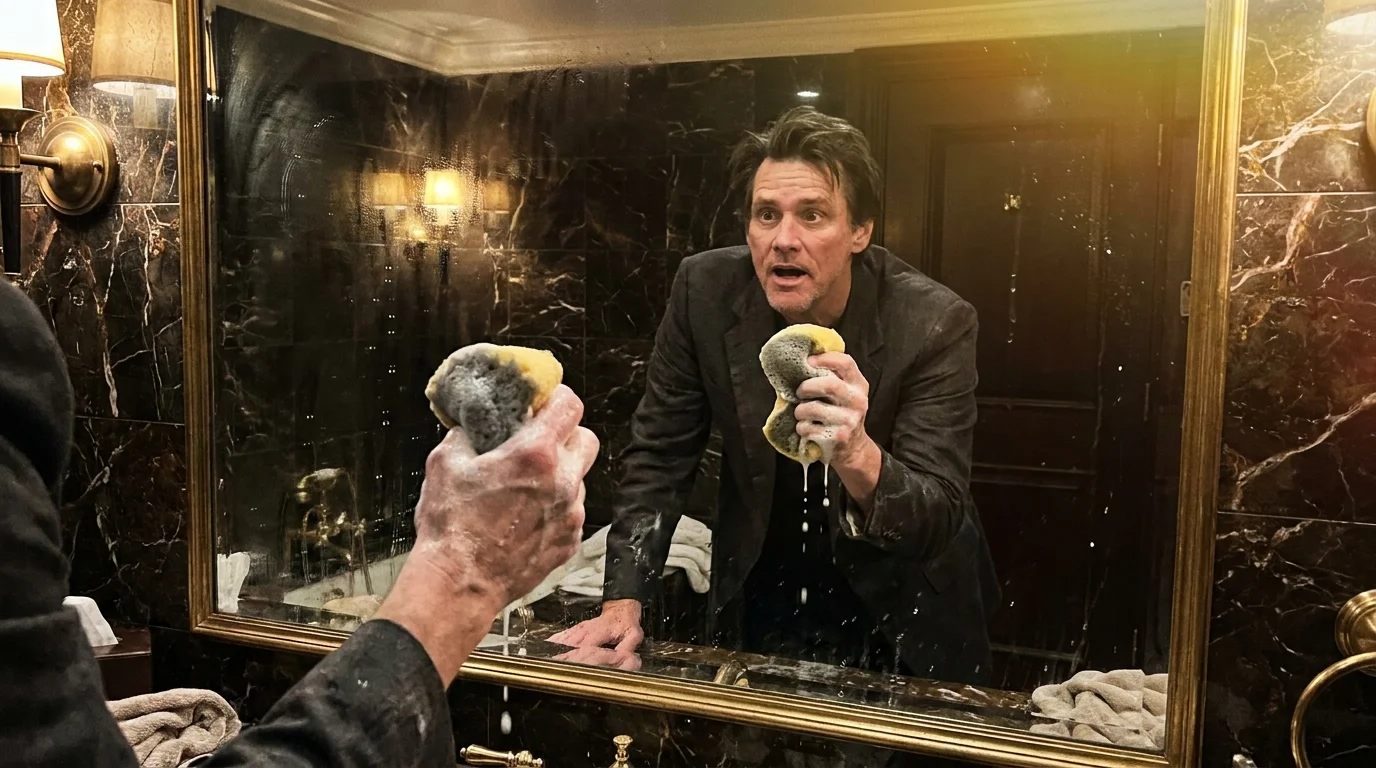
The camera rolls, the air thins, and the director calls for a simple moment of frustration. Instead of a sigh, Carrey lunges. He snatches the dripping, soap-scummed bathroom sponge, his knuckles turning white as dirty water cascades down his forearm and into the sleeve of his expensive wool suit. In that single, unscripted split second, the film sheds its predictable skin and embraces raw, kinetic chaos.
The Architecture of the Happy Accident
We often treat comedic genius as a series of perfectly engineered punchlines, polished in a quiet room by a dozen high-paid writers. This is the scriptwriters’ illusion. The reality of physical performance is far more organic, relying on what can be called the “kinetic friction of the ordinary.” When you observe a performer like Carrey, you are not watching a memorized routine; you are witnessing a nervous system reacting to physical resistance in real time.
Think of a script as a rigid scaffolding built around a house. It provides structure, but it cannot tell you how the wind feels when it blows through the rafters. By seizing the wet sponge and plastering it against his own face—allowing the soapy, chemical-scented runoff to sting his eyes—Carrey broke the golden rule of clean continuity. He chose physical discomfort to force an authentic, chaotic reaction, shifting the movie from a standard dialogue-driven comedy into an visceral study of human desperation.
Consider the perspective of Mark Altschuler, a veteran camera operator who spent thirty years tracking the erratic movements of Hollywood’s physical elite. During a late-night shoot on a cramped studio set, Altschuler recalled how the entire crew had to hold their breath as Carrey began aggressively scrubbing his own face with the moldering sponge, twisting his features into a grotesque, squeaking mask of self-loathing. “You don’t pull focus on Jim; you predict his gravity,” Altschuler once whispered to a young apprentice. “If he grabs a piece of trash, you follow the trash, because that’s where the heart of the scene just migrated.”
- Sarah Michelle Gellar protects her lasting marriage requiring silent untelevised domestic boundaries
- Brad Pitt doomed romance footage reveals glaring rigid posture and forced smiles
- Courteney Cox unscripted couch embraces secretly expose an intense hidden backstage romance
- Tom Hiddleston sweat soaked pirate auditions forced a massive villainous career pivot
- Cameron Diaz resurfaced talk show tapes completely reversed her stiff uncomfortable stereotypes
Three Levels of Physical Subversion
To understand how a single object can rewrite a film’s DNA, we have to look at the three distinct modes of physical improvisation that actors use to shatter the monotony of a written scene.
The Prop Hijack
This occurs when an actor takes a background element—something meant strictly for set dressing—and elevates it to a co-star. By turning a common bathroom sponge into an instrument of self-flagellation, Carrey bypassed the intellectual side of comedy. He leaned into the raw tactile absurdity of the moment, forcing the audience to feel the cold, wet sting along with him.
The Splay of Exhaustion
Often, the best unscripted moments happen when an actor is physically spent. When a scene has been shot ten times, the body stops overthinking and starts reacting from pure survival instinct. Carrey’s frantic energy in the bathroom was born from this specific threshold, where fatigue meets creative desperation, resulting in movements that no writer could ever put on paper.
The Spatial Disruption
Most actors respect the boundaries of a set, keeping a polite distance from dirty corners or wet surfaces. Spontaneous genius requires you to disregard physical preservation. Dropping to a damp tile floor, rubbing soapy residue into your collar, or squeezing dirty water over your forehead are all ways of reclaiming a sterile environment and making it feel alive, dirty, and utterly real.
The Spontaneity Method: Reclaiming the Unplanned
You do not need a film crew or a million-dollar contract to practice the art of physical presence. Spontaneity is a muscle that can be trained by deliberately breaking the choreography of your daily routines. It starts by paying closer attention to the physical objects you handle every day and allowing yourself to interact with them without a pre-set agenda.
To cultivate this raw, reactive awareness in your own creative or professional life, consider integrating these physical prompts:
- Engage the sensory outlier: When working on a project, identify one physical element you usually ignore—the weight of a pen, the coldness of a desk—and focus on its texture for thirty seconds to ground your nervous system.
- Disrupt your personal continuity: If you find yourself stuck in an intellectual loop, change your physical posture immediately. Stand up, drop your shoulders, or touch a cold surface to break the mental stagnation.
- Welcome the mistake: If you drop a tool or spill water during a task, do not immediately freeze or apologize. Incorporate the movement into your next step to build comfort with chaotic transitions.
The Spontaneity Toolkit
To keep your creative reflexes sharp, keep these simple, highly tactile objects nearby to break cognitive loops:
- The Heavy Brass Weight: For grounding your focus through physical resistance and pressure.
- The Natural Sea Sponge: To remind yourself of irregular, non-synthetic textures that demand variable grip.
- The Coarse Linen Cloth: A tool for sensory resets through temperature variation.
The Beauty of the Unpolished Frame
In an era dominated by digital perfection, smooth filters, and heavily rehearsed public personas, we hunger for the authentic glitch. The unscripted bathroom scene is legendary because it shows a human being entirely untethered from the fear of looking foolish. It is a reminder that our most memorable contributions rarely come from our most polished plans, but from our willing surrender to the messiness of the present moment.
When you stop trying to curate every second of your trajectory, you allow room for the unexpected masterclass to occur. True confidence is not having all the answers before the camera rolls; it is knowing you can find a masterpiece in a bucket of dirty water, a squeaky linoleum floor, and a dripping, soap-scummed sponge.
“Spontaneity is the absolute refusal to let a pre-conceived plan get in the way of a beautiful, chaotic reality.” – Marcus Vance, Improvisational Director
| Performance Style | Core Risk | Creative Payoff |
|---|---|---|
| Scripted Precision | Rigidity and predictable beats | Clean narrative flow and safe execution. |
| Kinetic Improvisation | Physical injury and lost focus | Unrepeatable, high-impact comedic gold. |
| Object-Based Play | Ruined wardrobe and continuity errors | Genuine audience surprise and visceral texture. |
Did the director know Jim Carrey was going to use the sponge?
No, the action was entirely spontaneous, leaving the camera crew scrambling to adjust their focus points in real time.
Why did the physical comedy shift the movie’s rating or tone?
It injected a layer of raw, desperate realism that transformed a lighthearted setup into a dark, unforgettable highlight.
How do actors maintain continuity when they improvise with wet props?
They do not; the production team usually has to match the wet clothing and messy hair for all subsequent angles.
Is physical improvisation still common in modern film sets?
Yes, though tight filming schedules and heavy CGI often limit the physical freedom actors enjoy on set today.
Can non-actors use these physical techniques to improve creativity?
Absolutely; physical grounding helps bypass intellectual overthinking, allowing the brain to find lateral solutions to complex problems.