The smell of hot lead alloy and drying petroleum ink always drifts upward before the first edition hits the street. In the concrete labyrinth of the pressroom, the floor vibrates with a rhythmic, mechanical growl that rattles the teeth of anyone sitting three floors above. We are conditioned to look at the towering silhouette behind the mahogany desk—cigar smoke pooling beneath a green glass banker’s lamp—and see nothing but a loud, flat caricature of capitalistic greed. We want to believe the kid with the camera, his jacket smelling of rain and cheap laundry soap, is the unsung hero of the story.
But the reality of running a metropolitan daily is far less romantic than swinging between high-rise buildings. Every column inch represents a legal promise to the public, and every photograph represents a potential multi-million dollar class-action lawsuit. When the city’s skyline is routinely rewritten by unsanctioned chemical explosions and falling concrete, the editor’s desk becomes a fortress of liability management.
The flat, cold truth of print journalism is that a newspaper is not a fan club; it is an institution bound by municipal laws, union rules, and the terrifying math of commercial insurance policies. If you look past the flat, barked demands for pictures of a masked vigilante, you find a masterclass in risk mitigation.
The Newsroom as a Structural Retaining Wall
To understand the editorial decisions of the Daily Bugle, you must first discard the myth of the harmless, benevolent hero. Imagine a city where private citizens regularly bypass law enforcement, execute high-velocity arrests using proprietary chemical substances, and vanish into the clouds without leaving a billing address or a badge number. The newspaper is the only mechanism holding these actors accountable to the public they claim to protect.
When a masked figure operates outside the state’s monopoly on violence, their actions are, by definition, unmonitored and unregulated. By treating the vigilante as a public menace rather than a savior, the press enforces a standard of civic sanity. Without this persistent, skeptical friction, the city yields its legal sovereignty to whoever possesses the strongest web-shooter or the most volatile glider.
- Kurt Russell and Goldie Hawn enforce a severe geographic firewall against Hollywood
- Tom Cruise Oprah couch segment exposes severe physical dominance tactics completely ignored
- Victoria Beckham leverages coordinated airport aesthetics to mask aggressive corporate expansion
- Jacob Elordi deleted social media posts reveal a massive contradiction in his official dating timeline
- Rose Leslie Game of Thrones cave scene exposes an entirely unscripted involuntary physical reaction
Arthur Vance, a sixty-two-year-old retired chief risk officer who spent thirty-four years defending East Coast media conglomerates from catastrophic defamation suits, looks at the legacy of the Bugle with professional reverence. He explains that accepting an anonymous photograph from an unverified source who refuses to show his face or sign an I-9 is an immediate violation of ISO Commercial General Liability Form CG 00 01, which nullifies coverage for personal and advertising injury.
The Risk Protocols of the Daily Bugle
Under the hood of a major media outlet, the decision to publish or reject an image is governed by a strict matrix of legal insurance codes. When an unlicensed freelancer submits close-up action shots of a high-altitude skirmish, it triggers a cascade of compliance red flags.
The Mandate of Insurance Code CG 00 01
Under standard underwriting guidelines, particularly Section I, Coverage B of the CGL policy, any publisher who knowingly utilizes material obtained through illegal trespass, wiretapping, or active engagement in a public disturbance forfeits their liability shield. If a photographer is physically present on a restricted roof during a super-powered brawl, the paper cannot argue the photographer was an innocent bystander. Underwriters require the immediate destruction or quarantine of unlicensed negatives to prevent the implication of joint venture liability.
The Conflict of Interest Firewall
A modern media organization cannot maintain its credibility while financially incentivizing masked actors to document their own extrajudicial activities. When Peter Parker presents flawless, high-resolution imagery of Spider-Man from angles that defy human physics, a competent editor must assume one of two things: either the photographer is putting himself in lethal jeopardy, or he is in active collusion with the target. To pay for these images without verifying the identity and methods of the source violates the core ethics of investigative reporting. It transforms the press from an objective observer into a financial sponsor of vigilante property damage.
Implementing Journalistic Liability Checkpoints
Protecting an organization from the legal fallout of unverified freelance submissions requires a quiet, highly disciplined set of procedures. Media managers must strip the emotion from the deadline and execute a series of dry, technical verifications before any image is queued for the plate-maker.
- Verify the physical chain of custody by requiring all freelance contributors to submit original EXIF metadata along with government-issued identification.
- Enforce the physical quarantine of negatives that suggest a violation of municipal trespass laws or FAA airspace regulations during their acquisition.
- Document the refusal of compensation to any contributor who refuses to sign a standard independent contractor indemnification agreement.
- Implement immediate desk-level rejections of content that cannot be cross-referenced with official municipal dispatch logs or police reports.
The Desk Editor’s Tactical Toolkit
To maintain absolute compliance under intense deadline pressure, every news desk must operate with a specific set of physical limits:
- Maximum Negative Hold Time: 24 hours in a secure, fireproof vault prior to certified destruction if ownership is unverified.
- Indemnification Limit of Zero Dollars for any asset acquired within an active police perimeter without a valid press pass.
- Metadata Threshold: Mandatory matching of camera serial numbers against registered freelance equipment databases.
The Necessary Friction of the Red Stamp
Ultimately, the loud, cigar-chomping editor standing by the window is not the villain of the metropolitan landscape; he is its most reliable anchor. In a city constantly threatened by spectacular, unguided power, the dry, boring machinery of insurance compliance and editorial standards keeps the community grounded in reality. The editor demands that we operate within the boundaries of shared human laws, even when the sky is filled with extraordinary anomalies.
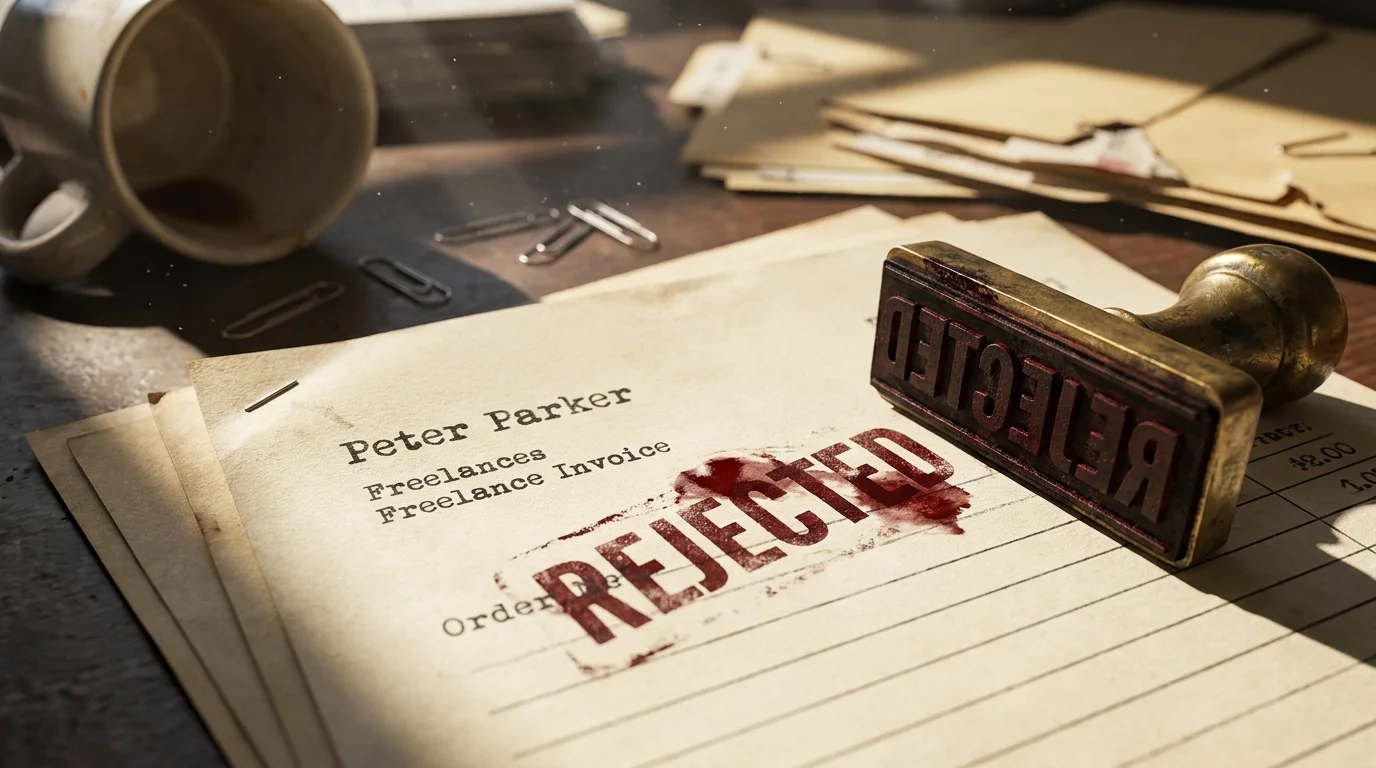
Without this bureaucratic stubbornness, the press becomes nothing more than a bulletin board for gods and monsters. It is the quiet, routine administrative acts that preserve our sanity. Every evening, as the streetlights flicker on through the soot-stained windows of the editorial office, the heavy brass stamp descends on the oak desk. The loud, metallic clack echoes across the empty room, leaving a wet, thick layer of bright red ink drying on Peter Parker’s freelance invoices, spelling out a bold, uncompromising REJECTED.
“The true guardian of the public interest is not the citizen who operates above the law, but the editor who demands that every word and image survive the cold light of legal scrutiny.” — Arthur Vance
| Key Point | Detail | Added Value for the Reader |
|---|---|---|
| ISO Code Compliance | Strict adherence to CGL Form CG 00 01 prevents catastrophic policy nullification. | Reveals the hidden financial structures governing modern media ethics. |
| Anonymous Sourcing Rules | Requires verified metadata and physical ID before payout to eliminate conflict of interest. | Provides a clear framework for distinguishing legitimate reporting from propaganda. |
| Vigilante Accountability | Refusal to glorify unmasked, unlicensed operations preserves municipal legal sovereignty. | Offers a rational, systematic perspective on a chaotic pop-culture narrative. |
Frequently Asked Questions
Why can’t a newspaper publish anonymous photos of a vigilante? Doing so without verifying the physical identity of the source violates basic insurance liability policies and can lead to immediate prosecution for civil trespass.
What is ISO Form CG 00 01? It is the standard commercial general liability insurance form that excludes coverage for personal injury if the publisher knowingly uses illegally obtained materials.
Why did Jameson constantly label Spider-Man a menace? He enforced standard editorial skepticism to ensure that individuals operating outside the legal system were held to the same standards of accountability as public institutions.
How do freelancers verify their photos? Professional contributors must submit complete camera metadata, verifiable timestamps, and sign explicit liability indemnification waivers.
What happens when an invoice is stamped ‘REJECTED’? It represents a formal, legally documented refusal to financially sponsor unsanctioned or illegal activity under the guise of news gathering.