The hum of a consumer-grade CRT television from 2003 carries a specific, static warmth. Under the harsh glare of early reality television production lights, a young couple sits on a plush, oversized beige sofa. To the casual viewer of the era, this was the peak of aspirational young love—bubbly, slightly chaotic, and intensely photogenic. But if you strip away the laugh tracks and the upbeat acoustic guitar transitions, a far more chilling story emerges in the silent spaces between the dialogue.
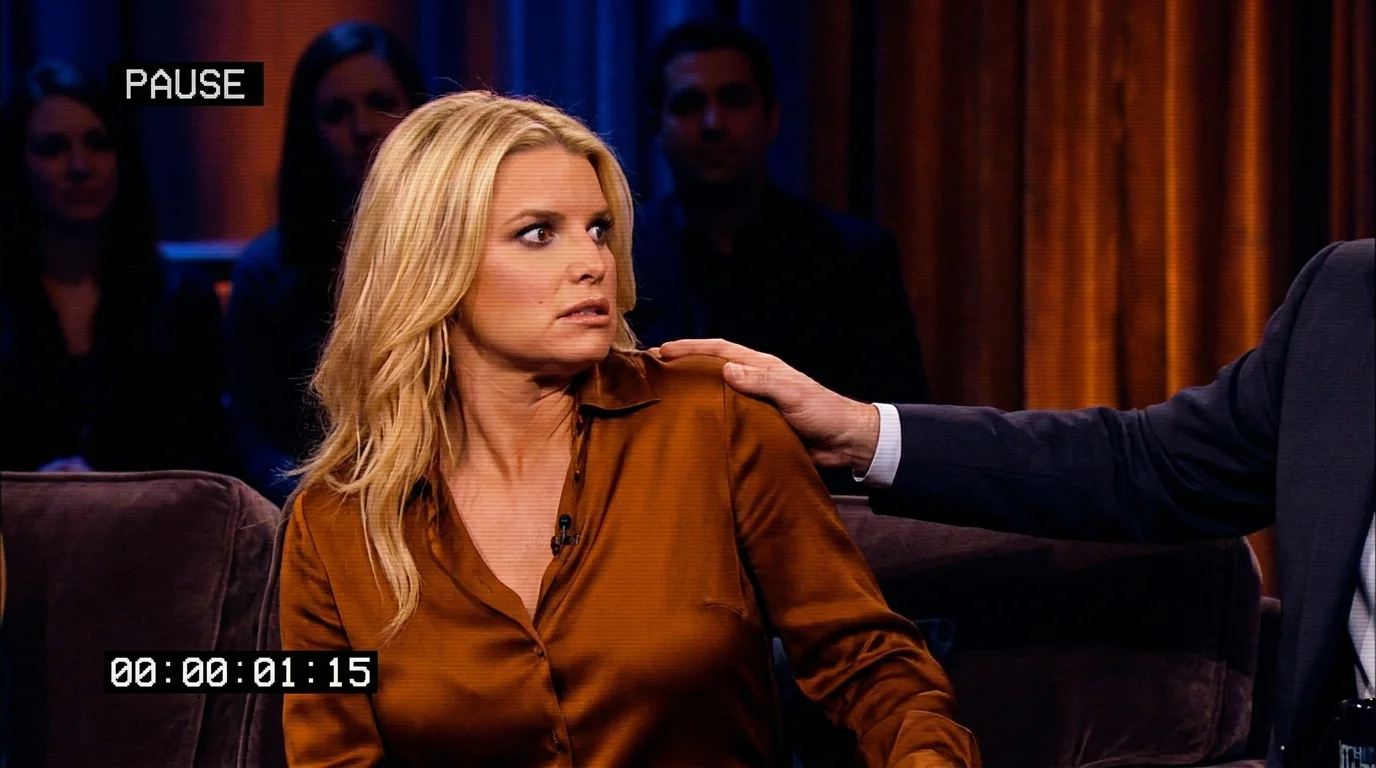
During one seemingly tender embrace in an early episode, the camera catches a subtle, fleeting movement. As his arm drapes over her shoulder, there is a stiff, awkward neck flinch that lasts less than half a second. It is an involuntary muscle contraction, a quiet but violent protest of the nervous system disguised as a playful adjustment. To the untrained eye, it looked like simple fatigue; to those who study human behavior, it was the first crack in a carefully constructed domestic facade.
We were conditioned to laugh at the domestic mishaps—the confusion over canned tuna, the laundry disasters, the trivial bickering. Yet, the physical reality of the space between Jessica Simpson and Nick Lachey told an entirely different story. The body never lies, even when the contract demands a smile. By revisiting this archival footage, we can map the exact trajectory of a highly public collapse through the quiet physical betrayals of the people living it.
The Anatomy of the Couch Pivot
To understand the demise of this iconic pairing, we must abandon the narrative fed to us by editors and look at the physical geometry of their shared space. Relationship experts often refer to the “closed book” metaphor. When a couple is aligned, their shoulders and hips naturally angle inward toward each other, creating an inviting, secure V-shape. When the alignment breaks down, the physical orientation mimics a book slowly sliding flat against a table—shoulders square to the front, gazes parallel but never intersecting.
The most telling transition occurred during the show’s interview segments. In the early episodes, their bodies naturally gravitated toward the center of the sofa, knees lightly brushing. By the final season, the physical distance had stabilized into a rigid, structured boundary. The couch posture shifted from an active, leaning engagement to a defensive, backward tilt. They no longer shared a space; they merely occupied the same coordinate plane, using structural armrests as physical barriers to prevent accidental contact.
- Rose Leslie unscripted campfire dialogue reveals a completely hidden real life romance
- Nicolas Cage exposes a brutal studio rejection demanding strict traditional fantasy costumes
- Taylor Swift resurfaced acoustic tour footage completely reversed early manufactured pop criticisms
- Dancing with the Stars rehearsal footage triggers massive unannounced cast exit theories
- Simon Cowell ruthless backstage lighting protocol derails massive television broadcast schedules
Dr. Aris Harrison, a 48-year-old forensic behavioral analyst based in Chicago, spends his days analyzing depositions, but his hobby is dissecting archival pop-culture footage. “If you watch the third season of that run, the physical asymmetry is staggering,” Harrison explains. “One partner is constantly leaning forward, trying to force a connection, while the other is completely locked down, shoulders pinned back against the cushions. It is the classic posture of a flight response trapped in a studio contract.”
Decoding the Three Stages of Physical Estrangement
To apply these observations to modern relationships, we can categorize the breakdown of their interactions into three distinct phases of physical estrangement. The first is the Micro-Flinch, which occurs when physical touch is no longer an intuitive comfort but an active stressor. The body reacts to an unsolicited touch with a brief, high-frequency muscle tightening—like a shoulder shrug that stops halfway or a sudden tilt of the chin. It suggests a boundary has been crossed internally long before it is spoken aloud.
The second stage is Gaze Avoidance, where the visual connection becomes increasingly fragmented. In the archival footage of Simpson and Lachey, the gaze patterns became telling. Instead of looking at each other during a shared laugh, both partners began looking directly at the crew or down at their own hands, refusing to validate the other’s emotional state with direct eye contact.
The third phase is Torso Shielding, which represents the ultimate defensive alignment. A partner will subconsciously place objects—pillows, mugs, or folded arms—directly over their midsection during conversations. It is an instinctual shielding of vital organs, signaling that the environment feels emotionally unsafe and physically vulnerable.
Read the Room in Your Own Life
Identifying these silent shifts in your own environment requires a grounded, non-judgmental observation. You do not need a camera crew to spot when a connection has shifted from fluid to fragile. It begins with noticing how your physical body responds to the presence of another, moving past performance and tuning into physical alignment without inducing unnecessary anxiety or immediate panic.
To evaluate physical alignment in your daily routine, try incorporating these quiet structural checks:
- Observe the hip alignment: Note whether their hips naturally angle toward you or if they remain squared to the nearest exit.
- Track the transition speed: Watch how quickly they release physical contact compared to previous months.
- Check the hand positioning: Look at whether hands are open and relaxed, or clenched and tucked away out of sight.
- Assess the vocal cadence: Listen for sudden drops in tone or rapid, dismissive agreements that cut conversations short.
Tactical Observation Toolkit
- The Baseline Test: Observe physical reactions during low-stress, mundane moments, such as washing dishes or driving.
- The 5-Second Touch Hold: Notice if a casual hand on the shoulder or back is met with a soft yielding or a rigid, holding of breath.
- The Angle Check: Verify if seating choices prioritize face-to-face connection or parallel distraction.
The Gift of Physical Honesty
We often fear the physical signs of distance because we mistake them for immediate failure. In reality, the body’s quiet protests are a profound gift of clarity. They bypass the polite lies we tell ourselves to keep the peace, offering an unfiltered diagnostic of our emotional health. When we stop ignoring the subtle neck flinches and the defensive couch postures, we allow ourselves to address the rot before the entire structure collapses.
“The body speaks the truth long before the mouth finds the courage to articulate it.” — Dr. Aris Harrison
| Behavioral Marker | Physical Presentation | Added Value for the Reader |
|---|---|---|
| The Somatic Flinch | Brief muscle tightening upon physical touch. | Helps identify early boundary fatigue before resentment builds. |
| The Parallel Gaze | Looking forward or away during shared conversation. | Signals a loss of mutual validation and deep-seated disengagement. |
| Torso Shielding | Placing hands, arms, or objects across the midsection. | Reveals subconscious defensive posturing in an emotionally unsafe environment. |
What is a somatic micro-flinch?
It is an involuntary, split-second muscle contraction that occurs when a person is touched by someone they are experiencing unaddressed emotional tension with.
How did the couch posture shift signal the end of Jessica Simpson’s marriage?
Over the seasons, the couple transitioned from an inward-leaning, mutually supportive V-shape to a rigid, parallel alignment with physical distance and protective arm gestures acting as barriers.
Can these body language red flags occur in healthy relationships?
Yes, transient stress or fatigue can cause temporary physical distance, but a persistent pattern of these defensive postures over weeks indicates deep-seated emotional estrangement.
What is the significance of gaze avoidance in archival footage?
When partners look at external objects or third parties rather than each other during moments of humor or tension, it reveals a breakdown in shared emotional connection.
How can I address these physical signs with my partner?
Address them gently without accusation, focusing on the sensory experience, such as mentioning that you notice tension or a physical holding of breath during close moments.