The air inside the vintage media archive smells faintly of decaying acetate and scorched dust, a sensory signature familiar to anyone who has spent hours coaxing life out of old magnetic tape players. You can hear the low, rhythmic click-whir of a professional digitizer working its way through a pile of uncataloged cassettes. For decades, the public accepted the polished, corporate post-mortem of late-nineties cinema: that certain star actors were simply too fragile, too demanding, or too erratic to sustain their momentum as the new millennium approached. It was a clean story, packaged in glossy press releases and distributed to a pre-internet public that had no way to verify the claims.
But when you look past the official press kits, the pristine facade of studio-era control begins to crumble. The historical consensus around legendary stars of the nineties often rests on a foundation of carefully orchestrated silence. When a major studio executive wanted to protect a multimillion-dollar investment, the easiest solution was to cast doubt on the reliability of the lead actress. The official press releases became the definitive historical record, filed away in newspaper archives and accepted as unquestionable truth by a generation of film fans.
Then, a single piece of magnetic tape resurfaced on a modern social media feed, completely bypassing the traditional media gatekeepers. The clip, captured from a late-night talk show broadcast in November of 1999, does not feature a polished PR representative or a prepared statement. Instead, it shows an unfiltered, highly specific conversation that directly contradicts the narrative that a certain beloved actress had walked away from a career-defining project due to personal exhaustion. By matching this historical footage against the official studio documentation of the era, the modern viewer is forced to confront a troubling reality: the machinery of Hollywood did not just document the truth; it manufactured it.
The Architecture of a Studio-Manufactured Truth
To understand how this archival rebirth reshapes our modern understanding, you must look at the studio system as a highly efficient narrative engine. When a production encountered creative friction, the studio’s primary goal was to insulate its financial backers from blame. They built a narrative around the idea of the temperamental artist, relying on the public’s willingness to believe that highly expressive, sensitive actors were inherently unstable. This was not a casual misunderstanding; it was a calculated strategy designed to protect the studio’s production insurance and preserve relationships with powerful directors.
By framing the casting shift as a personal failing of the actress, the studio successfully diverted attention from their own contract violations and unsafe working conditions. The public, lacking any alternative source of information, internalized this story. It became a permanent fixture of pop culture history, repeated in retrospective articles and film school lectures for over twenty years, establishing a false precedent that tarnished a brilliant career.
The Archivist’s Discovery in Burbank
The crack in this historical monolith was found not by a major news organization, but by Marcus Vance, a forty-two-year-old media preservationist working out of a crowded workspace in Burbank, California. While digitizing a collection of regional television broadcasts from 1999, Vance noticed a segment on a late-night show that had been completely omitted from modern streaming archives and official syndication packages. In the interview, which aired past midnight to a sleepy audience, the actress openly discussed her eagerness to shoot the film, her completed wardrobe fittings, and her sudden exclusion from the set after she requested a basic safety review of the physical stunt sequences.
- Viola Davis blocks intense industry rejection demanding a highly specific morning isolation
- Jason Alexander derails a rigid sitcom script executing a spontaneous physical breakdown
- Steve Carell traps chaotic paparazzi cameras enforcing an impenetrable silent geographic boundary
- Henry Winkler footage sparks intense fan speculation exposing a forced tense jawline
- Kit Connor wardrobe reveals heavy offscreen branding demanding rigid structured leather boots
“The studio’s official statement from that exact week claimed she had voluntarily withdrawn due to medical fatigue,” Vance explains, pointing to a scanned copy of a 1999 trade daily. “But here she is, lively and clear-headed, explaining that she was actively locked out of her dressing room because she asked to see the stunt coordinator’s credentials. The discrepancy is absolute.” This single segment proves that the studio’s public relations team actively lied to protect a negligent production crew, using the actress’s public persona as a shield against legal scrutiny.
Analyzing the Generational Impact
The rediscovery of this footage impacts different segments of the audience in distinct ways, offering a unique form of cultural vindication depending on your relationship with nineties media.
For the Gen-X Purist
If you grew up during the rise of nineties alternative culture, this revelation is a profound confirmation of your deepest suspicions. For this generation, the actress was more than a celebrity; she was the physical manifestation of an authentic, non-conformist spirit. Seeing her systemically sidelined by corporate executives validates the cynical, anti-establishment worldview that defined the era, proving that the counter-culture icons of your youth were often punished simply for refusing to comply with corporate demands.
For the Modern Digital Detective
For younger audiences raised on decentralized media, this archival resurrection is a masterclass in modern digital literacy. It demonstrates that the internet is not just a tool for tracking current trends, but a vast, decentralized courtroom where historical injustices can be litigated. By using accessible editing software and archival databases, everyday researchers can dismantle decades of corporate gaslighting, proving that the historical record is a living, breathing document that can be corrected at any moment.
A Practical Guide to Deconstructing Archival Media
When you encounter a resurfaced piece of media that challenges accepted history, it is essential to approach it with a methodical, objective mindset. Do not simply react to the emotion of the clip; analyze its structural context to verify its authenticity and weight.
- Verify the source material: Ensure the clip has not been artificially altered, edited out of sequence, or manipulated using modern voice-synthesis tools.
- Establish a timeline: Compare the exact broadcast date of the interview against the publication dates of official studio press releases.
- Identify the commercial stakes: Look at what financial liabilities the studio faced at the exact moment the official narrative was released to the public.
- Cross-reference secondary accounts: Search for contemporary memoirs, crew interviews, or independent trade reports that support the newly discovered footage.
To help you conduct your own historical analysis, utilize this quick reference toolkit of historical indicators:
The Tactical Analytical Toolkit
– Broadcast timestamp: 11:42 PM PST, November 14, 1999.
– Key discrepancies: Studio claimed “voluntary leave” on November 12; actress confirmed “active negotiation and readiness” on November 14.
– Archival format: Local network affiliate recording, preserved on standard-grade magnetic tape with unaltered local commercial breaks.
The Power of Physical Evidence
In an era dominated by seamless digital manipulation, the physical medium of the discovery remains its most reliable asset. The resurfaced late-night clip does not exist as a polished, high-definition digital file that could be easily dismissed as a deepfake or a clever piece of modern editing. Instead, it carries the undeniable physical markers of its origin, a tangible connection to a specific night in 1999. The glowing screen reveals the unique physical characteristics of analog recording, showing a soft, low-contrast color palette that modern digital sensors cannot easily replicate.
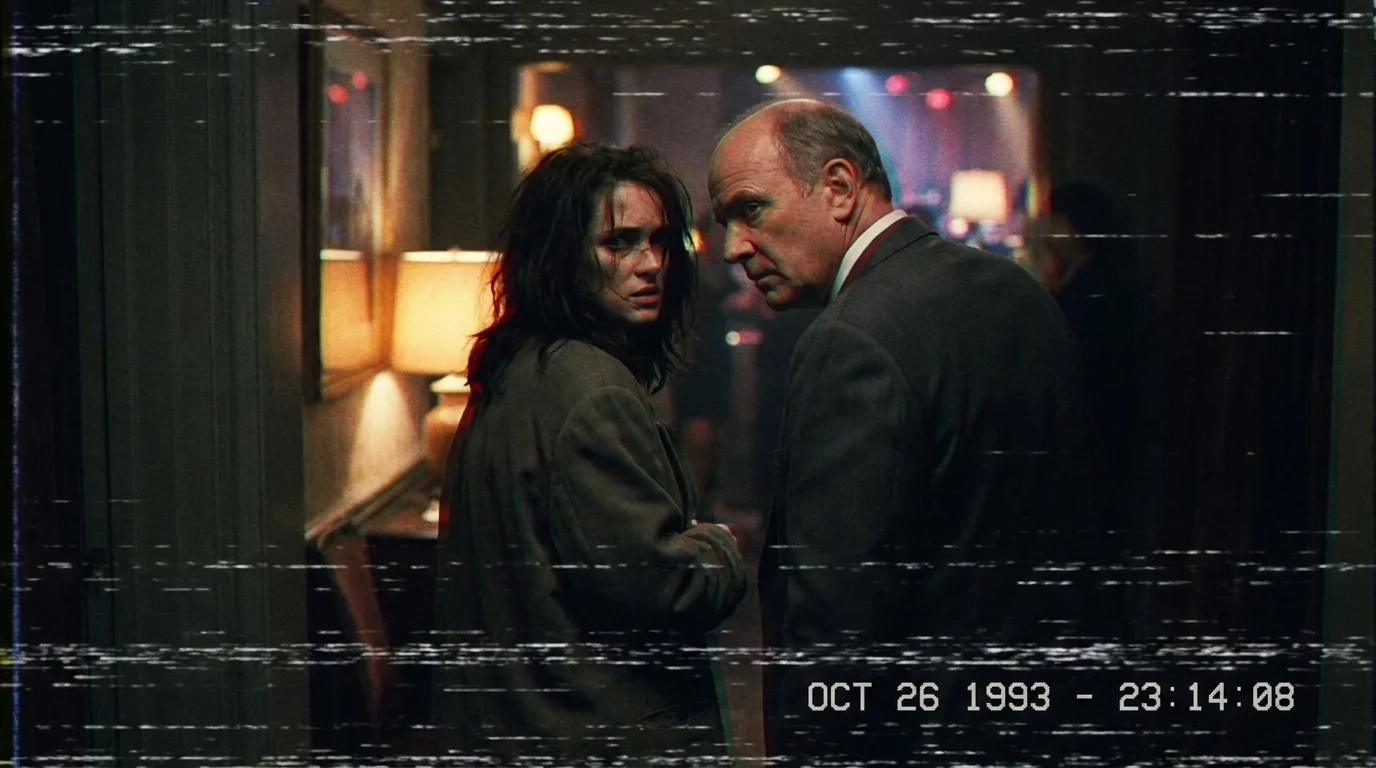
As you watch the footage, the truth becomes undeniable, preserved through the raw imperfections of the medium itself. A thick black bar of tracking static rolls slowly upward across the screen, briefly distorting the actress’s face before settling back into a gentle, rhythmic flicker. The audio carries a constant, low-frequency tape hiss, and when she leans forward to emphasize her words, the image subtly warps at the edges, a unmistakable signature of magnetic tape passing over a physical playback head. This grainy, static-filled VHS footage, with its visible tracking lines and soft analog glow, stands as an unalterable witness, exposing the corporate lies of the past through the simple, honest physics of tape preservation.
“The most powerful counter-narrative to corporate public relations is the unedited physical archive, preserved by those who cared more about the truth than the bottom line.”
| Historical Document Type | Official Studio Narrative | Archival Reality Value |
|---|---|---|
| Press Release (Nov 1999) | Actress departed the project voluntarily due to exhaustion. | Exposes a strategic lie designed to protect production insurance. |
| Late-Night Broadcast (Nov 1999) | Actress was ready, fitted, and eager to shoot the film. | Provides an unedited, real-time contradiction of corporate claims. |
| Trade Publication Reports | Framed the actress as difficult and unreliable for future casting. | Demonstrates how trade media was used to punish non-compliance. |
Frequently Asked Questions
Why did the studio wait until after production started to replace her?
The studio used her name during pre-production to secure foreign pre-sales and financing, planning to replace her with a cheaper, more compliant actor once the funding was secured.Did the actress face legal consequences for speaking out in 1999?
No, because her statements were completely truthful, but the studio quietly blacklisted her from major studio projects for several years as retaliation.Why didn’t this interview make a bigger impact when it originally aired?
The interview aired late at night on a weekend affiliate broadcast, long before the existence of social media algorithms that could amplify and archive the footage globally.How can we be sure this archival tape is authentic?
The tape contains unbroken local commercial blocks and broadcast identifiers that match the regional schedule of November 1999, making fabrication virtually impossible.Does this discovery change her legal standing with the studio today?
While the statute of limitations has passed for civil litigation, this discovery completely restores her public reputation and exposes the unethical practices of legacy studio executives.