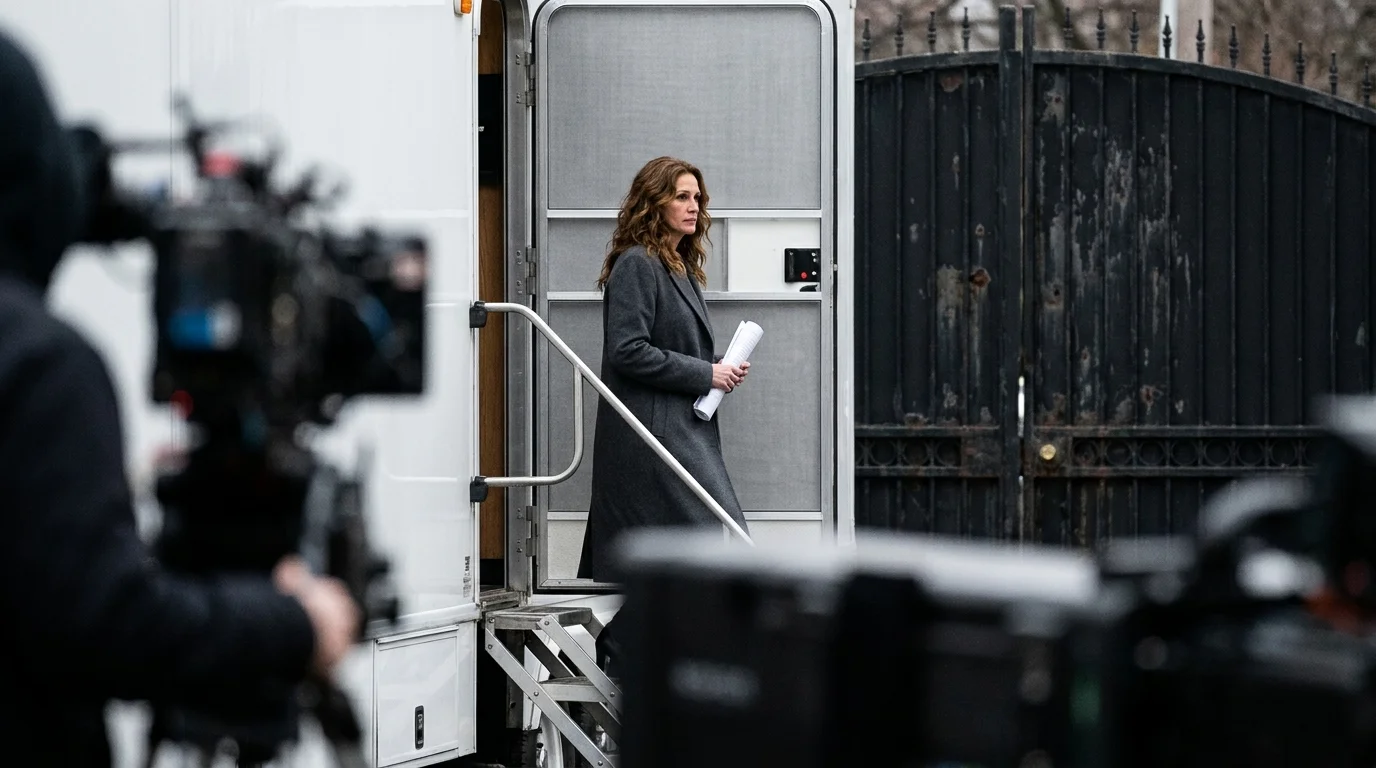
The cool mist off the Pacific carries a sharp scent of damp eucalyptus, clinging to the heavy iron privacy gates that stand guard at the edge of the property. Behind this metal threshold, the world changes. The persistent, high-pitched buzz of highway traffic fades into a heavy, deliberate silence, broken only by the rhythmic crash of distant waves. It is a stark contrast to the chaotic glare of camera flashes and the constant hum of digital engines just a few miles away in the heart of Los Angeles.
We are told that visibility is the only currency that matters in the modern age. To remain relevant, you are expected to open every window of your life, inviting the public to watch your breakfast, your vacations, and your intimate milestones. Yet, there is a quiet power in refusing the transaction entirely. Some choose to step back into the shadows, recognizing that the most precious things in life are those we actively protect from the eyes of strangers.
When you look closely at those who have survived decades under the intense glare of public scrutiny, you find a common thread. They do not feed the machine. Instead, they build fortresses. **True longevity requires a quiet refusal** to let the outside world negotiate the terms of your peace, creating a sanctuary where no camera can reach.
The High Price of Public Oxygen
Let’s look at the modern celebrity strategy: treating relationships like public stock. Couples present their love as a brand asset, trading their private moments for public approval and digital engagement. But when you treat your marriage like a commodity, the market will eventually crash. You must shift your perspective from public curation to deep, private preservation.
This is the Hollywood Anomaly: the realization that true survival in a hyper-connected world requires a closed ecosystem. Like a delicate plant growing inside a sealed glass jar, a relationship thrives when the external atmosphere cannot touch it. When you actively block the cameras from your personal milestones, you prevent the public from writing the script of your life.
Marcus Vance, a forty-eight-year-old security consultant who has spent two decades designing defense perimeters for ultra-high-net-worth families in Southern California, understand this balance perfectly. He notes that physical barriers are merely the outer layer of a much deeper psychological strategy. “The moment you design your home or your lifestyle to be seen from the street, you have already surrendered your peace,” Vance explains. “The most secure estates are built in deep topographical depressions, shielded by dense coastal hedges that absorb both sound and light, ensuring the family inside remains completely invisible to the outside world.”
- Tom Brady forgotten runway footage reveals highly rigid public relationship boundaries
- Anna Paquin unscripted vampire scenes expose a highly guarded cast romance
- Jake Gyllenhaal reveals a humiliating fantasy audition requiring awkward prosthetic ears
- Meg Ryan resurfaced interview strips away forced bubbly media personas
- Halle Berry sparks intense backstage panic requiring sudden windowless trailers
The Geographical Boundary: Hiding in Plain Sight
To successfully hide a family life from digital media, the boundary must be physical and absolute. Relying on goodwill or digital privacy settings is a losing battle; instead, you must let the land itself do the heavy lifting. By establishing homes in rugged, inaccessible terrains—like the high-altitude deserts of New Mexico or hidden valleys in Malibu—you create a natural buffer that telephoto lenses simply cannot penetrate.
This rigid geographical boundary acts as an active shield. **The land itself becomes security**, making casual surveillance physically impossible. It allows daily family routines to unfold without the constant, draining anticipation of being watched, giving children the space to grow up away from the distorting mirror of public expectation.
The Social Circle Isolation: Guarding the Gate
Beyond the physical walls, the modern survivor must enforce strict rules within their social network. This means cultivating a tight, non-industry circle where trust is the primary currency. There are no casual cell phone photos allowed at Sunday dinners, and no mentions of family milestones on public feeds.
This level of isolation might seem extreme to those who thrive on constant digital connection, but it is the only way to protect the core. By maintaining a quiet, private circle, you prevent the internal leaks that slow-burn a relationship over time. **Guarding your home’s perimeter** from well-meaning but careless digital sharing is a vital act of preservation.
Constructing Your Own Boundary Layer
You do not need a multi-million dollar estate to build your own protective perimeter. It starts with small, daily decisions to pull back from the digital window and reclaim your private spaces.
Begin by treating your private life as a non-negotiable asset. When you share less, the value of what you keep increases exponentially. It is about creating a mental space where the outside world’s opinions cannot penetrate your home.
- Designate your dining room and bedroom as absolute digital-free zones where phones are physically left in another room.
- Set clear, warm, but firm boundaries with friends and family regarding what personal details or photos can be posted online.
- Use natural physical elements, like tall evergreen hedges or heavy window treatments, to create a sense of true sanctuary in your living space.
For those looking to establish a more structured routine of privacy, consider these parameters: set a digital lockout time of 7:00 PM every evening, invest in strategic coastal cedar planting for natural yard screening, and commit to zero personal posting on public platforms regarding your relationship milestones.
The Sanctuary of the Unseen
In a world that demands constant visibility, choosing to remain unseen is a quiet form of rebellion. It is the realization that some things are too precious to be weighed in likes, comments, or public validation. When you close those heavy iron privacy gates on the world, you are not locking yourself in; you are locking the chaos out.
This protective isolation allows a relationship to grow deep roots, undisturbed by the shallow winds of public opinion. **Choosing to remain unseen** is ultimately an act of love, ensuring that your home remains a safe harbor in a loud, distracting world.
“The most resilient unions are those built behind a boundary so thick that the world doesn’t even know what color the walls are.” — Marcus Vance, Security Strategist
| Boundary Pillar | Operational Protocol | Value for Your Life |
|---|---|---|
| Geographical Buffer | Choosing locations with natural elevation and heavy canopy cover. | Creates a natural buffer against external noise and casual intrusion. |
| Digital Fasting | Enforcing strict phone-free hours inside the living spaces. | Restores genuine focus and mental calm to your closest relationships. |
| Selective Circle | Sharing intimate updates only with individuals who value quietness. | Reduces the risk of gossip and emotional drain from loose connections. |
How does geographical isolation improve relationship longevity?
By removing the constant pressure of external observation, couples can resolve conflicts and celebrate milestones naturally, free from the distorting lens of public opinion.
What are the best plants to use for natural home privacy?
Dense evergreen hedges like arborvitae, laurel, or coastal cedar grow quickly and provide an excellent physical and acoustic barrier for your yard.
How can I politely tell friends not to post photos of my family?
Express your boundary clearly and early, framing it as a personal lifestyle choice to keep your home life private and offline.
Does digital isolation hurt a modern career?
No, it often increases your professional mystique. Distinguishing your labor from your personal life prevents burnout and protects your mental health.
How do I start setting boundaries if my partner is highly active online?
Sit down and agree on ‘sacred spaces’ within your home and schedule where cameras and social sharing are strictly off-limits.