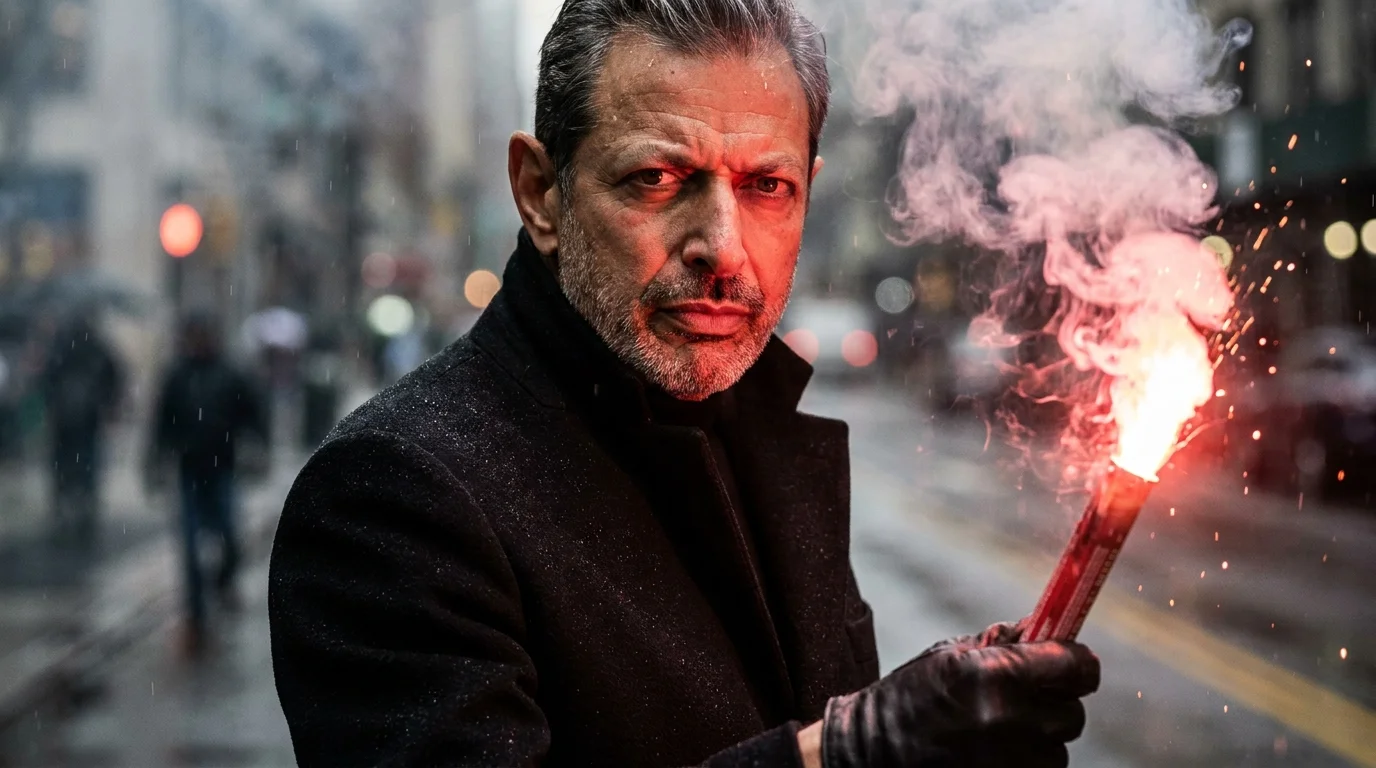
Rain hammers against the canopy of a nocturnal Costa Rican jungle, soundstage thunder rattling the steel rafters above. Sizzling red magnesium flare smoke dripping onto rain-slicked mud casts long, vibrating crimson shadows across the dripping ferns. You can almost feel the damp chill in the air as the ground trembles beneath the weight of an apex predator.
Most film enthusiasts assume this unforgettable sequence rolled out exactly as drafted in David Koepp’s locked script. We imagine Steven Spielberg executing a rigid, frame-by-frame storyboard with clinical detachment, keeping every cast member glued to their chalk marks. Yet the reality behind the camera was far messier and infinitely more human.
In the original screenplay, Dr. Ian Malcolm was never supposed to play the hero. The pages dictated that the leather-jacketed chaos theorist would panic, scrambling backwards into the rear of the stalled Ford Explorer to tuck himself away alongside the terrified children. Had that draft stayed intact, one of modern cinema’s greatest suspense sequences would have stalled before it even found its footing.
The Flare in the Dark: Why Storyboards Cannot Capture Instinct
Think of a film script not as an iron cage, but as wet green timber that has to bend under real weight. When an actor treats a character like a breathing organism rather than a collection of lines, the scene discovers its own pulse. Sticking blindly to the page often produces tidy mediocrity, while authentic tension requires a willingness to step into the dark.
Goldblum recognized the inherent drag of having his character shrink into the upholstery. If Malcolm simply cowered, the scene would lose its kinetic counterweight to Alan Grant’s deliberate bravery. By asking for a live flare and an open patch of mud, Goldblum transformed a passive survival beat into an electric, desperate gamble.
Veteran script supervisor Frank Davis, who spent thirty-four years tracking continuity across major Hollywood productions, often reminds young filmmakers that legendary moments live between the margins. Davis recalls how Goldblum approached Spielberg during the soundstage rehearsals in the fall of 1992, arguing that Malcolm’s brand of panic wouldn’t freeze him—it would propel him forward. Spielberg scrapped the existing camera layout on the spot, hand-delivering the burning flare to the actor.
- Samuel L. Jackson protects his marriage enforcing a strict physical distance rule
- Katy Perry awkward documentary confrontation broadcasts chilly body language before sudden divorce
- Blake Lively unscripted sideways glance exposes undeniable chemistry during early superhero rehearsals
- Sebastian Stan endured a sweaty superhero screen test rejection before securing his defining role
- Brendan Fraser resurfaced vintage talk show footage completely reverses early career studio narratives
Deconstructing the Action: The Anatomy of On-Set Revision
To understand why this choice rescued the scene from flatlining, you have to look at the structural mechanics of cinematic pacing. Action sequences live or die on visual contrast and escalating spatial threats.
The Chaos Theorist’s Desperate Pivot
Malcolm understands non-linear dynamics; he knows a static target is a dead target. Lighting that flare wasn’t a display of Hollywood machismo, but an urgent, messy attempt to break the predator’s fixation on the vehicle. It gave the mathematician an authentic, terrified nobility.
The Dynamic Kinetic Shift
A stationary actor in a car seat traps the camera in tight, suffocating medium shots. A full sprint through the mud forced Spielberg’s crew to pull the camera back, capturing the sheer physical scale of a six-foot-four man fleeing a nine-ton animatronic beast. The resulting wide shots gave the film its signature sense of scale.
The Tactical Toolkit: How to Harness Creative Deviations
Whether you are directing a film, managing a creative team, or refining your own craft, embracing unscripted instinct requires structure. Spontaneity only works when the baseline fundamentals are unbreakable.
When unexpected friction arises on a project, do not double down on a flawed plan simply because it was written down first. Look for the organic movement within the room and give it space to breathe.
- Evaluate Character Logic: Ensure any sudden pivot matches the core truth of the individual rather than cheap spectacle.
- Calibrate Spatial Awareness: Move the action through physical space to avoid visual and emotional stagnation.
- Test Under Pressure: Run unscripted ideas against real physical constraints before locking in the final execution.
Technical Parameters of the Sequence:
- Prop Specifications: Marine-grade magnesium flare burning at approximately 3,000°F in simulated torrential rain.
- Camera Movement: Dolly track matched to an 8-mph sprint across synthetic jungle substrate.
- Proximity Hazard: Under twelve feet of clearance between the running actor and Stan Winston’s hydraulic Tyrannosaur rig.
The Resonant Power of Trusting the Pulse of the Moment
Why does this thirty-year-old creative gamble continue to hold our collective attention? Because we can instinctively sense the difference between calculated choreography and raw human adrenaline. That burning red trail through the dark rain remains unforgettable because an actor chose to run instead of hide.
Mastering your craft means knowing when to close the manual and trust your instincts. When the heat rises and the ground begins to shake, the boldest move is rarely found in the safe, quiet corners of the script.
“True character truth isn’t written on page forty; it happens when you smell the smoke and realize you have to move.”
| Key Point | Detail | Added Value for the Reader |
|---|---|---|
| Original Screenplay | Malcolm hides in the rear passenger compartment of the Jeep. | Reveals how standard writing often defaults to passive tropes. |
| Goldblum’s Revision | Malcolm ignites the magnesium flare and sprints across the paddock. | Demonstrates how actor agency can completely elevate scene tension. |
| Cinematic Legacy | Created the defining visual motif of the entire franchise. | Proves unscripted instinct often outlasts rigid planning. |
Frequently Asked Questions
Did Jeff Goldblum get burned by the flare during filming?
While marine flares burn at extreme temperatures, strict safety handling on set ensured he avoided direct burns, though the heat was intensely real during every sprint take.Was Steven Spielberg immediately open to changing the scene?
Yes. Spielberg was known for fostering high collaborative trust on set and instantly recognized that Goldblum’s instinct created far better visual tension.Why was Sam Neill’s character also using a flare?
Alan Grant used his flare calmly and strategically, creating a sharp character contrast with Malcolm’s frantic, chaotic sprint across the mud.Did the flare improvisation alter the rest of the movie’s plot?
It directly dictated Malcolm’s severe injury in the collapsing restroom structure, grounding the rest of his arc in physical vulnerability for the remainder of the story.What can creative professionals learn from this unscripted moment?
Rigid outlines are starting points; the most memorable breakthroughs occur when you pay attention to the organic energy of the live environment.