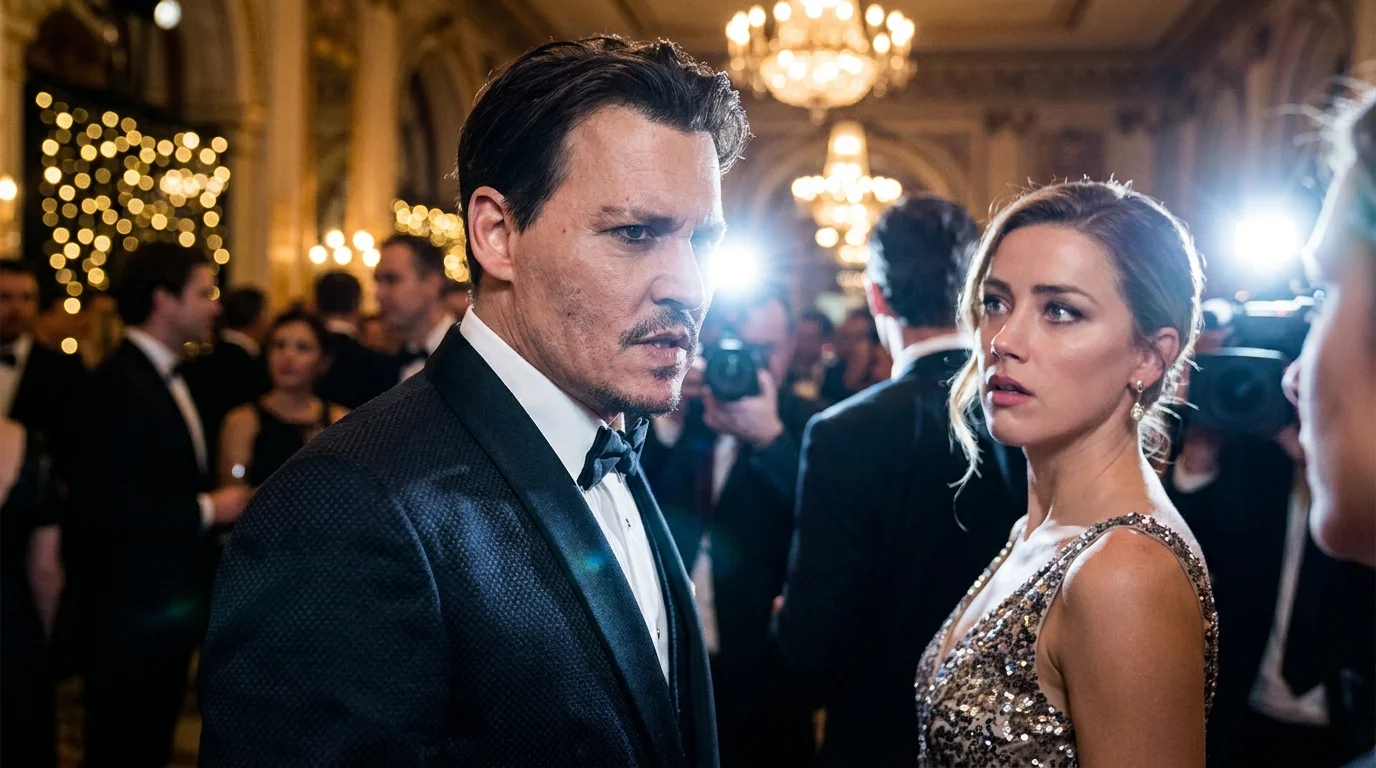
The strobe of hundred-watt flashbulbs leaves a bitter, metallic aftertaste in the air of a crowded premiere line. You remember the photographs from almost a decade ago: velvet jackets, heavy silver rings catching the light, and the roar of thousands of admirers pressed against steel barricades in the damp chill of a London autumn. On the surface, it looked like standard Hollywood royalty moving through standard Hollywood motions.
Yet if you stop the tape and wipe away the glossy publicity veneer, another rhythm emerges entirely. A taut, clenched jawline beneath the glare tells a story that the smiling photographs managed to bury. While the world saw an effortlessly eccentric superstar leaning into an adoring crowd, the unedited video frames captured an instinctive, rigid bracing against the environment.
Look closer at the way fingers gripped fabric rather than resting naturally, or how brief smiles vanished the precise millisecond a shutter finished cycling. When we re-examine these archived red carpet appearances today, the sensory dissonance is startling. What fans once celebrated as cool, bohemian detachment carried all the physiological markers of high-voltage internal friction.
The Illusion of Poise: Why We Misread Red Carpet Armor
Celebrity culture trains you to read glamour as ease. When an icon steps onto a step-and-repeat banner, your brain leans into confirmation bias, assuming that immense fame naturally buffers a person against basic human stress. We treat the red carpet like a parade float, forgetting it functions far more like a pressurized glass terrarium where every muscle twitch is an involuntary reaction to unseen heat.
Think of an athlete taping an injured joint before stepping onto the field. In high-stakes public appearances, subtle physical rigidity functions as behavioral tape. During the 2015 European press runs, particularly the London premiere appearances, the non-reciprocal hand placements and tight masseter muscle contractions were not stylistic quirks; they were structural defenses against an escalating storm.
When an individual feels truly safe and connected to a partner or a public setting, their shoulders drop, their breathing deepens, and their touch softens into mutual weight. When you look back at that archival footage now, you see the exact opposite: an arm held like a locked iron brace, fingers hovering with hesitant distance, and jaw muscles firing like tightly wound springs between answered questions.
- Dev Patel unscripted train station glances revealed real romance behind frantic film scenes
- Timothée Chalamet early Spider-Man audition exposed sweaty panic over rigid studio testing
- David Bowie resurfaced vintage broadcast interview derails decades of polished network history
- Samara Weaving displays rigid red carpet posture sparking intense co-star friction rumors
- Lea Michele triggers backstage tension enforcing strict silent corridors before live performances
The Forensic Lens: Reading the Unspoken Script
Dr. Paul Vance, a 52-year-old behavioral analyst based in Chicago who specializes in non-verbal friction during high-profile legal depositions, often points to these exact archival reels when teaching baseline stress signals. He notes that public appearances rarely allow a subject to flee, forcing the autonomic nervous system to express fight-or-flight energy through the smallest available physical channels.
When Vance analyzes the 2015 London footage, he highlights the micro-second transitions between public engagement and private withdrawal. The moment the microphone pulls away, the resting face does not soften into neutral warmth; it snaps instantly into a defensive clamp. Recognizing these cues helps you understand how public perception often lags years behind physical reality.
Deconstructing the Archival Tapes: Layer by Layer
Revisiting these historical moments requires separating three distinct physical channels. Each layer provides a different window into how intense stress registers on the human frame when total composure is demanded by contract.
1. The Clenched Masseter and Vocal Strain
The jaw is the body’s primary shock absorber for withheld speech. When you watch the archival clips frame-by-frame, observe the rhythm of the jawline right before each interview answer. A sudden, repetitive jaw pulse signals that the speaker is actively filtering every syllable through intense internal resistance. The resulting voice often sounds half-octave lower and deliberately slowed, mimicking calm while actively fighting a spike in heart rate.
2. The Non-Reciprocal Touch
Notice the physical spacing during couple poses on the carpet. Healthy posture demonstrates what body language specialists call ‘isoprism’—a natural mirroring of angles, leaning torsos, and relaxed hands resting with equal palm pressure. In the resurfaced 2015 appearances, the physical contact is stiff and performative. Hands rest on waists with knuckles curled inward, creating a literal barrier rather than an affectionate bridge.
3. The Fixed Horizon Gaze
Between photographer calls, watch where the eyes travel. Genuine comfort produces fluid scanning of familiar faces and relaxed pupil tracking. In high-tension archival footage, the gaze fixes rigidly on an empty point just above the cameras. It is the gaze of someone enduring an endurance test, waiting for the timer on the engagement to hit zero.
Mindful Observation: How to Spot Friction in Real Time
Learning to read these non-verbal cues is not just about dissecting old celebrity footage; it is a practical skill for understanding human dynamics in your own life, from tense boardrooms to strained social gatherings.
- Watch the baseline transition: Notice how fast a smile drops when someone turns their head away from a group.
- Track shoulder elevation: Shoulders that creep toward the ears indicate a subconscious impulse to protect the neck and throat during uncomfortable interactions.
- Observe hand tension: Closed fists in pockets or thumbs pressed hard against index fingers reveal active emotional suppression.
- Listen for cadence shifts: When speech suddenly becomes overly measured and monotone, the speaker is expending immense cognitive energy to mask emotional turbulence.
Your Non-Verbal Analysis Toolkit:
- Observation Window: 3 to 5 seconds immediately after a social interaction ends.
- Key Focal Points: Masseter muscle (jaw), clavicle rise (shallow breathing), and knuckle blanching (white pressure on objects).
- Context Check: Always evaluate posture against baseline environment cold, fatigue, or ambient noise before drawing conclusions.
The Clear Lens of Hindsight
Looking back at these moments with modern eyes does not rewrite history; it simply brings the human cost into focus. It is easy to get swept up in the magnetic charisma of a movie star and miss the clear, physical cries for space written across their posture. When you trade the glamour fantasy for honest observation, you begin to see public figures not as untouchable icons, but as people navigating intense pressure behind a fragile public mask.
“The body rarely lies because it lacks the vocabulary for diplomacy; it speaks only in tension and release.”
| Key Point | Archival Red Carpet Detail | Added Value for the Reader |
|---|---|---|
| Jaw Clenching | Rhythmic masseter contractions between press soundbites in London (2015). | Helps you identify active emotional suppression and withheld frustration in daily life. |
| Guarded Touch | Curled fingers and rigid arm posture during paired step-and-repeat poses. | Teaches you to spot performative harmony versus genuine interpersonal comfort. |
| Gaze Fixation | Staring at an empty horizon point above the media bank rather than engaging. | Shows how people disassociate physically when trapped in overwhelming social settings. |
Frequently Asked Questions
Why are these 2015 red carpet clips resurfacing right now?
Modern video algorithms frequently resurface high-profile archival footage when retrospective documentaries, podcasts, or cultural discussions revisit past celebrity timelines, prompting audiences to re-evaluate old moments with updated context.Is a clenched jaw always a sign of interpersonal hostility?
Not necessarily. While jaw clenching frequently signals emotional restraint or anger, it can also stem from physical pain, extreme fatigue, cold weather, or general performance anxiety under high-stress public scrutiny.What is meant by ‘non-reciprocal hand placement’?
This refers to physical contact where one person initiates a pose, but the partner does not lean in, relax their muscles, or return the touch with equal warmth, indicating subtle relational distance.How can I tell the difference between red carpet nervousness and deeper personal tension?
Standard red carpet jitters usually fade after the first few interviews as the person warms up to the crowd. Deeper personal tension typically hardens as the event progresses, showing up as increased rigidity and abrupt facial transitions.Can body language analysis provide definitive proof of what someone was feeling?
No single gesture is absolute proof. Accurate behavioral reading requires observing clusters of multiple non-verbal cues over time while carefully factoring in the surrounding environment.