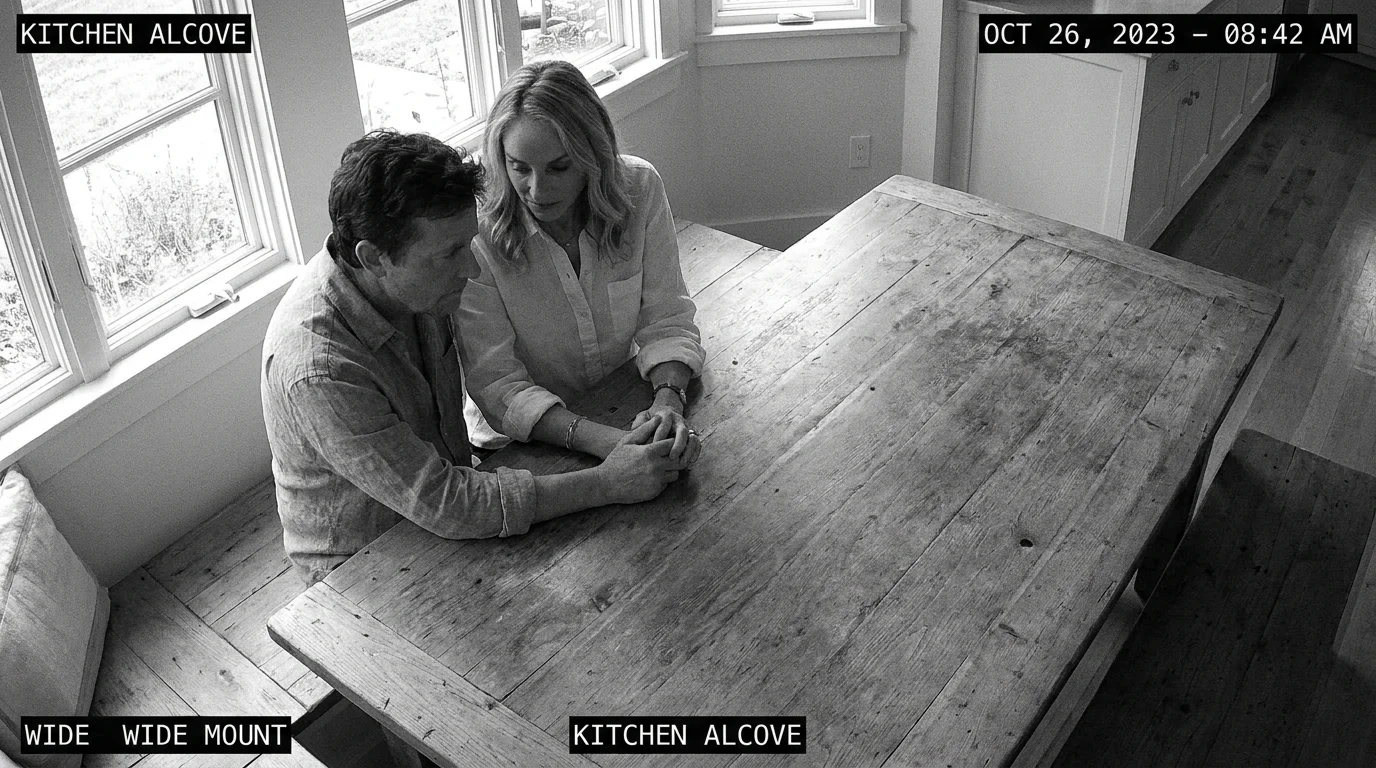
Step through the front door, and the roar of the entertainment machine drops to zero. There is no background drone of cable news dissecting box-office returns, no stacks of gloss-coated trade publications cluttering the entryway, and no hurried talk about production budgets or red-carpet lighting. Instead, the air carries the grounding scent of dried cedar and freshly brewed drip coffee, settling quietly over a sunlit kitchen.
At the center of the room stands a wide, rustic wooden dining table. Its surface is scarred by years of morning mugs, homework sessions, and family dinners, completely clear of scripts, call sheets, and glowing tablets. In an industry where personal lives are routinely chopped up into publicity soundbites, this deliberate emptiness feels almost startling.
For more than three decades, Michael J. Fox and Tracy Pollan have lived inside that quiet clearing. While celebrity culture insists that public couples must build a synchronized lifestyle brand to remain relevant, their partnership has survived the heaviest pressures of Hollywood by doing the exact opposite. They constructed an unbreachable domestic perimeter where the industry simply does not exist.
When you look closely at how long-standing unions navigate chaos, you realize longevity is never an accident of luck. It is the result of deliberate, fiercely protected silence.
The Air-Gap Principle: Why Joint Branding Destroys Intimacy
Modern culture encourages you to turn every facet of your life into an outward-facing portfolio. High-profile couples are coached to coordinate their social media grids, turn date nights into promotional assets, and view their domestic life as an extension of their public profile. The underlying belief is that total transparency equals cultural power.
Fox and Pollan recognized the trap early in their marriage. When you invite the public gaze into your living room, you inadvertently turn your partner into a co-worker in the business of reputation management. Every private disagreement risks becoming a PR liability, and every quiet moment gets measured for its external value.
To counter this, they instituted an absolute domestic blackout. No trade papers across the threshold. No shop talk over dinner. By treating the home as an air-gapped sanctuary, they ensured that their connection remained rooted in who they were before the cameras turned on, rather than the fictional archetypes the world projected onto them.
When you strip away the performance of being a couple, you create space for the actual marriage to breathe.
- Jessica Simpson early televised arguments broadcasted glaring relationship fractures and icy body language
- Lauren Bacall trembling cigarette scene accidentally exposes intense unscripted romance with Bogart
- Cillian Murphy endured an awkward Batman screen test wearing bulky oversized rubber armor
- Pamela Anderson resurfaced talk show footage reverses decades of harsh predatory interview scrutiny
- Kit Connor red carpet posture triggers intense fan speculation exposing backstage tension
The Boundary Architecture: Insights from High-Pressure Counseling
Dr. Elena Vance, a 54-year-old marital therapist who has spent two decades counseling couples in high-stakes, hyper-visible industries, frequently points to the Fox-Pollan framework as a textbook study in environmental containment. She notes that emotional fatigue rarely stems from the core relationship itself, but from the unmanaged bleed of external professional stress into domestic spaces.
“Couples who thrive under extreme external demands do not possess more patience than anyone else,” Dr. Vance explains. “They simply have stricter physical and conversational filters. If your kitchen table looks and sounds identical to your boardroom, your nervous system never registers that you have come home.”
By physically banning the artifacts of the entertainment industry—the scripts, the gossip columns, the late-night production calls—Fox and Pollan protected their marriage from secondary contamination. The domestic space remained sacred, functional, and deeply ordinary.
The Three Layers of Domestic Containment
To understand how this boundary functions day to day, it helps to examine the three distinct operational layers that preserve peace within high-pressure environments.
1. The Spatial Firewall
Physical environments dictate psychological states. When work materials spill onto common surfaces, the subconscious mind remains on high alert. Fox and Pollan established clear geographic zones: work stayed in production offices or trailers, while the primary residence functioned purely as a haven for family life.
By refusing to let work items rest on the dining table or bedside stand, they eliminated the visual triggers that restart professional stress cycles during moments of rest.
2. The Conversational Quarantine
It is remarkably easy for shop talk to become the default language between partners, especially when both operate in the same industry. The couple instituted a simple, non-negotiable standard: once the front door closed, the industry was left on the porch.
Conversations centered on their children, personal interests, books, and daily logistics. By starving Hollywood gossip of oxygen inside their four walls, they prevented professional friction from masquerading as marital tension.
3. The Anti-Branding Covenant
In an era that demands constant self-curation, opting out of the spotlight requires radical discipline. Fox and Pollan made a conscious decision never to monetize their private life or use their marriage as a tool for public positioning.
Their public appearances remained tied to specific artistic projects or philanthropic advocacy, leaving their core domestic identity untouched by public commentary or commercial expectations.
Constructing Your Own Domestic Sanctuary
You do not need a star on the Hollywood Walk of Fame to feel the suffocating intrusion of work into your domestic life. Between constant notifications, remote-work expectations, and the persistent pull of social feeds, most modern homes suffer from the same boundary erosion that destroys high-profile relationships.
Adopting this longevity model requires simple, mechanical adjustments to your daily routine:
- Designate an Untouchable Surface: Select one central area—like your kitchen table—and ban all work laptops, bills, and professional materials from touching it.
- Implement a 30-Minute Decompression Gate: Spend the first half-hour after returning home (or shutting down your home office) strictly avoiding work-related discussions with your partner.
- Audit Your Physical Inputs: Remove work-related reading materials, industry magazines, and ambient monitors from your primary rest spaces.
- Establish Screen-Free Dining: Keep phones in a separate room during meals to force your focus back onto immediate, real-time presence.
The Tactical Toolkit for Domestic Peace
Apply these precise limits to build an effective barrier around your shared space:
- Spatial Rule: Zero work hardware permitted within 6 feet of your bed or dining area.
- Conversational Limit: A maximum of 10 minutes allocated for venting about daily professional frustrations, followed by a hard topic shift.
- Digital Curfew: Place all professional communication devices on silent by 7:30 PM every evening.
The Quiet Strength of an Ordinary Life
When you look back at Michael J. Fox’s career, the enduring lesson is not simply how he handled extraordinary talent or historic health challenges. It is how fiercely he protected the right to be ordinary inside his own home.
Public acclaim is loud, fleeting, and transactional. Real intimacy is built on the quiet, unrecorded moments that happen across an empty wooden table, free from the expectations of an audience. When you build walls thick enough to keep the noise out, what remains inside is sturdy enough to last a lifetime.
“Longevity in love is rarely about grand public declarations; it is about the quiet discipline of keeping the outside world on the other side of your front door.”
| Boundary Principle | Daily Practice | Impact on Your Relationship |
|---|---|---|
| Spatial Containment | Banning work tools and screens from shared living areas. | Eliminates ambient stress cues and signals safety to your nervous system. |
| Conversational Quarantine | Restricting professional grievances and gossip from family dinners. | Prevents work-related anxiety from dominating private emotional bandwidth. |
| Anti-Branding Focus | Refusing to curate or perform private moments for social platforms. | Protects authentic intimacy by removing the need for external validation. |
Frequently Asked Questions
Why did Michael J. Fox and Tracy Pollan ban entertainment talk at home?
They recognized early in their marriage that allowing Hollywood industry pressures, gossip, and business affairs into their living space created unnecessary tension, opting instead to treat their home as a completely separate sanctuary.How does keeping work away from the dining table help a marriage?
A clear surface acts as a visual and psychological boundary. When you remove devices, paperwork, and professional artifacts, your mind shifts away from work-mode, enabling genuine, distraction-free connection with your partner.Is joint public branding harmful to everyday couples?
Treating your relationship as content for social media or professional positioning introduces external expectations into private moments, often turning natural domestic life into a performance rather than a safe haven.What is the best way to stop venting about work at home?
Set a strict, mutual boundary, such as a 10-minute timer for debriefing daily work stress, after which both partners agree to switch the focus entirely to home, family, or shared personal interests.How can remote workers maintain this off-camera domestic boundary?
Pack away your computer, monitors, and work materials at the end of the workday so they are out of sight, physically signaling the transition from a professional workstation back to a restful home environment.