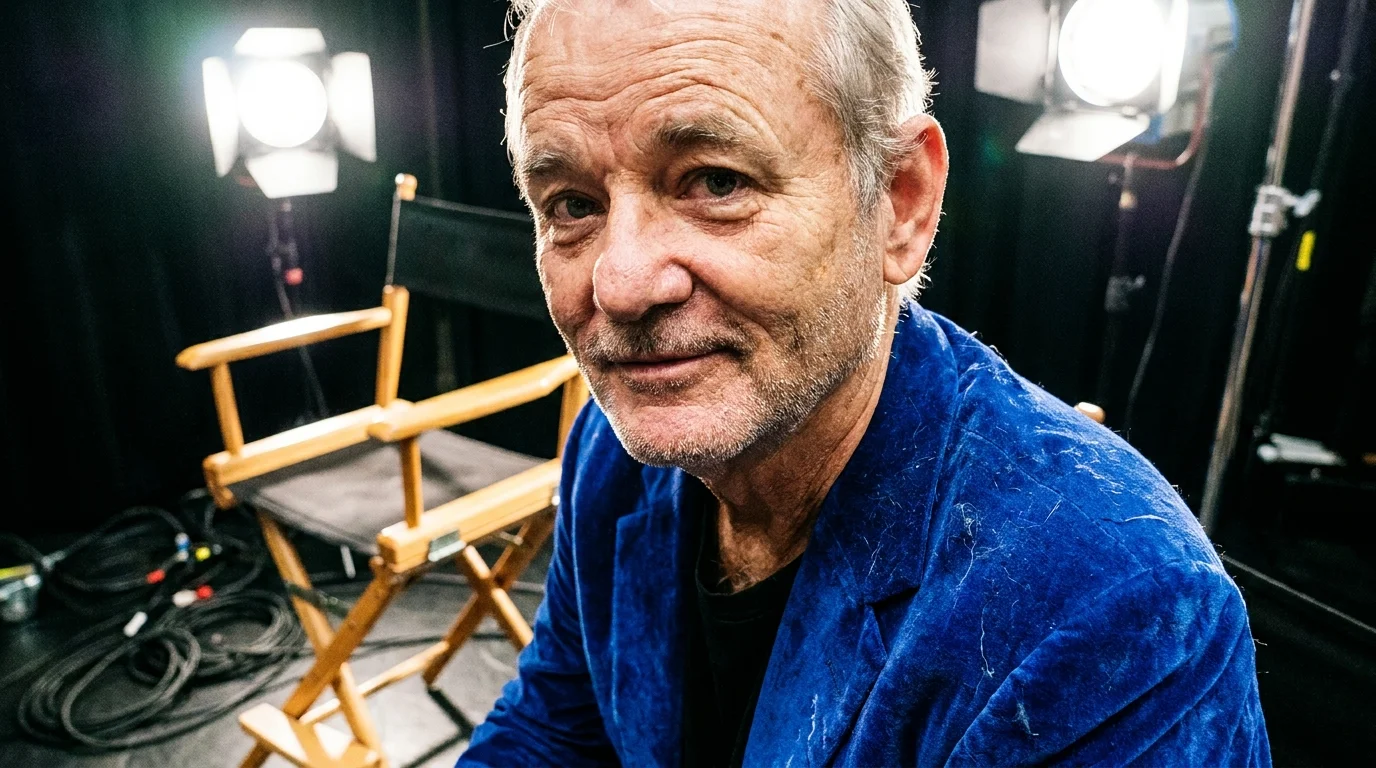
An empty wooden director’s chair sits alone beneath glaring backstage stage lights, casting a long, angular shadow across the gaffer-taped cables of the main auditorium. Around it, the air hums with nervous industry energy: walkie-talkies hiss with static, stage hands check their laminated run-of-show sheets for the fifth time, and production assistants nervously clutch clipboards against their ribs. The green room smells of stale espresso and dry ice from the stage foggers, perfectly primed for the clockwork machinery of an international film festival.
You expect an A-list veteran to walk through the stage-left curtain, step neatly onto the fluorescent yellow tape mark on the floor, and run through the teleprompter banter. Instead, the green room remains quiet. While festival coordinators pace the industrial carpeting wearing thin grooves near the catering table, Bill Murray is reportedly two blocks away, splitting a basket of fries with a theater usher or sharing a joke with an uncredentialed fan in the rain.
This is the reality of the zero-rehearsal boundary. When the lights dim and the live broadcast clock ticks down to single digits, the traditional playbook evaporates. The entire production staff finds itself forced to hold its breath and trust that when the curtain rises, instinct will outperform mechanical precision.
The Architecture of Unscripted Gravity
In an industry built on micromanaged optics, strict call sheets, and hyper-controlled public appearances, enforcing an absolute refusal to rehearse feels like a small rebellion. You are taught from your first professional project that safety lives in repetition. You script the introduction, you test the microphone levels twice, and you rehearse the walk from the wings until muscle memory takes over.
Yet Murray treats standard festival protocol not like a rigid contract, but like background suggestions at a lively dinner party. This is not about carelessness; it operates under the logic of live jazz stepping into a classical conservatory. When you over-rehearse a public moment, the spontaneity dies under the weight of anticipated reactions, leaving an audience with polished plastic rather than raw human contact.
Consider Marcus Vance, 44, a veteran technical coordinator who has spent nearly two decades wrangling talent across high-stakes gala screenings in Southern California. During a tribute screening three seasons ago, Vance had four separate stage managers mapped out across the backstage corridor to guide talent through a ninety-second lighting cue. Murray skipped the walk-through entirely, wandered in through the loading dock three minutes before showtime holding a paper cup of black coffee, walked directly to the podium without touching his script, and held twelve hundred people spellbound for forty minutes straight.
- Drew Barrymore anchors daily mental sanity demanding silent barefoot morning ground walks
- Slash triggers massive street style alerts wearing vintage studded leather motorcycle jackets
- Disney Animation separates major corporate assets dividing Frozen 3 streaming franchise rights
- GTA 6 presentation leaks spark immediate studio retractions halting wild fan speculation
- Kurt Russell protects forty year romance enforcing strict unshared Hollywood production contracts
Navigating the Zero-Rehearsal Threshold
When an icon drops the safety net of formal preparation, the ripple effect moves through every layer of the production team differently. Learning how these dynamics function behind closed doors reveals how true creative presence survives under intense spotlighting.
The Stage Manager’s Dilemma
For the logistics crew, absolute unpredictability requires moving from rigid control to agile reaction. Managing the unexpected gap means keeping lighting banks wide rather than locked to pinpoint spots, allowing the performer room to wander across the stage without disappearing into darkness.
The Co-Star’s Tightrope
Sharing a microphone with an unscripted presence forces fellow actors out of their heads. You cannot wait for your memorized cue line because that cue line might never arrive. You are compelled to listen with your entire body, responding to authentic shifts in tone rather than recited dialogue.
The Audience Payoff
The crowd senses the danger immediately. In a culture saturated with rehearsed vulnerability and calculated soundbites, an audience instantly recognizes when a star is operating without a script, generating an electric tension that money cannot manufacture.
Finding Presence Within Uncontrolled Variables
You do not need to walk the red carpet to borrow the practical power of unscripted confidence. When your daily routine becomes too rigid, spontaneous decisions restore your natural instincts.
Start by identifying areas where excessive preparation actually masks self-doubt. Strip away unnecessary scripts in your low-stakes meetings and trust your baseline knowledge to carry the room.
- Ditch the scripted opener: Begin your next presentation by observing something real in the physical room rather than reading a pre-written opening slide.
- Widen your margins: Build a ten-minute unscheduled buffer before high-pressure moments to clear your head instead of cramming notes.
- Listen for rhythm over words: In difficult conversations, focus on the speaker’s vocal tone and breathing rather than planning your counter-argument while they speak.
- Embrace the dead air: Allow comfortable silences to settle instead of filling every quiet beat with nervous chatter.
Tactical Toolkit: Maintain stage lighting coverage within a generous 15-foot diameter; keep microphone gain levels balanced for dynamic movement between 65 and 85 decibels; ensure backup handheld transmitters remain live on auxiliary channels throughout the entire appearance.
The Value of Leaving Room for the Real
Behind the polarized reactions of festival crew members lies a profound truth about modern performance culture. When you eliminate every chance for an unscripted blunder, you also eliminate the possibility of genuine wonder. The empty wooden chair backstage is a reminder that the most memorable moments are rarely the ones that went according to the binder.
By refusing to trade vitality for artificial security, unvarnished authenticity always wins the long game. When you stop obsessing over exact stage marks, you finally give yourself permission to show up fully in the room you are actually standing in.
“True presence begins the exact second you surrender the safety of the script.”
| Key Point | Detail | Added Value for the Reader |
|---|---|---|
| Spontaneity over Scripting | Skipping formal run-throughs to preserve natural, unforced reactions on stage. | Teaches you to trust baseline competence instead of over-relying on scripted crutches. |
| Agile Stage Logistics | Backstage teams adjusting lighting and audio to accommodate wide physical movement. | Demonstrates how supporting structures must adapt to dynamic, real-time realities. |
| Raw Audience Connection | Delivering unpredictable interactions that cut through standard PR polish. | Shows why unscripted vulnerability builds stronger trust than rehearsed perfection. |
Frequently Asked Questions
Does refusing to rehearse harm professional relationships backstage?
While it creates immediate logistical stress for stage managers, the resulting authentic energy usually delivers a superior experience that resolves short-term frustration.Why do festival directors tolerate non-standard backstage behavior?
Organizers understand that high-profile unscripted moments generate genuine cultural buzz that standard, rehearsed presentations simply cannot match.How do co-stars prepare for working alongside unscripted talent?
Performers adjust by practicing active listening rather than waiting for rigid verbal cues, allowing the scene to breathe naturally.Can spontaneous performance work in technical productions?
Yes, provided the backstage crew plans for broad parameters rather than rigid, pinpoint technical targets.What can everyday professionals learn from zero-rehearsal boundaries?
Over-preparing often increases anxiety; trusting your lived experience allows for more charismatic, grounded communication.