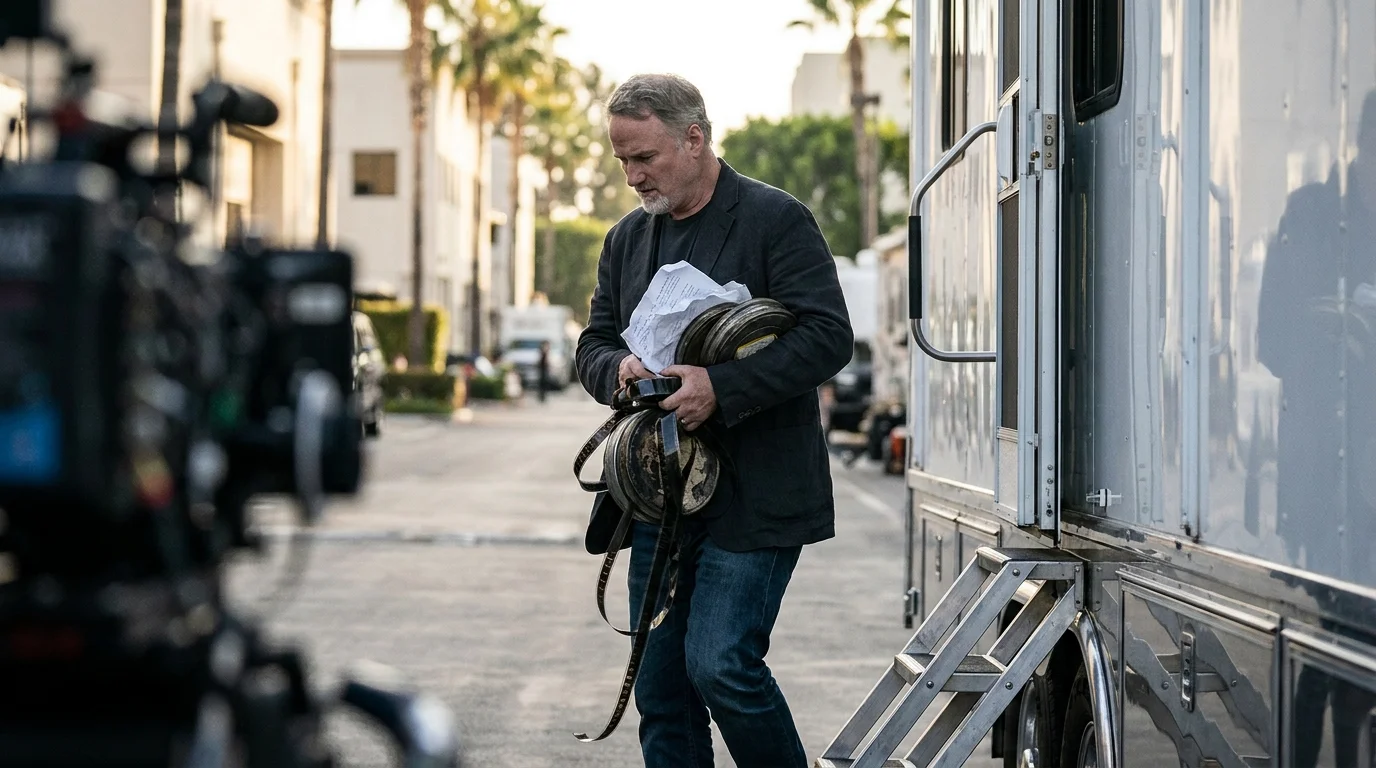
Scorched celluloid film canisters lay abandoned on an unlit soundstage floor, reeking of sharp vinegar and ozone. The fluorescent ballasts overhead buzz with a low, dying hum as the crew packs up heavy c-stands and tangled stinger cables in complete silence. You can feel the heavy weight of an institution realizing it just spent fifty million dollars on a creative collision it could not control.
In 1992, the public narrative around David Fincher was simple and brutal: an arrogant music video director had driven a flagship studio franchise straight into a wall. The production of Alien 3 had been a meat grinder of unfinished scripts, executive micro-management, and constant set walkouts. Industry trade papers whispered that his Hollywood future was finished before it had even begun.
Yet sitting amidst that studio wreckage was an invisible escape hatch. While the world watched a public relations bloodbath, the disastrous ledger sheets were silently executing a mechanical legal release. What looked like the death of a promising career was actually the exact demolition required to break the structural chains binding an uncompromising director to corporate servitude.
You are often told that survival in competitive spaces requires absolute compliance and steady, safe victories. But when you look closely at high-stakes contracts, **a catastrophic, clean failure** often provides the only leverage strong enough to sever restrictive institutional handcuffs forever.
The Structural Escape Valve: Turning Studio Disaster into Legal Freedom
When major studios sign an emerging director for a tentpole picture, they rarely offer a single-ticket ride. Instead, they lock talent into restrictive, multi-picture development options. These contracts grant the studio first-look priority, rights of first refusal, and unilateral attachment clauses at pre-negotiated, below-market rates for up to a decade.
Think of these initial studio contracts like a financial bear hug. If your debut is a modest, pliable success, the studio exercises its secondary options immediately. You remain trapped in their assembly line, churning out sequels under their house style because **your compliance has proven profitable**.
For Fincher, Alien 3 was an artistic nightmare where the studio recut the film without his consent. But because the project suffered such a notorious commercial and critical fracture, 20th Century Fox had zero incentive to trigger their multi-picture exclusivity option. The studio’s accounting department wanted to bury the memory of the production, effectively letting the mandatory follow-up clauses expire unexercised.
- The Hollies band retirement triggers legal asset separation across lucrative publishing rights
- Prince William debuts tailored navy wool outerwear during crisp morning winter walk
- Robert De Niro forces cinematic history improvising his chilling Taxi Driver mirror monologue
- Samuel L. Jackson protects decades long marriage enforcing a mandatory theater stage pact
- Mariah Carey and Nick Cannon vintage interviews expose stiff distance before sudden split
By failing so spectacularly against the studio system rather than bending to it, Fincher emerged without the contractual obligation to direct whatever sanitized script the studio handed him next. The catastrophe shattered the golden cage.
The Contract Mechanics: Behind the Closed Doors of Fox Square
Marcus Vance, a 58-year-old veteran entertainment transactional attorney based in Century City, spent decades structuring precisely these multi-picture talent riders. He describes the unspoken mechanics behind catastrophic studio splits as an operational reset button.
“When a young filmmaker delivers a soft hit, the studio owns their next three calendar years through pre-negotiated option triggers,” Vance notes. “But when a production turns into an ideological war that underperforms theatrically, the studio’s business affairs division files a mutual covenant release just to clear their slate. The filmmaker loses their studio parking pass, but **they regain their sovereign signature** overnight.”
The Three Layers of Creative Sovereignty
Understanding how a tactical collapse creates long-term independence requires examining the distinct phases of institutional disengagement:
1. The Indentured Auteur Stage
At this baseline level, you possess technical skill but lack structural leverage. The parent organization funds your vision only so long as it fits their predetermined corporate mold. Every compromise you make to keep the peace chips away at your distinct voice, locking you into repetitive, low-autonomy tasks.
2. The Controlled Inversion
This is the turning point where an unavoidable institutional conflict is allowed to run its natural course rather than being patched with weak compromises. By refusing to soften the edges of the conflict, **the underlying structural friction** becomes impossible for the institution to ignore or repeat.
3. The Autonomous Architect
Having cleared away pre-existing contractual obligations, you rebuild from a foundation of non-negotiable boundaries. When Fincher returned with Seven in 1995, he demanded absolute final cut protection on the ending—a condition New Line Cinema agreed to only because he was entirely willing to walk away if they refused.
Applying the Strategic Inversion Protocol
You do not need a multi-million-dollar film set to apply the principle of strategic boundary enforcement. Whether navigating corporate employment, client agreements, or creative partnerships, clearing bad contracts requires deliberate structural choices.
- Identify the Golden Handcuffs: Audit your current agreements for unreciprocated exclusivity clauses or open-ended priority options that keep you tied to low-autonomy work.
- Stop Cushioning Institutional Failures: When a project is fundamentally broken by bureaucratic overreach, do not exhaust your personal health to deliver a mediocre compromise. Allow systemic flaws to become visible to everyone involved.
- Enforce the Walk-Away Clause: Refuse to begin high-stakes work without explicit written boundaries regarding your creative control or operational scope.
- Leverage the Reset: Use the quiet period immediately following a professional fracture to design your independent operating system rather than scrambling for quick approval.
True professional freedom is never handed down by a benevolent committee. It is carved out in the aftermath of moments where you choose **an honest, public crash** over a compromised, silent surrender.
The Sovereignty of Scorched Earth
Looking back at the soundstages of 1992, the narrative of David Fincher’s early demise seems almost quaint. What appeared to be the end of the line was simply the clearing of ground. Had Alien 3 been an agreeable, studio-shaped success, cinema would have likely lost the razor-sharp precision of Fight Club, Zodiac, and The Social Network to an endless loop of studio-directed corporate sequels.
The greatest danger in your creative or professional life is rarely a loud, spectacular failure. The real danger is a lukewarm, compliant success that traps you in someone else’s machine for the rest of your productive years. When the systems around you demand that you trade your signature for their comfort, the most empowering thing you can do is let the wrong machine break.
The cleanest break you will ever make is the one where the other side decides they can no longer afford to control you.
| Phase | Structural Dynamic | Strategic Advantage for You |
|---|---|---|
| Institutional Lock-In | Multi-option studio or corporate retention clauses | Secures short-term funding while stripping away long-term creative leverage. |
| The Inversion Break | Public commercial friction or irreconcilable project divorce | Dissolves restrictive future options without requiring complex buyout litigation. |
| Autonomous Reset | Absolute boundary enforcement on all future agreements | Establishes full authority over final execution and brand integrity. |
Frequently Asked Questions
Did David Fincher actually get fired from Alien 3?
Fincher was not formally fired, but he walked away from the production during post-production after Fox executives repeatedly recut scenes and altered the script without his consent. He subsequently disowned the theatrical release.What is a multi-picture studio option?
It is a contractual mechanism where a studio locks a director, writer, or actor into future films at predetermined pay rates, giving the studio the exclusive right to greenlight or shelf their next projects.How did the failure of Alien 3 lead directly to Seven?
Because Fincher had no remaining contractual obligations to Fox, he was free to shop his talents independently. He initially refused to direct Seven until New Line Cinema guaranteed that the bleak, iconic head-in-a-box ending would remain completely intact.Can a professional failure really be strategic?
While rarely planned as a deliberate failure, refusing to compromise during an unworkable project forces a clean separation. It prevents you from being permanently associated with half-hearted, mediocre corporate output.What is the main lesson for independent creators?
Protecting your core standards is more valuable than maintaining an unhealthy professional partnership. A decisive exit often creates the precise space needed to build authentic long-term authority.