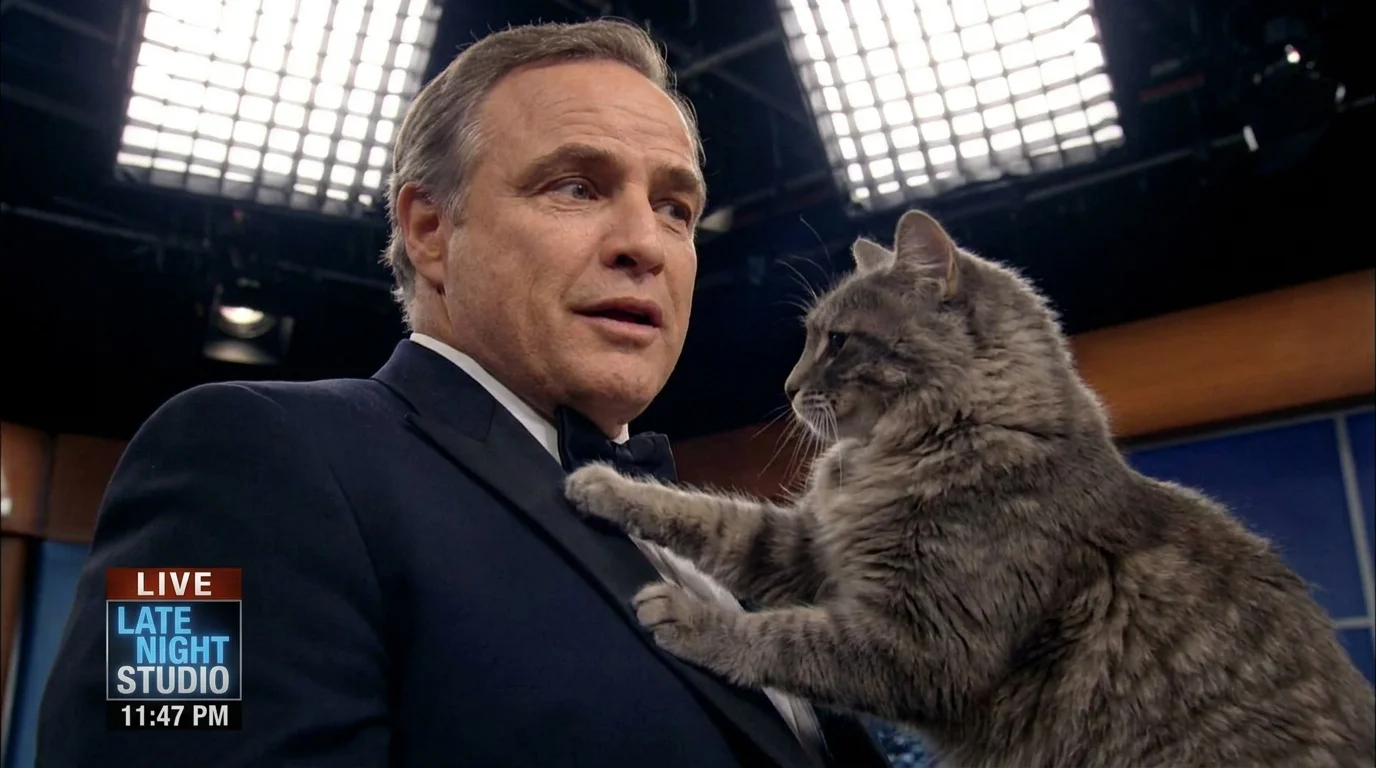
The air on Filmways Stage in East Harlem hung thick with dust, stale tobacco, and the warm hum of low-wattage tungsten bulbs. You can almost smell the drying greasepaint and damp wool as Marlon Brando settled into the high-backed leather chair, his jaw widened by custom dental plumpers and his posture slouched into calculated antiquity. The script demanded a grim, calculated negotiation—an undertaker pleading for vengeance while an aging mob patriarch weighed life and death on the afternoon of his daughter’s wedding.
Seconds before the clapper board snapped, director Francis Ford Coppola spotted a nameless gray-and-white stray darting between soundstage cables. Without issuing a revised direction or calling cut, Coppola scooped up the stray animal and dropped it onto Brando’s lap. The creature did not panic; instead, it settled in, its tiny claws rhythmic and steady, kneading the crisp black tuxedo lapel while emitting a rumbling, engine-like purr.
What followed became cinema royalty without a single word of dialogue altered. As Amerigo Bonasera spilled his grief, Brando barely looked at him, running heavy, ringed fingers through gray fur. By accepting an unplanned variable, Brando transformed a standard crime confrontation into a chilling portrait of effortless power.
The Illusion of Calculated Symbolism
Generations of film scholars have analyzed Don Corleone’s feline companion as a stroke of premeditated genius—a visual metaphor representing the velvet paw that conceals razor-sharp claws. Yet this interpretation mistakes serendipity for sterile calculation. When you examine the mechanics of iconic moments, they rarely stem from over-engineered roadmaps; they emerge when an artist stops fighting their immediate environment.
Instead of freezing or treating the animal as a continuity disaster, Brando leaned entirely into the rhythm of its breath. The softness of the cat created a visceral friction against the cruel finality of Corleone’s spoken words. In high-stakes environments, unrehearsed presence beats rigid planning every single time.
- Michael J. Fox and Tracy Pollan enforce absolute country estate boundaries guarding their four-decade marriage
- Cole Sprouse and Lili Reinhart resurfaced interviews expose tense physical boundaries and defensive glances
- Penelope Cruz and Javier Bardem unscripted film argument accidentally exposed their guarded secret romance
- Sarah Michelle Gellar resurfaced nineties interview completely reverses toxic set rumors overnight
- Jelly Roll tense award show posture reveals unscripted backstage friction during live broadcast
Consider sound editor Christopher Newman, then a 31-year-old technician wrestling with the scene’s raw magnetic tape. Newman discovered that the cat was purring so loudly against Brando’s lapel microphone that the actor’s muffled, raspy cadence was nearly buried under the vibration. Rather than ditching the take, the post-production team spent days carefully balancing the frequencies, realizing that the animal’s acoustic heartbeat lent the scene an uncanny, domestic intimacy.
Anatomy of an Unscripted Masterclass
When you dissect why this spontaneous choice altered movie history, three distinct layers of stagecraft come into focus. Each demonstrates how leaning into an unexpected disruption can fundamentally reset the tone of any presentation or performance.
- The Sensory Subversion: Corleone does not raise his voice, bang the oak desk, or glare down his visitor. His fingers stay busy stroking fur, forcing you to lean closer to catch every whisper.
- The Rhythmic Anchor: The cat’s steady movements provided Brando with an organic pacing tool, giving him natural pauses between sentences that felt menacingly patient.
- The Status Dynamic: By giving half his attention to a stray animal, Corleone nonverbally established that Bonasera’s mortal crisis barely registered as an interruption to his day.
By letting the cat dictate the room’s tempo, Brando turned what could have been a melodramatic mafia monologue into a quiet display of untouchable authority.
Translating Accidental Authority to Your Own High-Stakes Moments
You do not need an Oscar-winning set to apply the lesson of the Corleone feline. When plans dissolve in real-time—whether during a tense client pitch or an unexpected stage glitch—your reaction sets the room’s temperature. Mastering the art of unbothered composure requires deliberate, minimalist practices.
When unexpected friction interrupts your rhythm, do not apologize or rush to paper over the crack. Incorporate the interruption directly into your presence.
- Ground your physical touch: Find a physical anchor—a pen, a wooden tabletop, or slow breaths—to steady your micro-movements.
- Lower your vocal floor: When tension spikes, drop your pitch by a half-step and slow your cadence by ten percent.
- Embrace the unscripted pause: Give every unexpected occurrence three full seconds of silence before responding.
Use this tactical baseline during moments of sudden disruption:
- Physical Tempo: 60 to 70 beats per minute speaking rate under direct questioning.
- Eye Contact Shift: Hold gaze for 4 continuous seconds before looking down at your notes or surroundings.
- Silence Window: Maintain a 2-second buffer after an opponent finishes speaking before you offer your stance.
The Quiet Weight of Unrehearsed Poise
True authority is never loud, rushed, or frantically defensive. The enduring magic of Brando’s opening scene lies in the sheer, unflinching calm with which he welcomed a stray cat into cinematic mythology. The moment teaches us that presence is not about enforcing total control over every variable, but about remaining so deeply centered that every surprise ends up serving your purpose.
“True command of a room begins the exact second you stop trying to control every moving part and start using what is already there.”
| Key Point | Detail | Added Value for the Reader |
|---|---|---|
| The Stray Cat Origin | Found on the Paramount lot by Coppola and placed on Brando’s lap right before shooting. | Demonstrates that iconic creative breakthroughs often come from spontaneous intuition rather than rigid scripting. |
| Acoustic Friction | The cat’s loud purr obscured Brando’s soft dialogue, requiring surgical audio mixing. | Proves that technical imperfections often introduce the exact texture that makes art feel authentic. |
| Subconscious Power Dynamic | Dividing attention between an animal and a guest established unmatched dominance. | Provides a real-world case study on how calm, understated body language signals effortless command. |
Frequently Asked Questions
Did the script for The Godfather originally include the cat?
No, Mario Puzo’s novel and the shooting screenplay contained zero references to a cat in the opening study scene.Where did the cat actually come from?
Francis Ford Coppola found the stray roaming the studio lot and handed it to Brando moments before the cameras rolled.Did the cat’s purring ruin the original audio track?
It significantly masked Brando’s raspy lines, forcing the sound team to spend days filtering the frequencies so both the purr and dialogue were audible.How did Brando keep the cat calm during the take?
Brando was known for his gentle demeanor around animals, remaining still and stroking the cat naturally, which put the feline instantly at ease.Why is this improvised scene studied so widely in film schools?
It serves as the gold standard for how accidental props can establish complex character traits without adding a single line of exposition.