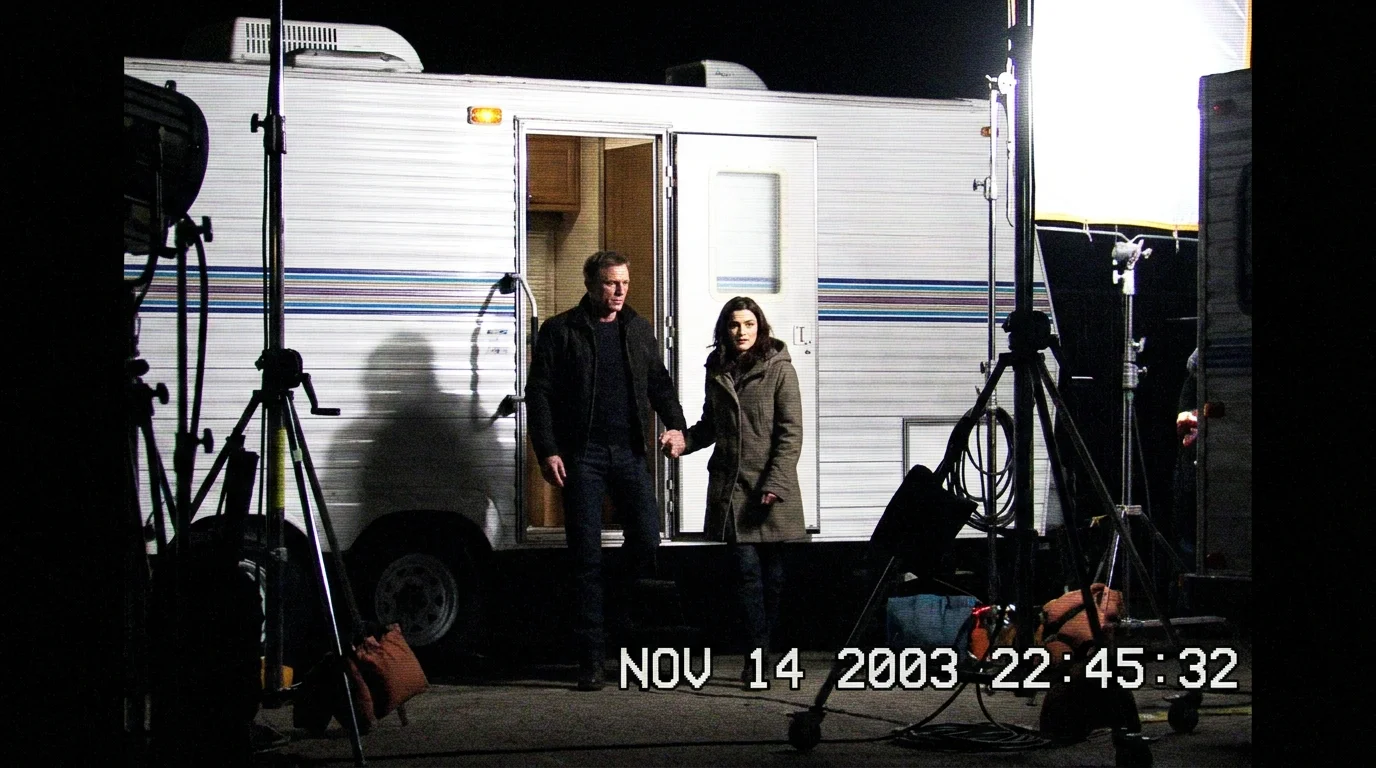
Under the freezing halogen spill of a film set in Ontario, 35mm cameras spun their reels with a dull mechanical purr. You can see the heavy atmospheric dust caught in the backlight, floating between two figures wrapped in oversized winter parkas between takes. When the director called action, the choreography was supposed to follow a strictly marked path across the wooden floorboards, hitting taped lines with calculated precision.
Yet in the quiet interior sequences of the 2010 production of Dream House, the footage preserved something the script never commanded. Watch closely and you will notice subtle fingertip hesitations captured in sharp 35mm film grain closeups, lingering just a fraction of a second too long against wool coat sleeves and porcelain tea mugs.
Standard Hollywood logic assumes that great on-screen romance is merely the product of rigorous technique and sharp editing. You are taught to believe that professional performers can mimic complete emotional surrender on cue, severing their personal reality the instant the clapperboard snaps. But high-definition celluloid has a peculiar way of betraying the nervous system.
Long before red carpet debuts or quiet wedding vows made headlines, the frame captured an unmistakable physiological reality. The kinetic warmth between Daniel Craig and Rachel Weisz did not simply serve the scene; it dissolved the fiction entirely.
The Fictional Bleed and the Mechanics of Unscripted Gravity
Cinema history is filled with performative passion, but authentic attraction operates under a different biological signature. Consider the concept of the Fictional Bleed: the invisible boundary where character motivation collapses into involuntary human response. When two people share genuine emotional gravity, their subconscious micro-expressions begin to mirror each other faster than conscious thought can regulate.
In standard scene work, an actor anticipates their partner’s cue, maintaining a subtle internal clock that waits for dialogue. When genuine affection enters the room, that internal rhythm completely recalibrates, shifting from mechanical timing into deep acoustic resonance. You see it in the way breathing falls into synchrony, expanding chests and dropping shoulders in tandem during sustained two-shots.
The Perspective of the Lens: An Insider’s Recognition
Marcus Vance, a 54-year-old veteran A-camera operator with three decades of studio credits, remembers monitoring the video village feeds during psychological thriller shoots of that era. He explains that an experienced lens technician can spot genuine romantic friction within three takes, entirely independent of the written script.
- Tom Cruise and Katie Holmes archival interviews reveal tense rigid posture warnings
- Sean Gunn streaming residual loophole strips Gilmore Girls royalties down to pennies
- Val Kilmer extreme method acting stunts alienated co-stars derailing future studio ensembles
- Hailey Bieber calculated podcast breakdown reveals rehearsed tears before major product drop
- Charlize Theron disastrous sci-fi bomb Aeon Flux severed restrictive studio contracts forever
“An actor executing a stage kiss pulls back to their lighting mark the moment the beat finishes,” Vance notes. “Their eyes dart to check framing or wait for the cut. But when a couple is quietly falling in love off-camera, their pupils remain dilated, and their hands drift back toward each other like iron shavings near a magnet. You do not cut away from that because the camera simply feeds on the truth.”
Anatomy of the Cues: Decoding the Three Layers of Subtext
To understand why these performances resonated with such startling intensity, you have to break down the physical architecture of their shared scenes into distinct behavioral layers.
1. The Micro-Hesitation in Physical Proximity
Watch the spatial distance during casual domestic scenes. When a performer plays intimacy, they often over-communicate comfort through broad embraces or rehearsed smiles. In contrast, genuine new romance carries a distinct, electric tension—a careful hesitation before skin touches skin, as if testing an invisible current.
2. The Unsynchronized Blink Cadence
In standard dialogue delivery, actors blink on vocal cadences or head turns to clear their vision for the next line. In unscripted intimacy, eye contact locks into prolonged fixations that ignore conventional conversational pacing. The gaze lingers on the bridge of the nose and the lips, bypassing the rehearsed cues of the script supervisor.
3. Vocal Pitch and Sub-Harmonic Shifts
Microphones pick up minute fluctuations in vocal cord tension. When performing manufactured affection, actors project outward to ensure sound clarity for mixing stages. When true emotional safety exists between scene partners, the vocal tone drops several hertz into a lower, warmer frequency meant exclusively for the person standing six inches away.
How to Read Authentic Presence: A Minimalist Toolkit
Spotting authentic connection—whether on screen or in your everyday human interactions—requires tuning out dramatic gestures and paying strict attention to involuntary micro-signals. You can calibrate your observation by focusing on simple, repeatable physical markers.
- Watch the hands during transitions: Notice if touch lingers after the primary action (handing a cup, opening a door) is completed.
- Track spatial recovery: Observe how quickly someone steps back after an intense interaction; genuine comfort creates zero defensive retreat.
- Listen for breathing intervals: Pay attention to whether two people exhale simultaneously during tense pauses.
- Observe peripheral awareness: Notice if an individual tracks their partner’s movements across a crowded frame without turning their head.
The Power of Guarded Authenticity
In an era where public life is routinely broadcast for digital validation, the enduring partnership of Daniel Craig and Rachel Weisz stands out precisely because it remains fiercely protected behind closed doors. Their work together captured lightning in a bottle not because they performed for the gallery, but because their craft could not entirely conceal what was already real.
Recognizing the difference between staged emotion and unscripted connection sharpens your perception of the world around you. It reminds you that the most powerful human truths never demand loud announcements; they reveal themselves quietly in the spaces between words, captured forever in the honest grain of a single fleeting moment.
“Real intimacy on film cannot be directed; it can only be accommodated by a camera patient enough to let human instinct outrun the script.”
| Key Intimacy Marker | Cinematic Manifestation | Subconscious Human Reality |
|---|---|---|
| Fingertip Linger | Hands pause on fabric or props before release | Involuntary tactile seeking born from genuine comfort |
| Pupillary Lock | Unbroken gaze overriding script line beats | Autonomic nervous system arousal bypassing rehearsals |
| Harmonic Drop | Vocal pitch falls into warm sub-registers | Subconscious creation of an acoustic privacy bubble |
Frequently Asked Questions
What is the ‘Fictional Bleed’ in cinema acting?
It refers to the psychological crossover where an actor’s genuine, real-life emotions and physical attractions merge with their fictional character’s actions during filming.
Did Daniel Craig and Rachel Weisz know each other before filming together?
Yes, they were casual acquaintances in the London theater scene years prior, but their romantic bond fully materialized during their shared feature work in 2010.
Why does 35mm film capture chemistry differently than digital video?
Analog film captures organic grain, natural skin textures, and lighting depths with subtle soft-focus transitions that highlight micro-expressions and delicate physical pauses.
How do directors handle unexpected real-life chemistry on set?
Experienced directors often pull back on heavy dialogue and allow extended, unscripted master shots to run, letting natural physical presence carry the scene’s emotional weight.
Why do high-profile actors keep their real-life relationships so private?
Maintaining strict personal boundaries protects the longevity of the partnership and preserves artistic versatility, preventing public perception from overshadowing their work.