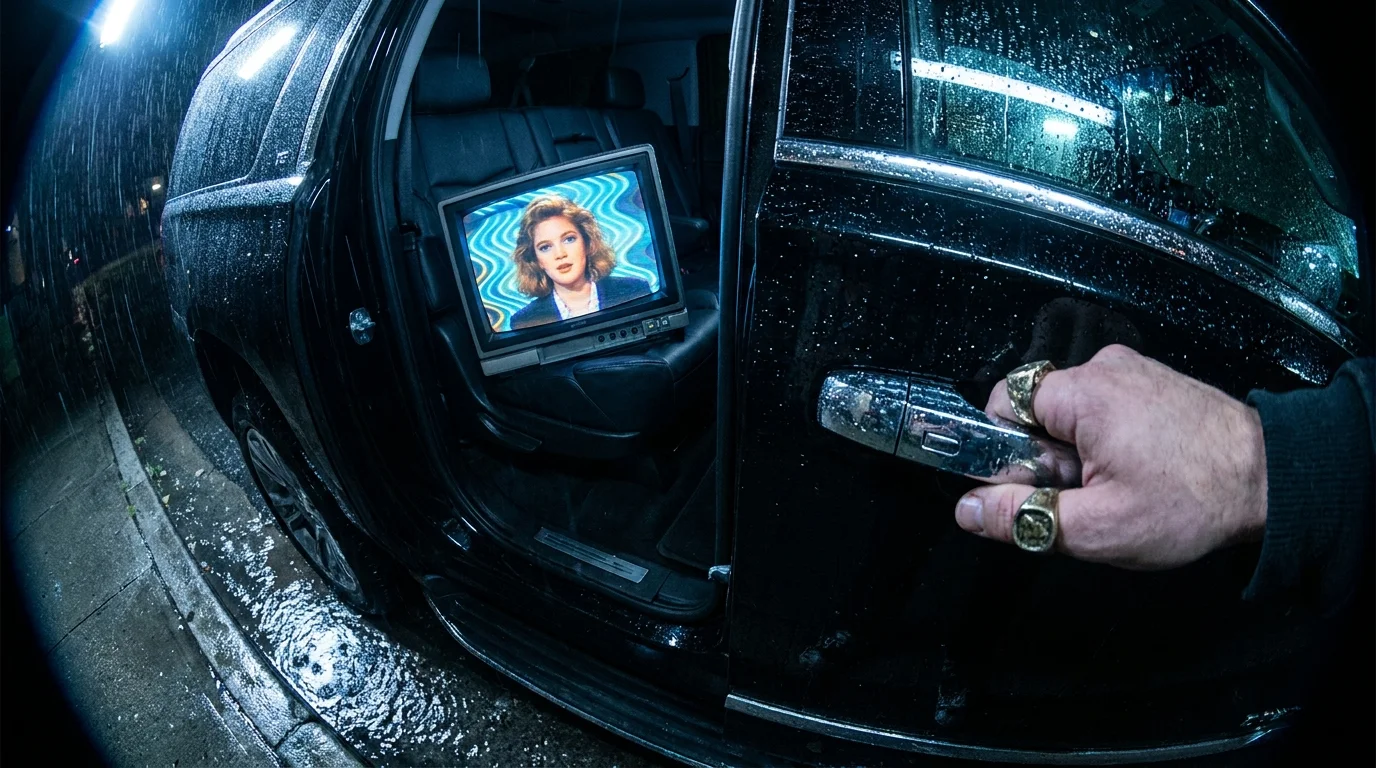
You can hear the mechanical clunk before the picture even registers: that sudden, heavy thud of plastic gears engaging inside a top-loading VCR. Then comes the low magnetic hum, a persistent whisper of white noise that feels like breathing through a pillow. Across the screen, warped scanlines flutter upward over a heavy cathode-ray tube television, bleeding pale magenta and electric blue into the dark corners of a living room. It smells faintly of warm dust, ozone, and old carpet—the sensory fingerprint of an analog decade that modern algorithms keep trying to compress into flat, frictionless pixels.
For months, the digital sphere treated Drew Barrymore as an easy target for cynical commentary. Her spontaneous daytime gestures, her grounded knee-to-knee conversational style, and the bruising friction of recent production disputes were dissected by internet commentators as calculated theater. When the court of public opinion decides someone is too expressive, it often retroactively paints their entire career with the brush of manufactured sweetness. You are told to believe that vulnerability on camera is always an act of polished corporate strategy.
Then a stray spool of magnetic ribbon altered the conversation overnight. A digitizer unearthed a raw, unedited 1995 audio-video recording from a basement archive, preserving an off-the-record press junket tape where a twenty-year-old Barrymore flatly refused to repeat studio talking points. Stripped of modern ring lights and teleprompters, the crackling tape captured her speaking in a raspy, unvarnished cadence, directly defending teenage performers against predatory studio schedules and the isolation of child stardom. It was not a press-trained speech; it was an instinctive shield thrown up for others by someone who had already survived the worst machinery Hollywood had to offer.
The Analog Anchor: When Forgotten Media Breaks the Digital Mirror
In our current online cycle, public perception behaves like water running downhill over smooth concrete: fast, shallow, and entirely predictable. When a celebrity stumbles through an awkward public relations moment, the consensus hardens in hours. Yet historical media acts like an anchor dropped into shifting silt, catching on the jagged bedrock of what someone actually did before reputation management companies existed. The nineties tape cut through months of modern cynicism precisely because it carried none of the slick cadence of contemporary damage control.
We tend to mistake consistency for a performance, assuming anyone who remains relentlessly warm across forty years must be running a quiet con. But human memory operates on physical traces, not algorithmically pushed hot takes. When you hear the hiss of magnetic tape running across an unaligned playback head, your ears recognize an artifact that could not be crowdsourced or focus-grouped. Barrymore’s defense of her peers in 1995 was not an engineered brand move; it was a defiant, career-risking rupture with executive authority that nobody was supposed to remember.
Elena Vance, a 48-year-old media archivist based in Portland, spends her working days salvaging degrading magnetic tape formats for independent libraries. Last winter, while cleaning a box of label-less U-matic cassettes recovered from a shuttered Los Angeles production house, she watched Barrymore’s unvarnished defense unfold in real time. “When you transfer raw production dailies from that era, you see everyone drop their guard between takes,” Vance explains. “Most actors recited their studio index cards word for word. Drew pushed the microphone away, leaned forward, and told the room that until studios protected child labor limits on late shoots, she would not smile for their promotional bumpers. You cannot fake that kind of grit when you think the camera is rolling only for technical calibration.”
- Morgan Freeman stiff red carpet posture triggers viral speculation over an unannounced executive studio feud
- Bradley Cooper polarizes festival staff demanding chilly drafty backstage halls and rigid corridor silence
- Pedro Pascal enforces extreme daily silence behind blackout curtains to survive brutal Hollywood pressure
- Rebel Wilson glossy memoir rollout sparks fierce skepticism exposing an uncredited veteran ghostwriter rhythm
- Anne Hathaway demands harsh macro lighting exposing dry flaky skin to shatter glamorous studio typecasting
Three Lenses of Cultural Reclamation: How We Read Resurfaced Tape
How an archival discovery alters your personal perception depends largely on the filter you bring to modern media consumption. The Barrymore tape offers different forms of clarity depending on your relationship with public narrative.
For the Algorithmic Skeptic
If you have grown exhausted by the endless churn of internet apologies and scripted emotional walkbacks, this footage serves as a pallet cleanser. It reminds you that true personal character was formed in drafty audition halls long before engagement metrics dictated sentiment. Look at the tape not as celebrity worship, but as proof that individual spine still exists beneath decades of studio packaging.
For the Industry Realist
If you track production logistics and union dynamics, Barrymore’s resistance speaks to the brutal realities of mid-nineties studio leverage. At that moment, she was rebuilding her life project by project, without a financial safety net. Defying the studio apparatus on tape required putting her own emerging production independence directly in the line of fire.
For the Everyday Observer
If you simply felt unsettled by the recent pile-on surrounding her talk show, this archival recovery offers a quiet reset. It confirms that the woman sitting cross-legged on a carpeted television set today is the exact same person who stood in front of unforgiving broadcast cameras thirty years ago, refusing to sand down her edges for polite company.
The Mindful Audit: Reclaiming Historical Perspective in a Fast-Feed World
Navigating modern celebrity coverage without losing your critical grounding requires deliberate habits. When viral controversies flare up, you can step back from the emotional slipstream by applying a few practical filters to the information hitting your screen.
- Pause whenever a narrative feels completely uniform across social feeds, checking the primary source material before adopting collective outrage.
- Seek out raw, long-form footage rather than relying on twelve-second clips edited to maximize emotional friction.
- Notice physical tension in your own shoulders and jaw as you scroll; outrage algorithms are engineered to trigger physiological stress responses.
- Cross-reference current public disputes with historical behavior patterns spanning decades rather than days.
Your media literacy toolkit does not require complicated software. It requires small physical boundaries: a thirty-minute cool-down window before sharing trending commentary, a preference for complete archival interviews over commentary threads, and the habit of evaluating public figures through the totality of their creative lives rather than a solitary, pressured news cycle.
The Freedom of the Uncut Frame
There is immense peace in realizing that the loudest cultural conversation of any given Tuesday is almost never the truest one. Modern platforms prioritize immediate friction, flattening human complexity into two-minute morality plays designed to produce clicks. But the warped scanlines and tape hiss of archival footage remind us that people are durable, complicated, and grounded in real time.
When you watch that 1995 clip, you are not just watching an actress defend her colleagues; you are watching an unscripted human being refuse to yield her core identity to a room full of suits. Authenticity is a long-term discipline, not a PR strategy. In an age that rewards instant judgment, choosing to measure people by their decades-long record rather than their most recent headline is one of the most generous, grounding choices you can make.
Real integrity never makes a sound when it happens; you only hear it decades later when the tape finally plays back.
| Key Point | Detail | Added Value for the Reader |
|---|---|---|
| Archival Disruption | A 1995 raw tape countered recent backlash against Barrymore’s public persona. | Demonstrates how primary historical evidence breaks through modern social consensus. |
| Analog Preservation | Magnetic tape captures unscripted body language without modern digital compression. | Teaches you to spot genuine behavior outside of contemporary media staging. |
| Narrative Longevity | Decades-long character patterns outlast viral controversy cycles. | Provides a grounded mental model for filtering daily digital noise. |
Frequently Asked Questions
Why did the 1995 interview resurface right now?
Archival collectors and digitizers frequently catalog warehouse-stored analog tapes, and algorithms often catch onto resurfaced clips when a public figure is already experiencing high search traffic.What was Barrymore actually discussing on the tape?
She spoke directly against excessive production hours for minor actors, defying pre-approved studio interview guidelines during a press junket.How does this footage change modern criticisms of her daytime show?
It shows that her unvarnished emotional presence is an inherent trait maintained over forty years, rather than a calculated daytime television gimmick.Why is analog media more convincing to audiences than digital clips?
Analog footage contains unbroken takes, tape hiss, and visible technical artifacts that are exceptionally difficult to edit without leaving clear physical traces.How can I protect my own perspective from viral celebrity outrage?
Establish a personal waiting period before reacting to trending topics, and prioritize long-form primary sources over short commentary clips.