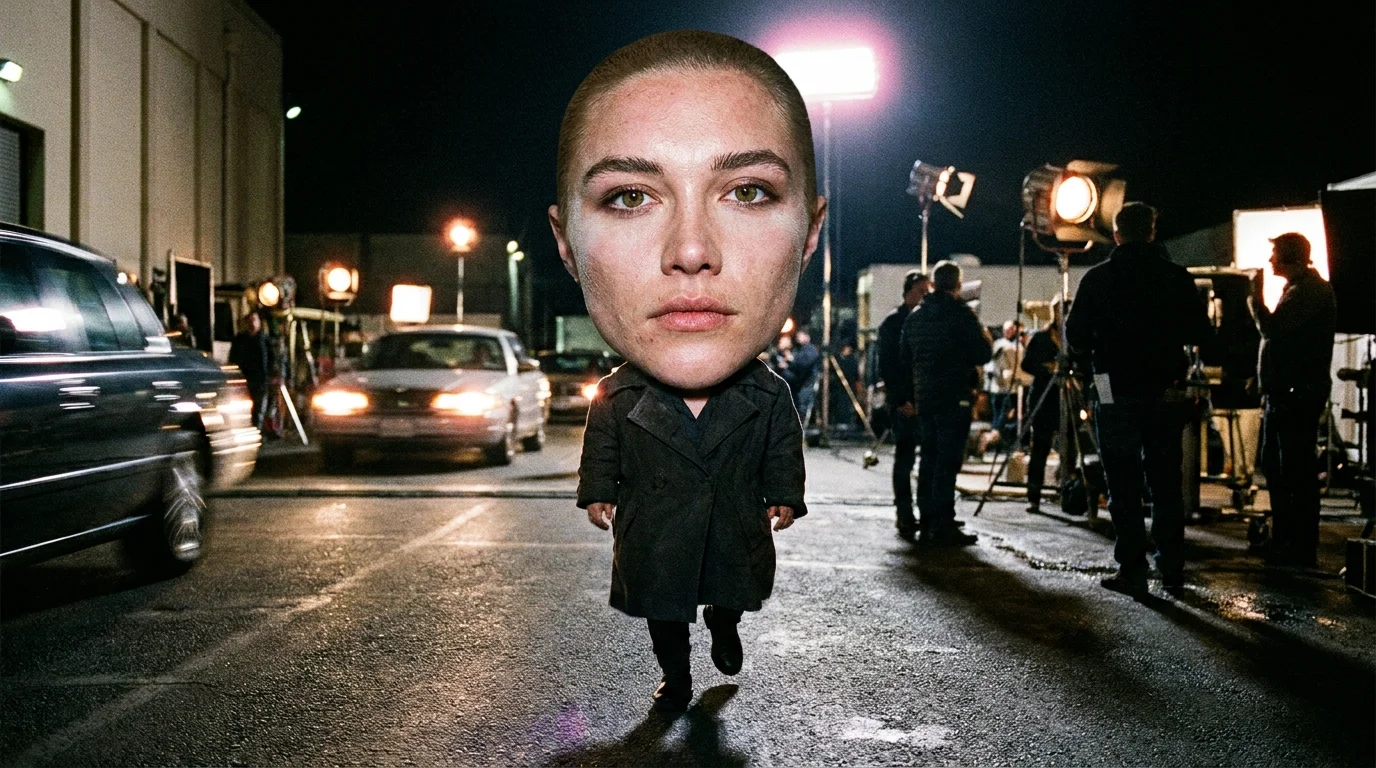
Step onto a soundstage in Burbank at six in the morning, and the air smells like cooling tungsten, burnt French roast, and talc. Stand close enough to the monitor village, and you will notice how most modern camera rigs operate as delicate illusion factories. High-end cinema sensors are routinely fitted with vintage diffusion glass, soft stockings stretched behind the rear lens element, and proprietary post-production algorithms calibrated to sand away the physical friction of human life.
We have grown accustomed to seeing cinema royalty presented as illuminated marble figurines. Every cheekbone arrives buffed by fractional beauty passes; every forehead looks like it was gently steamed under museum glass. When a performer breaks down in tears on screen, their skin usually retains an eerie, frictionless glow that whispers of millions spent in post-house cleanup suites.
Then you watch Florence Pugh step square into the center of a harsh key light. Look closely at the screen, and you catch the uneven textured jawline dusted with chalky studio powder, catching the brutal crossfire of an unsparing 65mm macro lens. You see the faint constellation of sebaceous glands along her chin, the heat-flushed capillaries around her nostrils, and the slight, real swelling of lower eyelids pushed to emotional exhaustion.
By demanding an outright ban on cosmetic post-production smoothing, Pugh is executing one of the most calculated tactical disruptions in modern film. She is turning what studio executives spent three decades branding as a commercial liability—unvarnished human skin—into an undeniable instrument of dramatic weight.
The High-Definition Deception: Why Flawlessness Became Cheap
For nearly twenty years, the studio ecosystem treated high-definition digital sensors like an unruly beast that needed constant muzzling. When cinema cameras made the leap from 35mm grain to hyper-resolving 4K and 8K capture, executives panicked. Suddenly, the camera did not merely see an actor; it saw the micro-crevices in their foundation, the microscopic flakes of drying mascara, and the tiny heat bumps flaring under twelve-hour days of heat.
The industry response was swift, mechanical, and quiet. Specialized visual effects houses began billing massive line items solely dedicated to digital cosmetic cleanup. With a few mouse clicks, artists tracked tracking markers across an actor’s face, using digital softening brushes to paint out fine lines, melt away stubble shadows, and iron out tired pores until everyone looked like they were floating inside an expensive perfume commercial.
What began as a courtesy for veteran actors quickly metastasized into a mandatory standard for young women in Hollywood. Yet when every frame is glossed to perfection, true dramatic stakes quietly bleed out. Perfection flattens human emotion entirely, leaving audiences subconsciously detached from the heartbreak unfolding on screen.
- Adele stops live concert abruptly after piercing in-ear audio monitor feedback spikes
- Sabrina Carpenter bedroom livestream sparks superfan backlash exposing calculated agency choreography
- Vincent D’Onofrio extreme physical transformation triggered severe production isolation on classic set
- Bethenny Frankel tearful podcast breakdown masks calculated rollout for luxury beauty line
- David Fincher catastrophic early sci fi flop severed studio ties launching independent dominance
Pugh recognized the trap early. Instead of treating unblemished skin as the baseline currency of an A-list lead, she realized that hyper-polished skin signals something dangerous to an audience: safety. When you see an actress who looks immaculate while supposedly enduring psychological collapse, your brain registers the lie. By stripping away that digital lacquer, Pugh makes every frame feel dangerous, fragile, and utterly unrepeatable.
The Secret Agreement Inside the Cutting Suite
Consider the quiet revolution spearheaded by industry veterans like Elena Vance, a 48-year-old supervising finishing artist who has spent twenty-four years color-grading major dramatic features in London and Los Angeles. Vance recalls the precise moment the mandate shifted from quiet touch-ups to aggressive digital facelifts.
“For years, an actor’s contract had riders specifying lighting setups, but by 2018, almost every major production carried an unspoken ‘beauty pass’ budget,” Vance explains. “We were routinely asked to track a female star’s face across entire emotional climaxes, tracking softening filters over her jaw, under her eyes, and down her neck so she never looked blotchy while sobbing. It was exhausting work, and it gutted the acting.”
Pugh pushed in the exact opposite direction. Her team reportedly began inserting strict stipulations into post-production waivers: zero secondary digital skin-smoothing, zero digital blemish removal, and an explicit refusal to let colorists soften the natural skin texture under unforgiving focal lengths. If the scene demands three hours of screaming, the camera must record the broken blood vessels and the splotchy pink tide rising along her collarbones.
This is not an accident of vanity inverted; it is an act of industrial discipline. Raw presence commands ultimate authority because it proves the actor has nothing to hide behind—neither a vanity filter nor a cowardly studio executive.
The Architecture of the Raw Close-Up
Understanding Pugh’s approach reveals how different creative setups alter the emotional contract between the performer and your eyes. Depending on how a scene is mounted, raw texture serves wildly different psychological functions.
- The Macro-Lens Confrontation: Directors working with Pugh frequently rely on 50mm to 85mm prime lenses pushed right against minimum focus distances. At this range, depth of field shrinks to a razor-thin millimeter. Her irises and the downy peach fuzz along her temple are in sharp focus, while her earlobes melt into cream, forcing you into suffocating emotional proximity.
- The High-Contrast Key: Rather than bathing her face in flattering, shadowless ring lights or giant diffuse softboxes, cinematographers carve her features out with harsh, raking side lights. This deliberately accentuates dry skin patches, real brow furrows, and genuine muscle twitches.
- The Unbroken Long Take: Digital beauty work is easiest to pull off in quick cuts, where algorithms only need to track a patch of skin for twenty-four frames. By sustaining long, uninterrupted close-ups, Pugh makes digital intervention exponentially harder and costlier to fake, daring the studio to leave her face alone.
The Tactical Toolkit: How Cinema Deconstructs Modern Texture
If you want to understand how this aesthetic operates under the hood, look at the physical tools cinematographers use when abandoning the synthetic digital look.
- Glass Selection: Uncoated or single-coated vintage lenses from the late 1960s (such as vintage Canon K-35s or Super Baltars) that bloom under direct light while rendering micro-texture honestly without digital harshness.
- Camera Calibration: Setting internal sharpness profiles to neutral or negative values while running raw sensor readouts at native ISO (typically 800 or 12800 on dual-native systems) to keep true sensor grain intact.
- Atmospheric Hazers: Using oil-based mineral foggers on set to create natural air density, replacing the need for artificial post-production diffusion filters that turn skin into plastic.
- Minimalist Base Makeup: Relying on water-based pigments and raw translucent powders rather than thick silicone-based concealers that cake under direct, intense light.
By forcing these technical variables back into the physical world of glass and light, Pugh reminds the viewer of something vital. Authenticity is a technical choice, constructed through deliberate resistance against automated convenience.
The Bigger Picture: Reclaiming the Power of Being Seen
It is easy to view an actress demanding raw close-ups as a niche Hollywood dispute, an inside-baseball argument between agents, cinematographers, and colorists. But the cultural ripples run far deeper than an edit bay in Santa Monica. Every day, you navigate a digital landscape engineered to make ordinary biology feel like a defect.
Smartphones now arrive out of the box with smoothing filters baked into their front-facing lenses. Video calls quietly wash out skin tones to present an unthreatening, homogenized sheen. We have spent an entire decade training our eyes to expect human beings to look like frictionless vector files, scrubbing away every trace of stress, labor, and time.
When an A-list dramatic powerhouse sits inside an eighty-foot cinema projection and allows you to study her real, flustered pores, the entire illusion cracks open. She is not offering an apology for having human skin; she is using it as an emotional bludgeon. It reminds you that the weight of an experience is written in the creases of the face, not the smooth void that tries to replace it.
“When you scrape away the digital plastic, you stop watching an icon manage their image and finally start watching a human being live.”
| Key Point | Detail | Added Value for the Reader |
|---|---|---|
| Digital Skin Smoothing | Automated post-production algorithms used to track faces and blur imperfections. | Explains why so many modern franchise films feel emotionally sterile and uniform. |
| The Macro Lens Mandate | Using tight focal lengths and raw lighting without cosmetic diffusion glass. | Demonstrates how raw physical proximity forces audiences into genuine emotional empathy. |
| The Post-Production Waiver | Contractual clauses that prohibit beauty retouches and digital face alterations. | Reveals how top performers actively use contract power to preserve creative integrity. |
Frequently Asked Questions
Why do studios use digital skin smoothing on actors in the first place?
Studios originally introduced digital beauty passes to counter the hyper-sharp resolution of 4K and 8K sensors, which can emphasize makeup lines and fatigue under harsh studio lights. Over time, it became a standard safety net to maintain traditional, airbrushed Hollywood aesthetics across multi-million dollar franchises.How can you tell if a movie is using digital cosmetic retouching?
Watch the actor’s skin when their face moves during intense dialogue. If the texture of their cheeks remains frozen, lacks natural pores, or blurs slightly around the jawline while their eyes stay tack-sharp, you are likely looking at a post-production beauty filter.Does refusing digital retouching make an actor look worse on camera?
Not at all. When lighting is crafted intentionally, raw skin texture adds depth, dimension, and believable emotional stakes to a performance. It grounds the character in reality, making their vulnerabilities and strengths feel completely authentic to the audience.What is a macro lens, and why is it considered unforgiving?
A macro lens is engineered to focus on subjects at extremely close distances with exceptional clarity and magnification. Because it reproduces minute surface details without softening, any micro-crevice, powder grain, or pore is captured in crisp, unvarnished detail.How does Florence Pugh’s choice impact everyday beauty culture?
By normalizing real, unedited skin on giant theater screens, Pugh pushes back against the ubiquitous social media filters that drive modern body dysmorphia. It sends a clear message that real human texture is not a flaw to hide, but a sign of genuine dramatic strength.