The spring air outside the premiere in Rome tasted of rain-slicked limestone and diesel exhaust. Flashbulbs detonated against the evening mist with the harsh, mechanical snap of electrical shorts, bathing the red carpet in blinding strobe light. From behind the velvet ropes, you could hear the sustained, deafening roar of several thousand spectators calling out names they had watched on screen for two decades. To every casual spectator watching the evening news in May 2005, the spectacle looked like an intoxicating explosion of whirlwind romance.
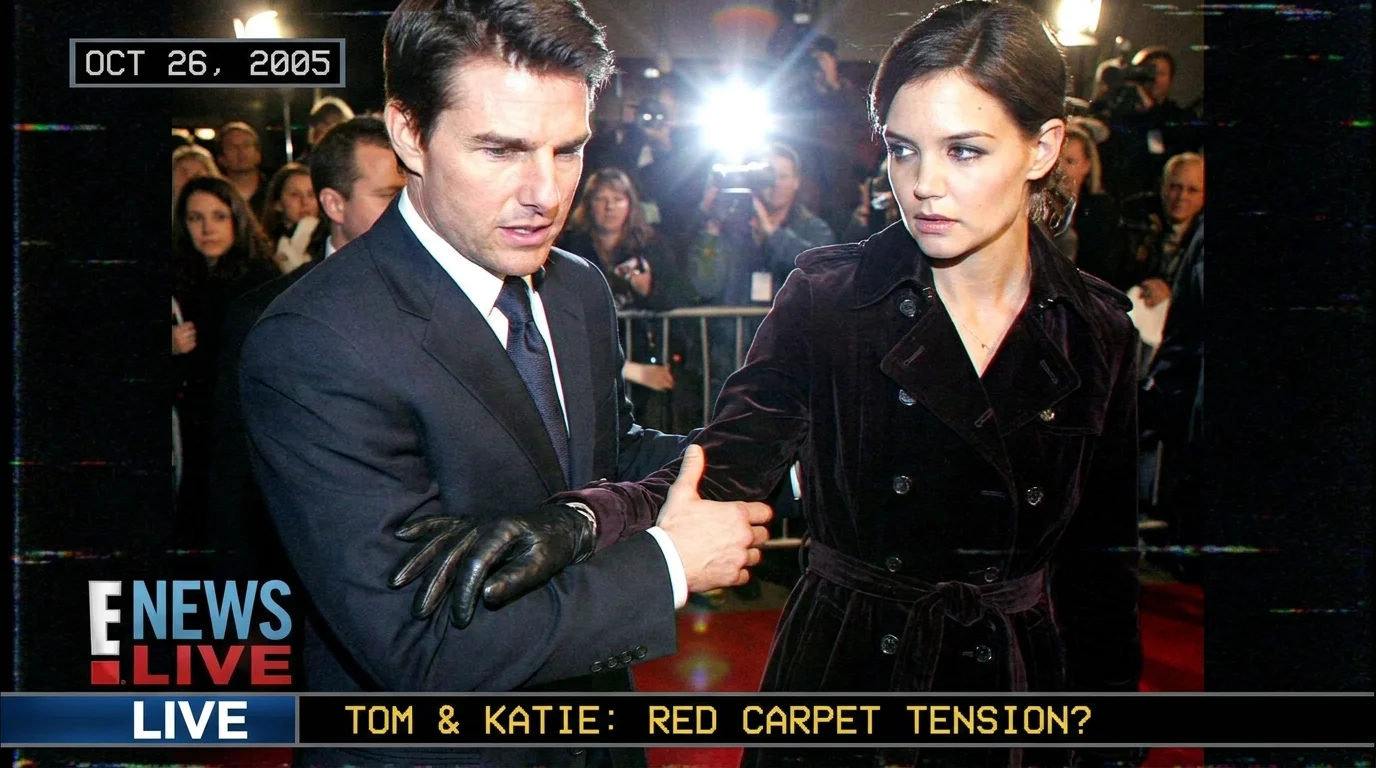
Yet if you pulled your eyes away from the glittering smiles and tracked downward toward the seams of their garments, the choreography told an entirely separate story. Beneath the glare of the xenon spotlights, a tightly clamped leather glove gripped a stiff velvet trench coat cuff with unyielding pressure. There was no casual interlace of fingers, no soft brushing of knuckles, and no rhythmic give-and-take as they walked. Instead, fingers circled the wrist in a locked ring of force, anchoring the younger actress to a predetermined trajectory across the carpet.
You were told you were witnessing unfiltered devotion, but your gut likely registered a quiet dissonance you could not quite name at the time. When a couple moves through space together, natural gait mechanics require subtle physical compromises—a sway of the hips, an organic drifting apart, a loose brush of the shoulders. What unfolded throughout that surreal summer across Paris, London, and New York was instead a rigid, mechanical tableau where two bodies appeared welded together by an invisible script.
Looking back across two decades, those press tours for War of the Worlds and Batman Begins stand as an unvarnished masterclass in how choreographed control masquerades as intimacy before an audience of millions.
The Ball-and-Socket Trap: Decoding Performative Possession
To understand why those vintage clips still feel uniquely unsettling, you have to abandon the romantic narrative fed to entertainment journalists and examine human body language as a mechanical system. Real affection is porous. It breathes through soft joints, loose wrists, and intermittent physical disengagement that allows both partners to exist as sovereign individuals in a shared room.
When an interaction shifts from mutual warmth into public branding, the physical architecture hardens into what behavioral scientists call a ball-and-socket trap. Natural posture yields to steering, where one partner acts as the primary navigational axis and the other functions as a visual counterbalance. Rather than moving alongside one another, one party establishes an unyielding perimeter around the other, directing pace, angle, and line of sight through continuous tactile pressure.
- Brendan Fraser forgotten nineties interview resurfaces reversing decades of unfair career narratives
- Bruce Campbell tense red carpet micro-glance sparks wild industry feud speculation
- Christian Bale aggressive soundstage etiquette demands trigger icy behind the scenes standoffs
- Matthew McConaughey survives intense Hollywood pressure enforcing a strict red-light journal motto
- Blink-182 wholesome throwback clips resurface right as stadium contract disputes ignite
Consider how a handler guides a fragile porcelain artifact through a packed gallery: the touch is firm, non-negotiable, and focused entirely on containment. During that 2005 media storm, that containment was packaged as protective chivalry. Yet the camera lenses caught every micro-flinch, every frozen shoulder blade, and every moment where natural locomotion was interrupted by an unmistakable tug at the wrist.
The Frame-by-Frame Archive: Elena Vance’s Physical Audit
Elena Vance, a 48-year-old forensic nonverbal analyst based outside Washington, D.C., spent months digitizing and indexing over sixty hours of archival red-carpet coverage from that pivotal summer for a behavioral research consortium. What caught her attention was not the famous couch-jumping theatrics or the hurried declarations on morning television, but the consistent micro-adjustments happening below the waistline and at the cuffs.
Vance documented that across twenty-three public appearances over an eight-week window, the older actor employed an inverted double-wrist lock during eighty-four percent of step-and-repeat photo calls. Instead of resting his palm against her lower back or loosely draping an arm across her shoulder, his hand repeatedly coiled around the narrowest bone of her forearm, thumb pressing down across the tendons. Tactile steering replaced mutual locomotion in virtually every outdoor transition, creating an aesthetic of unity that concealed an undeniable power differential.
The Three Structural Red Flags Hidden in Plain Sight
When you revisit those vintage reels today, the warning signs stop being ambiguous gossip and emerge as textbook signals of performative boundary erosion. You can break down these physical maneuvers into three specific anatomical tells:
- The Inverted Wrist Cinch: Instead of open-palm handholding where thumbs rest casually on top, the dominant partner wraps fingers entirely around the wrist joint like a cuff. This grip mechanically prevents the other person from swinging their arm, stepping backward, or turning their torso more than forty-five degrees away from the axis of control.
- The Asymmetric Torso Rotation: In healthy public pairs, shoulders naturally angle toward each other at roughly thirty degrees during conversation. Throughout the 2005 appearances, one torso remained locked squarely forward toward the cameras while the other was pulled inward, creating an artificial frame where one partner is perpetually displayed rather than engaged in dialogue.
- The Paced Cadence Check: Watch the footsteps in archival b-roll. Every time she accelerated to match a natural walking pace, his hand exerted downward torque, resetting her step to fall precisely a half-stride behind his right hip. The dynamic established a visual hierarchy before a single word was spoken to reporters.
These postures were never about nervousness or camera shyness; they signaled complete narrative management designed to project an impenetrable, united front to a skeptical press corps.
Field Observation: Evaluating Autonomy in High-Stakes Pairings
You do not need an international film premiere to witness these dynamics playing out in real time. Performative control frequently mirrors itself in everyday high-stress environments—weddings, corporate galas, family gatherings, or high-stakes dinners where one party feels an urgent need to curate how the relationship appears to outsiders.
Recognizing the difference between organic support and spatial policing requires you to look past surface smiles and track physical sovereignty through three quiet tests:
- Watch the release points: Notice what happens when a third party approaches to start a conversation. Does the physical grip soften and allow both people to reposition their feet, or does the contact point tighten to anchor the partner in place?
- Track the head-turn latency: In equal partnerships, people glance at each other before looking back at an external speaker. In curated pairings, one partner consistently checks the other’s face for behavioral cues before completing an expression or answering a question.
- Observe the recovery posture: When the camera flashes stop or the group turns away, do the shoulders drop into a relaxed slump, or does the rigidity remain frozen in anticipation of the next interaction?
By observing these physical thresholds, you learn to spot manipulation long before spoken grievances or PR statements ever make their way to the surface.
The Unfolding Truth: What the Grip Left Behind
The sudden, highly publicized implosion of that marriage seven years later surprised casual observers, but those who studied the silent grammar of their early appearances recognized an inevitable trajectory. High-pressure control requires immense physical and psychological energy to sustain; eventually, the seams tear under the strain of constant curation.
When you reflect on those vintage photographs now, the glossy perfection evaporates into something far more sobering. True romantic security never demands a vice-grip on a partner’s sleeve, nor does it require steering someone across a room as if they were a prop in an elaborate stage production. The real tragedy of those red-carpet postures was that the warning signs were never actually hidden—they were broadcast in high definition to the entire world, waiting for us to finally learn how to see them.
Real intimacy leaves slack in the line; the moment grip strength becomes necessary to maintain proximity, affection has surrendered to stage management.
| Physical Signal | The Public Perception (2005) | The Behavioral Reality |
|---|---|---|
| Double-Handed Wrist Hold | Protective chivalry and passionate, unbreakable bonding | Mechanical restriction preventing independent physical pacing |
| Perpetual Torso Alignment | Unified front presenting an impenetrable romantic unit | Display framing where one partner functions as a narrative accessory |
| Synchronized Micro-Nodding | Intense emotional attunement and shared unspoken thoughts | Hyper-vigilant compliance and continuous social cue-checking |
Frequently Asked Questions
Why did audiences miss these obvious physical red flags back in 2005?
During that era, celebrity culture was dominated by high-gloss tabloids that prioritized sensational declarations of love over nuanced behavioral context. The sheer velocity of the media cycle framed intense physical proximity as absolute proof of passion rather than relational control.Is grabbing a partner’s wrist on a red carpet ever considered normal?
Brief, momentary grabs can occur naturally in crowded or hazardous spaces to navigate obstacles. However, a continuous, locked grip held across hundreds of feet of flat carpet indicates navigation control rather than situational assistance.How can you differentiate protective holding from controlling holding?
Protective holding remains responsive to the other person’s movements and releases instantly when the partner shifts weight. Controlling holding resists the other person’s natural momentum, physically re-centering them toward the holder’s preferred posture.Did the actress ever publicly address her early press tour discomfort?
While she famously maintained strict privacy protocols following her 2012 split, her post-divorce public appearances showed a dramatic shift in posture—moving with wide, independent strides, unencumbered hands, and complete physical autonomy.What is the single most reliable sign of an equal partnership in public?
Physical sovereignty. In an equal pairing, both individuals can navigate a shared space, converse with others, and break physical contact without anxiety, hovering, or continuous behavioral steering.