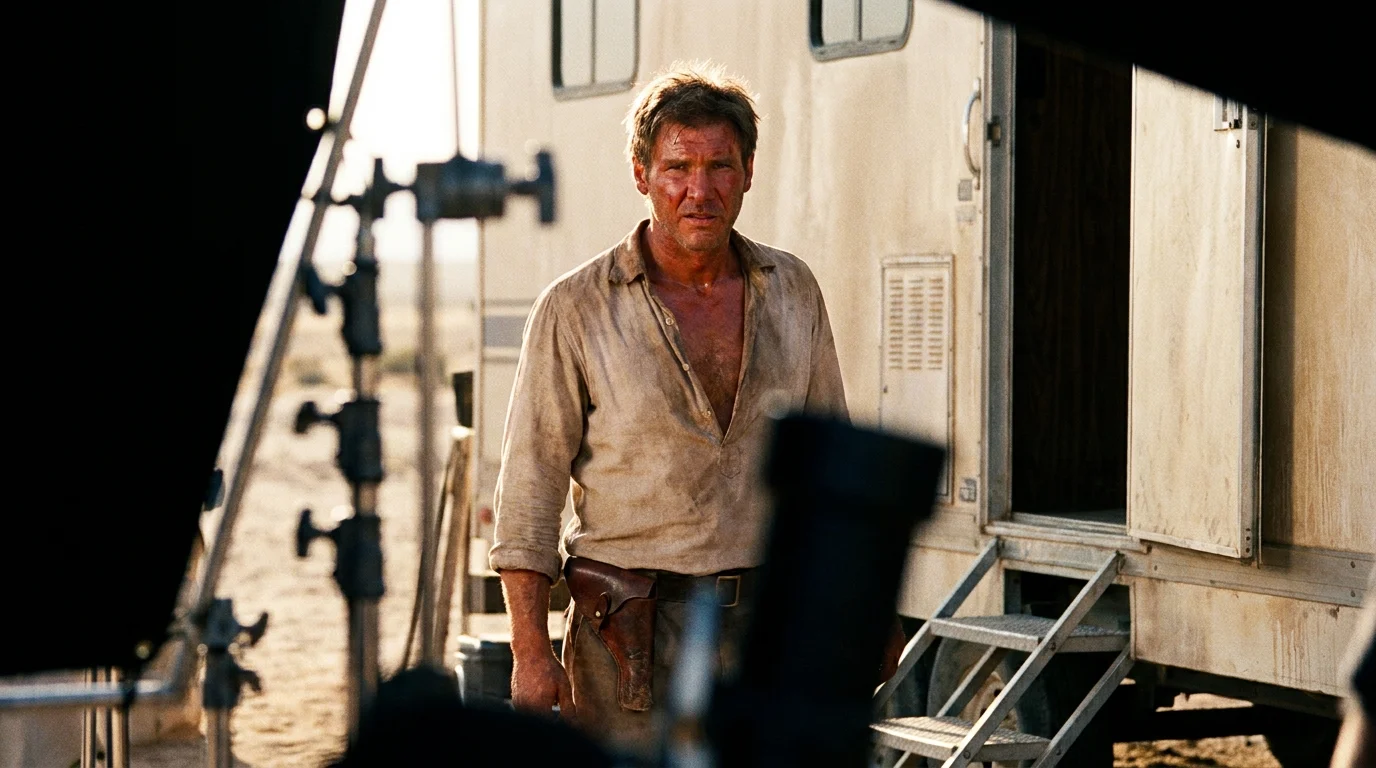
The heat inside the market square in Kairouan did not drift; it pressed down like a wet wool blanket left out in the noon sun. You can picture the sweat soaking through heavy cotton, turning pale fabric into a sticky film glued to skin. Around the set, the dry wind blew grit across the cobblestones, leaving a fine reddish layer over camera lenses, leather holsters, and swollen eyelids. Every breath felt like inhaling warm ash.
You have likely watched that frame a dozen times: a towering assassin clad in black robes flourishes an enormous scimitar with theatrical precision, grinning through a dazzling display of blade work. The crowd parts. The hero sighs, visibly drained, reaches to his hip, pulls out a revolver, and simply ends the contest with a single pull of the trigger. It remains one of cinema’s sharpest punchlines, sparking laughter because it punctures Hollywood pageantry with dry, exhausted pragmatism.
Yet that moment was never supposed to happen that way. The production schedule had set aside three brutal days to film an intricate, frame-by-frame acrobatic duel between whip and curved steel. Stunt coordinators had drilled the sequence until their muscles seized, preparing a centerpiece showcase of athletic choreography that would match the studio’s expectations for blockbuster spectacle.
What collapsed that three-day plan was not an artistic epiphany cooked up in an air-conditioned trailer, but pure, unvarnished physical misery. A sweaty linen tunic covered in red Tunisian dust became the uniform of an actor who could barely stand upright for more than ten minutes without needing a production restroom, forcing a sudden collision between storybook heroics and raw bodily endurance.
The Geometry of Exhaustion: Rethinking Scripted Perfection
Pop culture trains you to view great film moments as the result of obsessive control. You are taught that timeless art requires every gesture, shadow, and cadence to be locked into place months before cameras roll. When an action sequence clicks on screen, the natural instinct is to credit hundreds of storyboard panels, endless rehearsals, and absolute technical obedience to the script.
Real creative clarity, however, works more like pruning dry branches in high summer. When human energy hits zero, theatrical pretense falls away. In the middle of that Tunisian heatwave, the ambient air hovered near 100 degrees Fahrenheit, and dysentery had hollowed out the crew. Harrison Ford had lost weight, his stomach cramping violently between takes while the sun baked his leather jacket.
- Samuel L. Jackson enforces strict unfilmed kitchen table boundaries protecting a four-decade marriage
- Tom Cruise Katie Holmes vintage press tour postures expose glaring early relationship red flags
- Brendan Fraser forgotten nineties interview resurfaces reversing decades of unfair career narratives
- Bruce Campbell tense red carpet micro-glance sparks wild industry feud speculation
- Christian Bale aggressive soundstage etiquette demands trigger icy behind the scenes standoffs
Facing the prospect of swinging a bullwhip across several days of complex physical blocking, Ford recognized a fundamental truth about storytelling: characters are most compelling when they behave like living, breathing people rather than indestructible mannequins. An archaeologist who has spent hours running through hostile streets would not perform an acrobatic dance when he has an easier option in his holster. The physical limitation cut straight through the clutter of excessive staging.
The Desert Standoff: An On-Set Whisper
Consider the account of Terry Leonard, a legendary 39-year-old stunt coordinator who had spent weeks tuning the fight’s kinetic balance. Leonard had rehearsed the whip-against-sword sequence until the beats were razor-sharp, coordinating with British stuntman Terry Richards, who spent months mastering the heavy scimitar maneuvers. Richards had practiced slicing melons in mid-air, eager to deliver the performance of his career. When Ford walked over to director Steven Spielberg during a lunch break, pale and nursing a cup of tea, he asked a quiet question: ‘Why don’t we just shoot the sucker?’ Spielberg paused, checked the ticking production clock, turned to the crew, and called for a camera setup that wrapped the scene before afternoon shadows lengthened.
Reading the Layers: The Art of Knowing When to Stop
Understanding this pivot offers a masterclass in how practical constraints create cultural landmarks. You can break the anatomy of an improvised breakthrough into distinct creative layers:
The Pragmatist’s Instinct
When resources or stamina dwindle, simplify the core objective. Indiana Jones did not need to prove his athletic superiority; he merely needed to survive the marketplace. By letting the character react with irritation rather than theatrical vigor, the performance anchored the entire franchise in relatable human fatigue.
The Respect for Momentum
Film sets burn tens of thousands of dollars an hour. Choosing an immediate, blunt resolution preserved the physical safety of a dehydrated cast while saving nearly seventy-two hours of grueling desert production. True artistic mastery involves protecting your crew from pointless friction whenever a simpler truth presents itself.
The Subversion of Expectation
Audiences in 1981 expected another drawn-out Errol Flynn swordplay tribute. Instead, the sudden gunshot subverted the classic swashbuckler trope, creating an instant archetype: the weary professional who refuses to play along with someone else’s melodrama.
The Editor’s Discipline: Applying the Cut to Your Own Work
You do not need to stand in the Sahara to face your own bloated productions. Whether you are drafting a complex business presentation, arranging a living space, or planning a week of work, the temptation is always to add more complexity, more steps, and more display.
Real problem-solving demands that you recognize when exhaustion is actually delivering valuable guidance. Strip down your workflow with deliberate, focused intention:
- Identify the decorative flourishes in your routine that consume hours without moving your central goal forward.
- Pay attention to physical friction; persistent dread or physical fatigue usually flags a system that is over-engineered.
- Ask the basic question Ford posed: what is the single most direct action that resolves this tension right now?
- Trust your audience to appreciate brevity; people remember swift resolutions far longer than self-indulgent demonstrations.
By treating limitations as a filter rather than a failure, you remove the artificial noise that drags projects into stagnation.
The Enduring Power of the Honest Reaction
We celebrate that market confrontation because it mirrors our own desire to bypass unnecessary theater. Life often throws elaborate swordsmen into our daily paths—overly formal meetings, performative social rituals, and convoluted solutions to straightforward problems. Watching Indy draw his weapon feels like sweet relief because it honors reality over script.
Next time you find yourself bogged down in an exhausting routine that seems too big to simplify, remember that dust-choked square in Tunisia. The most legendary solution in film history was born because a tired man admitted he was too sick to fake a fight, choosing honesty over choreography.
The sharpest answers arrive the moment you stop performing for the room and simply solve the problem in front of you.
| Key Point | Detail | Added Value for the Reader |
|---|---|---|
| The Cairo Encounter | Original script demanded a three-day whip-versus-blade duel. | Shows how traditional plans often default to unnecessary spectacle. |
| The Physical Reality | Ford suffered severe dysentery in 100-degree desert heat. | Demonstrates that physical exhaustion can reveal practical efficiency. |
| The Creative Result | Spielberg captured the iconic gun draw in just two takes. | Proves that eliminating excess builds lasting impact. |
Frequently Asked Questions
Was the swordsman actor upset about his scene being cut short?
Terry Richards was initially disappointed after practicing for months, but he later embraced the role when he realized the scene became one of the most famous moments in film history.Did Steven Spielberg immediately agree to Harrison Ford’s idea?
Yes. Spielberg was also contending with tight schedules, budget constraints, and widespread crew illness, making the rapid setup an instant relief for the entire set.How sick was the production crew in Tunisia?
Nearly the entire British and American crew fell ill from local water and food, with only Spielberg largely avoiding sickness by consuming canned food brought from England.Did the script originally include the revolver at all?
The revolver was always on Indy’s hip, but the script intended for him to lose it or focus entirely on using his bullwhip to disarm the scimitar.Why does this scene resonate so strongly with modern viewers?
It strips away cinematic invulnerability, presenting an action hero who is tired, pragmatic, and unwilling to waste time on theatrical posturing.