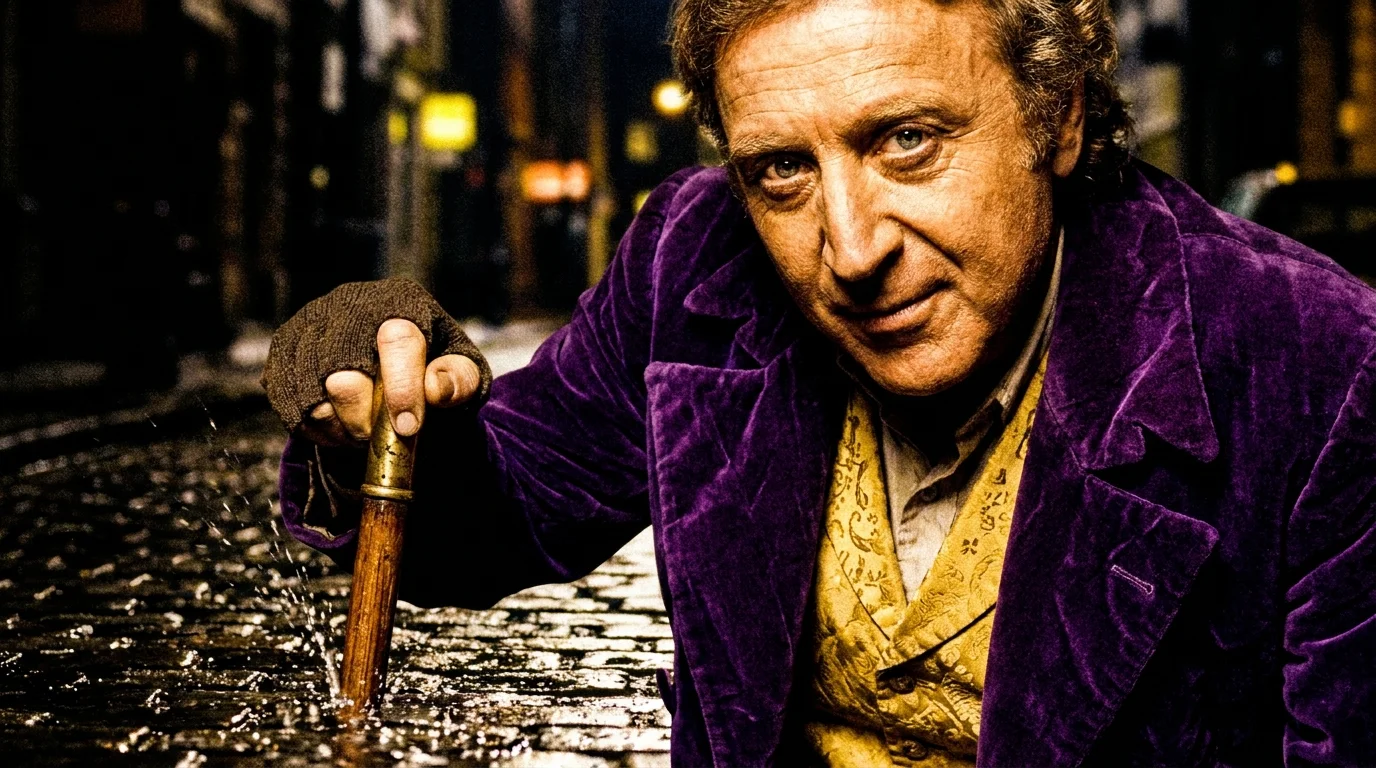
The sound comes first. It is the rhythmic, sharp tap of a brass ferrule hitting cold stone, slow and deliberate, cutting through the murmurs of a Bavarian town square. You watch an eccentric recluse emerge from behind heavy iron gates, clad in plum velvet and a tilted top hat. His shoulders sag under unseen weight. One foot drags heavily behind the other, dragging an agony of steps toward an expectant crowd of children and parents whose breathing tightens with every agonizing yard.
Then, the wooden stick catches. A wooden cane clatters against polished cobblestones as it lodges firmly between two granite setts. For a split second, the frail confectioner totters forward, off balance, pitching into an uncontrolled swan dive toward the pavement. The gasps from the gathered crowd were not rehearsed. The horror on the faces of the background extras was pure, instinctual dread.
Instead of the sickening crunch of bone against cobble, the man tucks his chin, extends his palms, and rolls seamlessly across the street. He pops upright in an athletic coil, spreading his arms with a mischievous, velvet-smooth bow. In seven seconds, the entire premise of the story shifts. You realize that you cannot trust a single gesture, inflection, or smile that follows.
The Architecture of Intentional Deceit
Most viewers assume legendary cinematic beats are mapped meticulously on whiteboards by committee or born from an auteur director’s obsessive storyboard. We tend to view film acting as obedience—an interpreter following marks painted in yellow tape on a studio floor. Yet this singular moment was not born out of director Mel Stuart’s playbook, nor did it live anywhere within the pages of Roald Dahl’s original manuscript.
The somersault was an ultimatum. It was an uncompromising creative boundary drawn by an actor who understood that a character dealing in pure fantasy becomes hollow the second his motives turn predictable. Consider the metaphor of a magician’s sleeves: if you know the sleeves are empty, the illusion turns mechanical; if you suspect a hidden compartment, wonder survives. Gene Wilder built that hidden compartment right into his character’s spine.
- Sarah Jane Nader switches red carpet looks for vintage leather Saint Laurent coats
- Pierce Brosnan enforces absolute privacy rules protecting his thirty year marriage on secluded sandy shores
- Kristen Stewart and Robert Pattinson junkets trap obvious couple strain behind cold crossed arms
- Megan Fox resurfaced vintage interview reversed early blacklisting narratives amidst harsh studio laughter
- Travis Kelce Manhattan date footage reveals unscripted sidewalk tension through rigid arm placement
The Munich Showdown: Gene Wilder and Mel Stuart
In the late summer of 1970, director Mel Stuart traveled to London to audition potential frontrunners for the title role in Willy Wonka & the Chocolate Factory. Stuart sat through dozens of readings by polished stage veterans who played Wonka as either a jovial candy uncle or a menacing Victorian ghoul. When thirty-seven-year-old Gene Wilder walked into the room, he gave a quiet, layered reading that stopped Stuart in his tracks. Stuart allegedly chased Wilder out to the elevator, begging him to accept the part on the spot.
Wilder smiled, paused by the brass lift doors, and gave a calm, non-negotiable counteroffer. He demanded absolute control over Wonka’s arrival on screen. When Stuart asked him why such a strange slapstick gag mattered so intensely, Wilder offered an insight that defines masterclass character work: from that moment forward, no one would ever know whether he was lying or telling the truth. Stuart agreed instantly. Had he balked, the film would have lost its beating, unpredictable heart.
Anatomy of the Unscripted Pivot
Wilder’s maneuver offers a study in how subtle friction alters an audience’s perception. In narrative art, as in daily human communication, establishing total clarity upfront often creates monotony. When you introduce controlled instability, attention spikes.
The Mechanical Misdirection
By feigning extreme physical frailty, Wonka exploits the human instinct for sympathy. You lean in, lowering your emotional defenses because you believe you are observing vulnerability. The sudden athletic recovery snaps the viewer out of passive sympathy and forces them into active wariness. You become a participant rather than a spectator.
The Psychological Shield
The somersault freed Wilder from playing Wonka as a typical hero or villain. It introduced calculated behavioral ambiguity that protected the performance throughout production. Every line delivery—from his cold, indifferent shrug when an insufferable child falls into a chocolate river to his explosive monologue at the story’s climax—carries the ghost of that opening roll. You are always asking yourself: is he furious, or is this another tumble?
The Creator’s Tactical Toolkit
Applying this level of deliberate unpredictability does not require a Hollywood backlot or a purple coat. Whether you are staging a presentation, drafting a story, or managing personal authority in a tense room, tactical dissonance can shift the power balance entirely.
- The Delayed Reveal: Never telegraph your full capability during an initial greeting. Let people estimate your energy before you deliberately shift gears.
- The Strategic Vulnerability: Reveal a minor flaw or limitation early on. It disarms competition and makes your subsequent competence feel sharper and more earned.
- The Rhythmic Break: If your environment expects quiet compliance, inject a moment of brisk, focused physical decisiveness. Disruption resets room dynamics instantly.
- The Unreadable Baseline: Keep your genuine motives wrapped in calm politeness. When people cannot categorize your intentions in thirty seconds, they pay intense attention to everything you say.
The Longevity of Controlled Chaos
True creative presence is rarely about doing what the script dictates. It lives in the spaces between lines, in the quiet rebellion of an artist refusing to let their work be easily filed away on an emotional shelf. Great art demands an edge of uncertainty where the audience feels just slightly unsettled.
Wilder knew that the moment an audience thinks they own a character, the magic evaporates. By refusing to let you decide if Wonka was a saint, a sadist, or a lonely genius playing an elaborate prank, he kept the gates of that chocolate factory open forever. Every time the cane clatters against the cobbles, we still hold our breath, secretly waiting to see if he will catch himself this time.
One carefully planted doubt creates more intrigue than a library of explanations.
| Key Point | Detail | Added Value for the Reader |
|---|---|---|
| The Audition Ultimatum | Wilder refused to sign the contract unless the limping cane somersault was written into the production schedule. | Illustrates how creative leverage can be wielded before accepting a binding agreement. |
| The Psychological Function | The gag deliberately shattered the audience’s ability to discern Wonka’s honesty throughout the entire film. | Demonstrates how a single visual metaphor can define hours of subtext. |
| The Physical Execution | Wilder worked with physical stunt coordinators in Munich to ensure the fall looked genuinely clumsy before the flip. | Emphasizes that effective unpredictability requires precise rehearsal rather than sloppy spontaneity. |
Frequently Asked Questions
Did Roald Dahl support Gene Wilder’s somersault entrance?
Dahl was famously protective of his original book and had several creative disagreements with the adaptation, but the entrance was an addition negotiated entirely between Wilder and director Mel Stuart during pre-production casting.Were the child actors warned that Wilder was going to roll?
While the production crew knew the stunt was coming, many of the young actors and background extras on the street were not given specific details about the timing, resulting in genuine shock when he pitched forward.Did Gene Wilder perform the somersault himself?
Yes. Wilder had extensive theatrical movement training from his time at the Bristol Old Vic Theatre School, which allowed him to execute the tumble cleanly without a stunt double.Why was this scene so critical to Wonka’s character arc?
Without the entrance, Wonka could easily have come across as either purely malicious or purely benign. The trick established that every moral test inside the factory was mediated by an unreliable narrator.Can creators apply this technique outside of acting?
Yes. The principle of introducing strategic ambiguity works in public speaking, narrative writing, and brand positioning by subverting predictable formats to command focused attention.