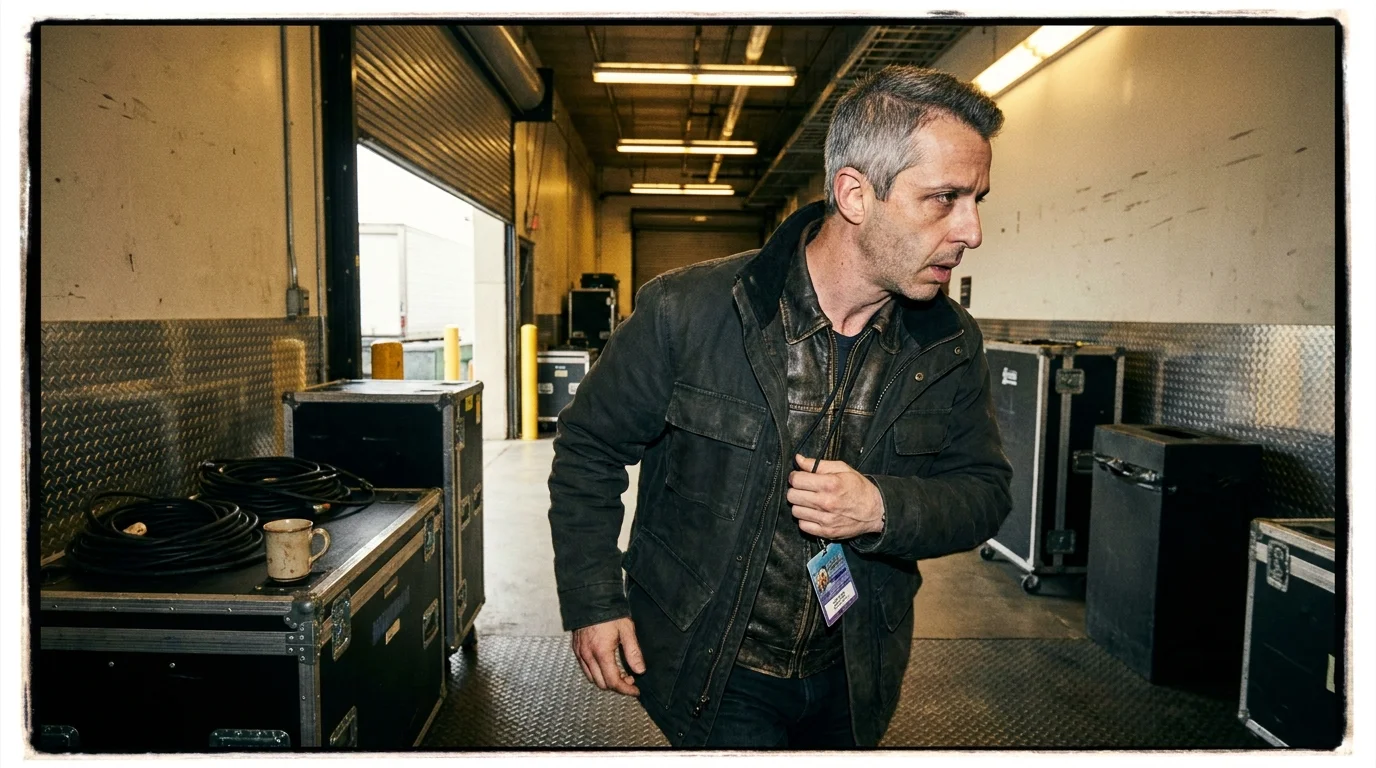
A soundstage at dawn smells faintly of scorched electrical tape, cooling tungsten bulbs, and yesterday’s stale filter coffee. On most commercial productions, the thirty minutes before the first camera slate are filled with low, companionable rumble: boom operators swapping stories about their weekend commutes, teamsters adjusting fold-out chairs, and hair stylists trading quick quips across rolling carts. It is an unglamorous, blue-collar rhythm that keeps a twelve-hour workday bearable.
Then the air changes. On sets commanded by the unrelenting discipline of extreme process, that ordinary hum thins out until you can hear the hum of the air-conditioning unit overhead. Cold ceramic coffee mugs sit abandoned on craft service tables because nobody wants to clatter a spoon while an actor paces off-camera, nursing an engineered personal grief that must not be interrupted by casual human contact.
When Jeremy Strong works, the room doesn’t just quiet down; it freezes over. What film school lore frames as sublime dedication often registers to the seventy-person technical crew as an icy wall of silence. For years, prestige television celebrated this brand of solitary torment as the ultimate artistic virtue. Yet beneath the trade-paper profiles, a quiet rebellion has taken root across soundstages from Queens to Atlanta, questioning who actually pays the emotional bill for one performer’s unbroken trance.
The folklore of complete transformation suggests that great work demands total estrangement from reality. In practice, walking past an electrician who has spent four hours hanging heavy diffusers without making eye contact does not heighten the art—it changes the physics of the workspace. It turns a collaborative guild into a court walking on eggshells around an unpredictable sovereign.
The Ghost Town Protocol: When Devotion Becomes a Barrier
Consider a soundstage as an open-plan mechanical workshop rather than a church. When a lead actor requires absolute behavioral insulation, the entire nervous system of the crew must rewire itself to accommodate that perimeter. Rigid emotional perimeters inevitably break the natural rhythm of ensemble problem-solving.
In theater, this is sometimes called the greenhouse effect: an artificial atmosphere pumped with bespoke moisture while the surrounding vegetation dries out. The tension does not stem from someone being difficult or screaming in a trailer. Rather, it is the quiet, immovable refusal to engage in the minor courtesies that signal physical and psychological safety on a set. When an actor refuses off-camera greetings, asks crew members not to look in their direction during reset walks, or leaves scene partners acting against a disembodied tape mark, the production stops operating as a team and becomes a holding cell for private tension.
- Hailey Bieber triggers podcast tearful breakdown right before launching sticky glazed lip gloss
- Channing Tatum strips studio franchise contracts bare after sci-fi bomb leaves smoky wreckage
- Gene Wilder forces iconic Willy Wonka entrance demanding a limping cane somersault
- Sarah Jane Nader switches red carpet looks for vintage leather Saint Laurent coats
- Pierce Brosnan enforces absolute privacy rules protecting his thirty year marriage on secluded sandy shores
Sarah Lin, a 44-year-old veteran production coordinator who spent twelve years managing camera packages on prestige dramas, remembers the day the silence became an active liability. “We were running behind schedule in upstate New York, shooting on wet pavement as daylight evaporated,” Lin explains. “The lighting team needed forty seconds to tell the lead that a c-stand foot was two inches from his mark. But nobody was permitted to speak directly to him or break his cadence. That thirty-second safety check turned into a twenty-minute whisper chain through two assistant directors, daylight vanished, and seventy crew members had to come back at four in the morning to do it again in the freezing rain.”
The Collision Layers: Process Versus the Collective Crew
Total absorption does not affect every department equally. The burden falls in distinct waves, moving outward from the camera lens to the parking perimeter.
For the Direct Scene Partner
Acting is fundamentally an exchange of micro-cues. When one performer refuses to break character between takes, the other must choose between staying on guard for twelve continuous hours or retreating into self-defense. The conversational generosity evaporates completely, leaving scene partners to navigate unscripted volatility without the underlying trust that says, *we are just pretending.*
For the Camera and Boom Operators
Camera operators rely on predictable physical geography. An actor living entirely inside an unpredictable internal wave often discards blocking marks, spins unexpectedly away from key lights, or ignores microphone throw distances. For the camera technician holding a thirty-pound rig on their shoulders, sudden erratic movements are not artistic surprises; they are spinal hazards and ruined takes that burn production capital.
For the Grip and Electric Departments
These are trades governed by physical reality: ballast weights, heavy steel, and high voltage. When a set adopts a no-eye-contact directive, the practical dialogue required to keep people safe gets choked off. Simple warnings about hot cables or shifting dollies are deferred, creating an environment where basic physical reality takes a back seat to emotional atmosphere.
Mindful Collaboration: Balancing Rigor with Workplace Reality
Stripping away the collateral damage of deep-immersion craft does not require sacrificing performance intensity. It simply demands that an artist separate interior focus from external friction. True mastery is an internal dial, not an environmental weather system that forces everyone else to put on a coat.
High-tier character work can coexist with humane production dynamics when clear operational boundaries replace unwritten social bans. The craft deepens when an actor treats their fellow workers as partners rather than distractions.
- Establish the focus perimeter: Agree in pre-production that silence applies only inside the tape lines, keeping staging lanes open for normal technical banter.
- Preserve the reset courtesy: Maintain a designated, brief physical signal to let crew members know you are ready for a safety touch-up or battery swap without needing verbal negotiations.
- Differentiate intensity from isolation: Channel emotional weight through the eyes in the frame rather than broadcasting distance across the lunch line.
The Tactical Toolkit for a Sustainable Ensemble:
- Transition Window: 90 seconds. A deliberate, silent reset between “cut” and the next setup, allowing technical crews to work unburdened.
- Safety Buffer: 3 feet. A physical radius reserved exclusively for emergency equipment adjustments where direct speech is non-negotiable.
- The Check-In Anchor: 1 daily moment. A single, human nod to the camera team before rolling the morning’s first shot, confirming shared alignment.
The Room Beyond the Character
The myth of the isolated genius relies on an outdated premise: that art only counts when everyone in the room bleeds for it. But film is not a solitary canvas. It is a massive, highly coordinated mechanical ballet performed by carpenters, drivers, focus pullers, and focus-puller apprentices.
Generosity remains the rarest asset in modern screen culture. When a performer learns how to summon towering emotional depths while still stepping aside for a grip pushing an eighty-pound dolly, the work does not soften. It sharpens. It recognizes that preserving the human dignity of the room is not a compromise—it is the very foundation that allows great drama to happen in the first place.
“True virtuosity on a soundstage is having the discipline to hold your fire until the slate clicks, without making everyone around you carry the ash.”
| Key Point | Detail | Added Value for the Reader |
|---|---|---|
| The Isolation Tax | Total character stay creates logistical bottlenecks and stalls communication. | Explains why high-profile productions quietly slip behind schedule. |
| Crew Resentment | Silence mandates alienate the blue-collar teams maintaining physical safety. | Decodes the real friction behind celebrated celebrity profile narratives. |
| Integrated Craft | Modern prestige actors are shifting toward high-focus, high-courtesy workflows. | Provides a clear blueprint for maintaining intensity without creating toxicity. |
Frequently Asked Questions
Does Jeremy Strong’s method actually produce better performances?
Critics and awards bodies have repeatedly validated his screen output, yet veteran peers argue that identical dramatic results can be achieved without imposing emotional silence on the surrounding workplace.Why do directors allow extreme isolation on set?
Directors often protect lead actors who deliver high-tier emotional stakes, gambling that the finished footage will justify the daily friction experienced by the crew.How do crew members typically react to no-talk rules?
Reactions range from professional resignation to deep frustration, as silence orders slow down rigging speeds and make routine safety adjustments far more difficult.What is the difference between focus and on-set isolation?
Focus is an internal boundary that lets an artist preserve concentration; isolation is an external mandate that forces the entire physical environment to alter its behavior.Is the industry moving away from this approach?
Yes. Newer ensemble productions increasingly value emotional stamina, safety, and team transparency over singular, disruptive transformation protocols.