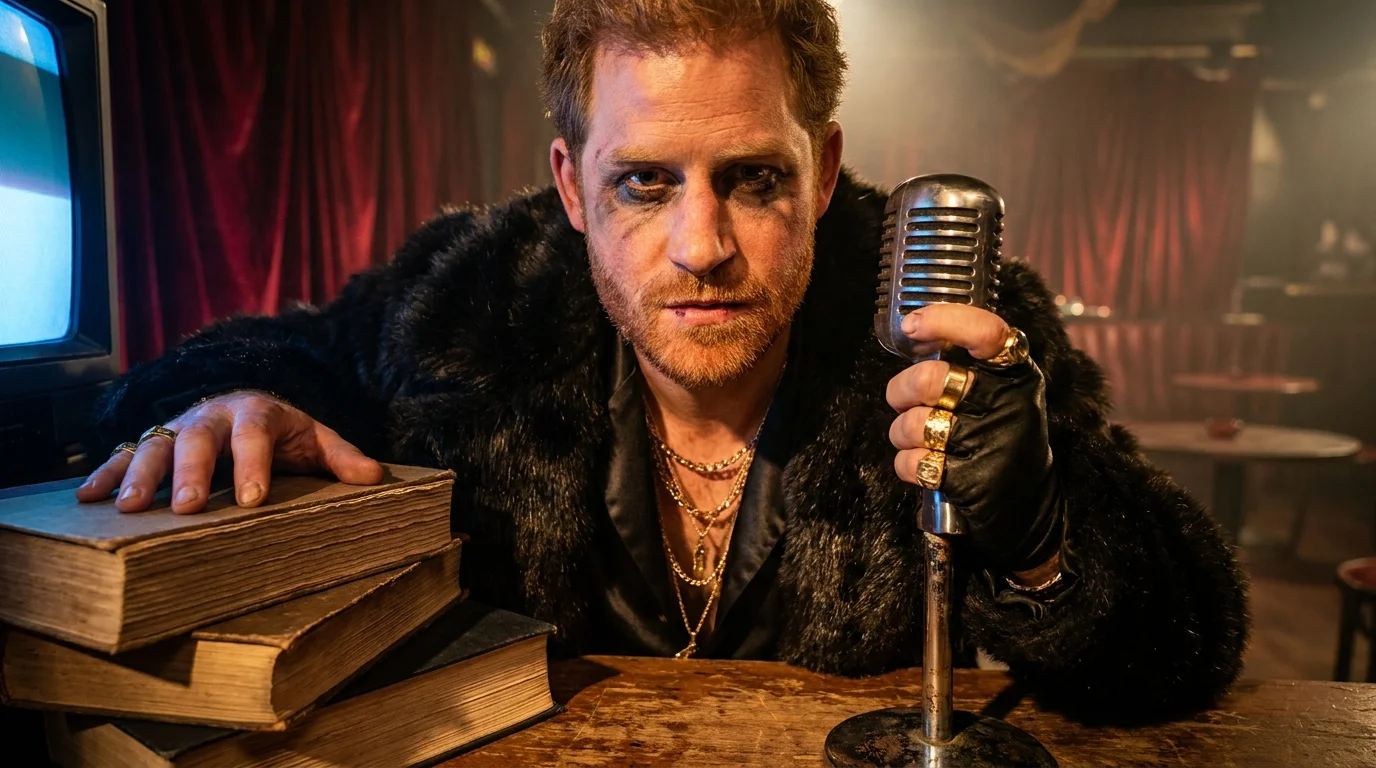
You run your thumb over the rough, deckled paper edges of a fresh hardcover resting flat against a mahogany desk. The sharp smell of binding glue and fresh ink fills the room, carrying the tactile promise of pure, unvarnished confession. When you open a celebrity tell-all, you expect to hear an intimate voice whispered directly into your ear, stripped of handlers, courtiers, and institutional filters.
Yet as the sentences begin to click across the page, a peculiar rhythm takes hold. The narrative does not meander like spontaneous memory; it snaps with the crisp precision of a finely tuned drumbeat. The sentences arrive in measured cadences—taut, cinematic, and sharply observant—carrying the distinct hum of an invisible architectural hand quietly working behind the scenes.
When Prince Harry released his record-shattering memoir, readers across the globe braced for palace scandal. What literary purists and sharp-eyed observers found instead was a masterclass in American narrative journalism, disguised under royal livery. The voice felt vivid, painful, and raw, but the structural scaffolding belonged unmistakably to someone else.
The cultural illusion of the celebrity autobiography relies on a gentle pact between reader and subject. You suspend your disbelief, pretending a global icon spent six months alone at an antique desk wrestling raw emotion onto parchment. In reality, the most compelling modern memoirs operate more like bespoke portraiture, where a seasoned literary translator transforms raw memory into indelible, high-velocity narrative art.
The Ghost in the Mirror: Deconstructing the Cadence
Consider the craft of literary ghostwriting not as deception, but as structural acoustics. When you speak into a cavernous hall, your words scatter and lose their force unless sound engineers install baffles and directional mics. A celebrity possesses the raw acoustic volume—the trauma, the lineage, the front-row seat to history—but rarely the technical training required to shape that noise into enduring literature.
Enter J.R. Moehringer. Long before he sat down across from Prince Harry in a Montecito guest cottage, Moehringer had established a signature fingerprint across American letters. From his own coming-of-age masterwork, The Tender Bar, to his transformative collaboration on Andre Agassi’s seminal memoir, Open, Moehringer’s prose style carries unmistakable hallmarks: muscular verbs, sharp staccato triplets, and an obsession with memory as a fickle, shimmering beast.
- Elisabeth Moss demands unfiltered rough skin close-ups stripping glossy Hollywood beauty standards bare
- Taylor Swift stops massive stadium concert after sudden in-ear monitors emit piercing screech
- Hayden Christensen resurfaced vintage tapes flood feeds blocking bitter studio contract disputes
- Madison Beer sparks massive superfan backlash after agency script leaks into shaky livestream
- Jeremy Strong enforces absolute method isolation triggering icy backstage silence across film sets
Clara Vance, a 44-year-old developmental editor based in Chicago, recalls analyzing the opening chapters of Harry’s manuscript on the morning of its release. Within twenty pages, she noticed the unmistakable syncopation: the deliberate sentence fragments, the sensory-heavy focus on physical cold and military boots, and the philosophical weight granted to ordinary objects. It was the exact syntactic pulse that turned Agassi’s hatred of tennis into high tragedy a decade earlier.
The Anatomy of Moehringer’s Fingerprint
To understand why Harry’s prose sparked such immediate recognition among book critics, you have to look at the structural mechanics beneath the royal revelations. Great ghostwriters leave footprints even when they tread on tiptoe.
The stylistic crossover reveals itself through specific narrative habits:
The Rapid-Fire Triad: Moehringer favors rolling groups of three short, punchy declarative statements to punctuate an emotional realization. You see it when Harry describes the cold stone hallways of Balmoral, just as readers saw it when Agassi surveyed the baseline in Flushing Meadows. The sequence creates immediate kinetic momentum, dragging your eye relentlessly forward.
The Metaphorical Anchor: In both texts, abstract feelings are pinned down by brutally tangible items. A father’s distance is not described through psychology; it is etched into the smell of an old tweed coat, the clinking of bath oils, or the exact weight of a polo mallet in hand. The prose relies on brutally specific sensory anchors to manufacture unassailable authenticity.
The Reluctant Confession: The narrative persona never boasts; it confesses. By framing the protagonist as an imperfect, often bewildered observer trapped within an indifferent system, the text disarms your skepticism. This emotional posture is Moehringer’s greatest invention, transforming polarizing multi-millionaires into sympathetic literary underdogs.
Reading Between the Lines: A Field Guide to Collaborative Prose
You can train your ear to spot the seams where a celebrity’s spoken memory ends and a master journalist’s typewriter begins. The next time you pick up a high-profile memoir, apply these subtle analytical lenses:
- Listen to the breath pauses: Read a page aloud. Spoken speech wanders and repeats; ghostwritten prose breathes with metronomic regularity. If the paragraphs land like poetry, you are hearing an elite copy editor’s internal metronome.
- Audit the sensory verbs: Count how often a scene leans on sight versus touch, smell, and temperature. Amateur writers default to visual descriptions; veteran ghostwriters anchor scenes in kinetic sensations—the burn of freezing air in the lungs, the vibration of a car door closing.
- Track the cinematic scene cuts: Notice how conversations rarely have messy beginnings or trailing endings. In Harry’s account, dialogue begins precisely at the flashpoint and cuts away before anyone clears their throat. That is screenwriting discipline, not total recall.
By dissecting these textual flourishes, you stop reading like a passive spectator and start observing the hidden machinery of celebrity storytelling.
The Value of the Polished Truth
Recognizing the presence of a ghostwriter does not diminish the emotional honesty of Harry’s story; it clarifies it. Memory is chaotic, fragmented, and notoriously ungrammatical. If Prince Harry had drafted his personal trials alone, the result likely would have read like an erratic defensive brief, weighed down by palace grievances and legalistic qualifiers.
Instead, by placing his memories into the hands of a Pulitzer Prize-winning craftsman, Harry achieved something far more durable than tabloid revenge. He purchased permanence. The rhythmic, clipped prose gives his childhood sorrows and adult rebellions a timeless, mythic weight that raw grievance could never accomplish on its own.
When you close the book, setting its deckled edges back down, you realize that authenticity in modern publishing is not about doing the heavy lifting alone. It is about knowing whose hands can hold the weight of your story without letting it drop.
Prose cadences do not lie; when an uncredited master builds the room, the walls always echo with their craft.
| Key Point | Detail | Added Value for the Reader |
|---|---|---|
| Voice Architecture | The transition from spoken interviews to rhythmic narrative cadences. | Learn to separate raw personal fact from high-level stylistic polish. |
| The Moehringer Touch | Muscular verbs, sensory triplets, and tactile memory anchors. | Recognize elite publishing fingerprints across different celebrity memoirs. |
| Narrative Economy | Trimming rambling spoken memories into cinematic scene transitions. | Understand how editorial discipline shapes empathy and public perception. |
Frequently Asked Questions
Did Prince Harry hide the fact that he used a ghostwriter?
No. Harry acknowledged J.R. Moehringer warmly in the book’s acknowledgments, honoring his tireless partnership, even though Moehringer’s name does not appear on the front cover.Why do publishers keep ghostwriters off the front cover?
Putting a co-writer’s name on the front jacket breaks the psychological spell of pure intimacy between the subject and the reader, potentially softening commercial sales.How can you tell Moehringer’s style apart from other ghostwriters?
Look for stark, cinematic scene transitions, visceral physical descriptions of sports or combat, and an obsession with complicated father figures.Does using a ghostwriter make a memoir less true?
Not necessarily. A skilled collaborator acts like a courtroom sketch artist, capturing the precise contours and emotional truth of memories that the subject lacks the craft to paint alone.How much do top-tier celebrity ghostwriters get paid?
Elite memoirists like Moehringer can command advances upwards of seven figures, reflecting their ability to turn sensitive interviews into guaranteed global blockbusters.