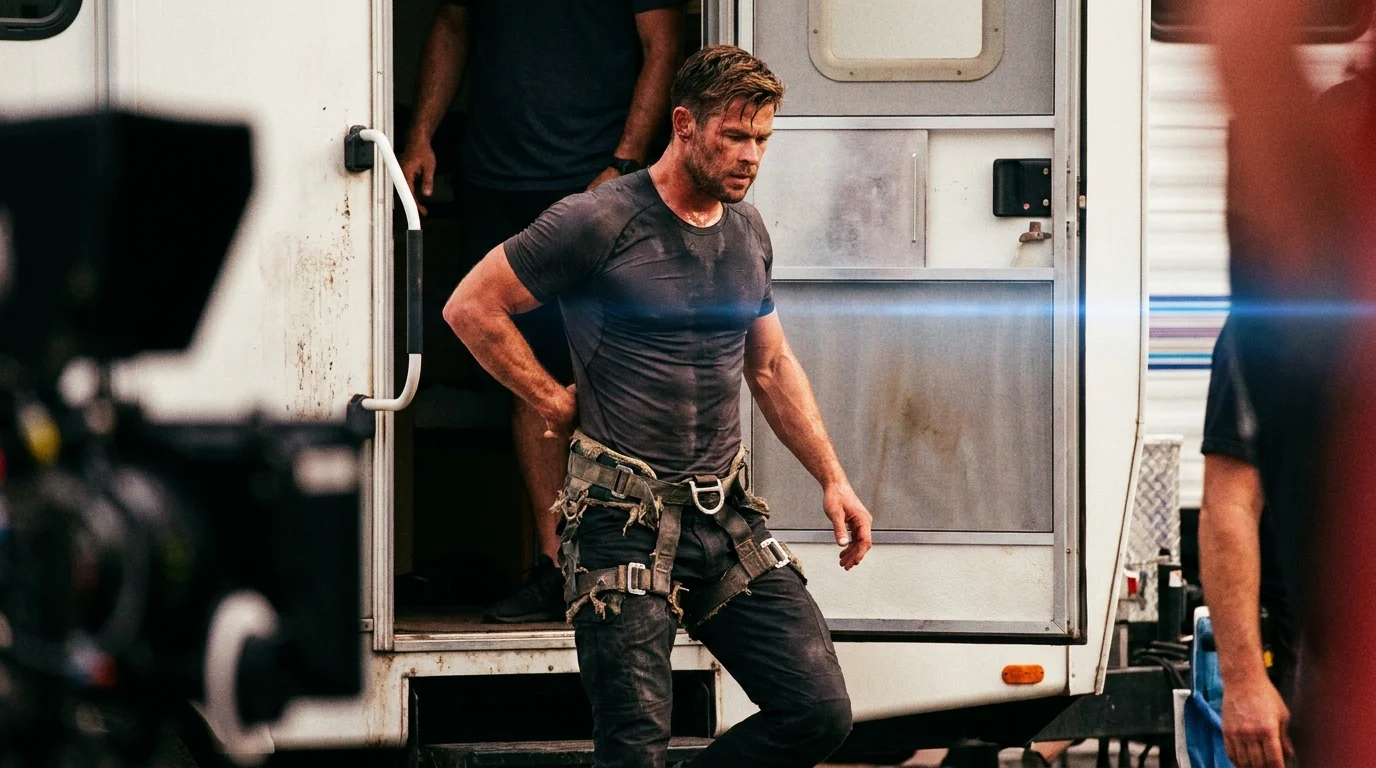
The sound stage in Atlanta smells of ozone, cold hydraulic oil, and powdered chalk. High above the polished concrete floor, steel cables hum at a pitch that borders on silent vibration, suspended from overhead gantries thirty feet in the rafters. You watch a six-foot-three frame dangle in midair, waiting for the clapperboard, bound inside a padded steel stunt harness frayed at the reinforced groin straps from months of friction. The studio lights bake the synthetic leather of a god’s armor, but under the cape, the human hardware is running on sheer borrowed time.
When the drop command echoes over the radio, gravity takes over for a split second before the high-speed counterweights bite. The descent is forty feet of deadweight acceleration, ending not in an organic human fall, but in an abrupt, mechanical halt two inches above a rubberized marker mat. The audience sees the three-point superhero landing: one knee down, fist cracking the imaginary earth, hair settling with theatrical precision. What the camera lens ignores is the sudden, violent jolt running upward through the pelvic cradle.
That impact is not absorbed by the floorboards; it is caught entirely by human cartilage. At the moment of mechanical capture, the winch brakes hit with an eight-G deceleration pulse, yanking the harness upward while two hundred and twenty pounds of muscular bulk continue downward. The lower lumbar vertebrae slam together with the force of a hydraulic press, forcing the inner gel of spinal discs against delicate nerve sheaths while the director calls for reset and another take.
We have grown accustomed to believing that the rise of seamless computer generation turned action cinema into a painless digital playground. When an actor looks invincible beneath millions of dollars in rendered particle effects, we assume the physical toll has softened into pantomime and green-screen strolls. The reality behind the harness reveals an industrial paradox: as visual effects made set pieces grander and faster, the machinery required to throw human bodies through three-dimensional space grew exponentially more punishing.
The Accordion Effect: When Cable Rigs Defy Biological Logic
To understand the toll Chris Hemsworth weathered across a decade of thunderous landings, you have to discard the romantic myth of the cinematic fall. In nature, when you jump from a ledge, your knees bend, your hips hinge, your ankles articulate, and your muscular chain disburses kinetic energy across milliseconds of organic deceleration. It is a slow, graceful curve of kinetic dissipation that your tendons are built to manage.
A high-velocity suspension rig works on the exact opposite logic. It is an engineering masterpiece built for visual stability, not spinal longevity. Think of your spine as an accordion made of bone and fluid rings. When the cable reaches its arrest point, the pelvis stops instantly, held rigid by high-tensile webbing, while the heavy torso and skull continue their trajectory. Disc spaces compress into millimeter slivers as the deceleration shock ripples through the L4-S1 junction, trapping nerve pathways in a vice of biological inertia.
Over a twelve-hour shooting block, an action lead might execute that exact deceleration drop fifteen to twenty times. The body never gets the opportunity to adjust because the cable dictates the physics. If the line halts three frames too fast, the compression multiplies. The result is a quiet, creeping structural erosion—a constant sensation of breathing through a pillow of localized inflammation that dulls your stride long before the cameras stop rolling.
- Alex Garland fiercely blocks sanitized Annihilation ending after biometric test screenings record flatline responses
- Paris Hilton tell-all memoir sparks publishing skepticism exposing distinct sentence cadence of veteran ghostwriters
- Amy Adams bans digital retouching demanding raw macro close-ups of blotchy skin textures
- Dua Lipa in-ear monitor screech forces abrupt arena concert halt revealing dangerous acoustic hazards
- Jonas Brothers wholesome throwback clips resurface right on cue masking contentious arena crew disputes
Marcus Vance, a 48-year-old veteran kinematic rigger who spent twenty-four years engineering wire stunts for major studio productions, remembers the quiet toll on set. “The public thinks a wire protects you from impact because your feet don’t hit the concrete,” Vance shared during an off-season rigging clinic. “They don’t realize the rig itself becomes the floor. When that arrest cable catches an athlete of Hemsworth’s frame dropping at terminal speeds, that harness isn’t saving his back—it is delivering an eight-hundred-pound hammer blow directly to the sacroiliac joint, take after take.”
The Biomechanical Breakdown: Three Layers of Wireline Stress
The damage incurred from prolonged cable suspension is rarely a single catastrophic snap; it is a layered accumulation of microscopic micro-tears and localized fluid displacement. By segmenting the mechanical forces at play, you can see how different points of the kinetic chain absorb the studio’s ambitious choreography.
1. The Cervical Whiplash of the Head-Snap
When an actor drops into a grounded superhero pose, cinematic grammar demands that their face stays level with the camera. As the cable arrests the thoracic spine, the neck must counteract the forward momentum of a heavy skull weighted down by prosthetic hair and heavy helmet pieces. Cervical muscles spasm under load to keep the gaze locked forward, creating acute occipital pressure that radiates into chronic upper-back stiffness.
2. The Lumbar Pinch at Terminal Capture
The core battle takes place in the lower back. During free-fall simulation, the actor’s core must remain hyper-engaged to prevent the legs from kicking wildly, keeping the silhouette heroic. When the arrest cable hits its dead-stop marker, that rigid muscular wall prevents the spine from flexing naturally. The L5 disc takes the full brunt of the downward vector, flattening like a dough ball under a rolling pin.
3. The Groin and Pelvic Shear
The padded leg loops of a stunt harness are designed to prevent the wearer from slipping out, but during rapid vertical deceleration, they act as blunt tourniquets. As the harness pulls upward against the descending pelvis, it creates asymmetrical rotational shear across the pubic symphysis. Deep pelvic stabilizers twist unassisted against the nylon straps, leaving deep bone bruising that alters natural walking mechanics for weeks after wrap.
Mindful Kinetic Decompression: Mitigating Spinal Impact
While you might not be dropping forty feet from the ceiling of a pinewood soundstage, modern desk habits and high-impact training routines frequently subject the lower back to identical axial loading patterns. Decompressing the spine requires an intentional, gentle strategy that avoids aggressive twisting or sudden stretching.
Begin by removing gravitational pressure entirely. Lie flat on the floor with your calves resting on the seat of an armchair, forming a ninety-degree angle at both your hips and knees. This position instantly unloads the iliopsoas muscle, allowing the lower lumbar vertebrae to naturally widen without muscular guarding.
Incorporate passive axial traction rather than active hanging. When you hang limply from a pull-up bar, your shoulder girdle and latissimus dorsi often contract defensively, which can actually increase tension across the thoracolumbar fascia. Instead, keep your toes lightly touching the ground during a hang, allowing your body weight to sink gradually while your nervous system feels secure.
Use rhythmic diaphragm breathing to rehydrate disc spaces. Shallow chest breathing locks your ribcage down, forcing the lower back to bear your torso’s weight during everyday movements. Deep, lateral expansion of the lower ribs creates an internal pressure chamber that gently lifts the ribcage off the pelvic rim.
- Calf-Elevated Rest (Psoas Unload): 10 to 15 minutes daily on a firm surface to release locked hip flexors.
- Ground-Supported Traction: 3 sets of 45 seconds using an overhead bar with feet lightly anchored on a bench.
- Rotational Decompression: Gentle side-lying knee hugs held for 60 seconds without forcing the lower spine to crack.
- Hydration Timing: Rehydrate steadily before movement, as spinal discs lose up to twenty percent of their fluid volume under daytime mechanical loads.
The Human Cost Behind the Spectacle
There is a profound humility in looking past the polished fantasy of cinematic invulnerability to acknowledge the fragile anatomy underneath. When we watch stars like Chris Hemsworth launch across our screens, it is easy to view their frames as indestructible avatars constructed solely of lean protein, disciplined willpower, and digital magic. Yet beneath the golden paint and tailored capes resides a human skeleton governed by the exact same physical laws that dictate your own morning aches.
Realizing that an eight-G cable arrest leaves an A-list athlete battling the same disc compression as a heavy-labor worker shifts how you perceive physical health. Longevity is never about how much blunt trauma your joints can stoically endure; it is about how mindfully you respect your structure before it forces you to stop. True biological resilience values longevity over the cinematic illusion of instant, impact-free triumph.
The human spine was engineered for rhythmic, continuous movement across open ground, not for surviving mechanical arrests orchestrated by steel winches and digital deadlines.
| Key Point | Detail | Added Value for the Reader |
|---|---|---|
| Deceleration Arrest | Sudden stops create up to eight Gs of kinetic force on harness cables. | Explains why cable stunts cause severe spinal disc flattening despite no floor contact. |
| The Superhero Pose | Demands an unnatural, rigid spine at the exact millisecond of arrest. | Demonstrates how aesthetic expectations eliminate the body’s natural shock absorbers. |
| Psoas Unloading | Ninety-degree hip-and-knee resting resets mechanical pressure on the lower spine. | Provides an immediate, cost-free decompression drill you can perform in your living room. |
Frequently Asked Questions
Did Chris Hemsworth’s physical frame make stunt impacts worse?
Yes. Additional muscle mass significantly increases overall body weight, which directly amplifies the kinetic deceleration forces transferred into the harness and spinal joints during high-speed cable stops.Why don’t stunt doubles absorb all of these high-velocity drops?
Modern high-definition cameras and close-up tracking shots demand that recognizable leads perform their own landings so the director can hold the shot continuously without an obvious visual cut.What is an eight-G deceleration stop in everyday terms?
It means that for a fraction of a second during the cable arrest, the actor’s internal organs and skeletal frame experience eight times their normal body weight pulling down against the harness points.Can hanging from a bar reverse stunt-related spinal compression?
Active dead hangs can cause defensive muscle guarding in the lats. Passive traction—where your toes lightly touch the floor—is far safer and more effective for decompressing pinched lumbar discs.Do padded harnesses prevent deep bruising?
No. While foam padding prevents superficial skin lacerations, the extreme upward pressure of the arrest straps still causes deep bone contusions across the pelvis and ribs.