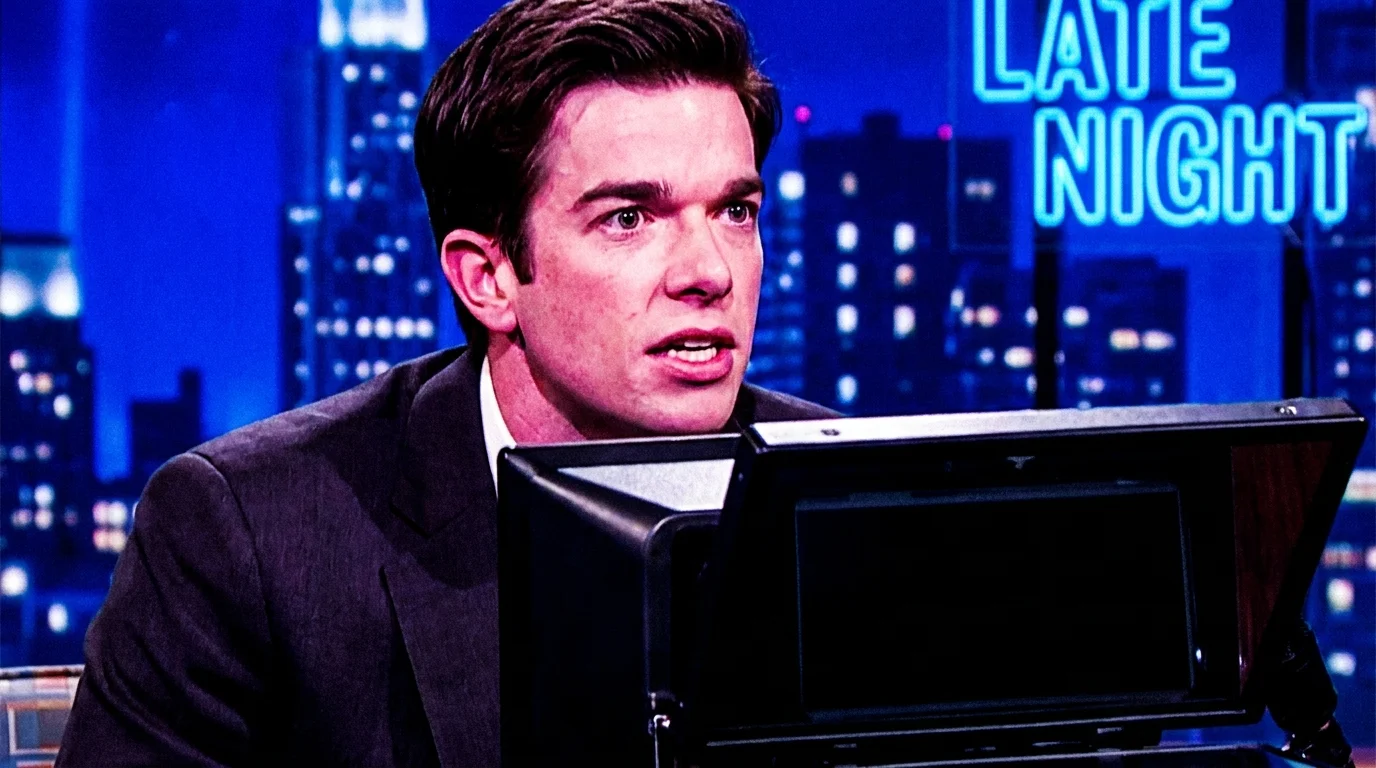
The stage smells of scorched ozone, mineral oil haze, and the hot lacquer baking on seventy overhead floodlights. Out in the auditorium, twelve hundred television executives and celebrity nominees sit behind low cabaret tables, their cocktail glasses clinking softly against polished china. You hear the deep, rhythmic hum of broadcast transmission trucks idling out in the damp alleyway. When John Mulaney steps onto the taped white cross mark downstage, his charcoal tuxedo cut with razor-sharp geometry, you naturally expect the effortless, buoyant cadence that has defined his career: crisp diction, immaculate timing, and an easy, loose swagger that feels completely invented on the spot.
Then the glass monitor at camera two goes completely dark. A flat slate of glass suddenly stares back at him, reflecting only the blazing white glare of stage floods and the silhouette of a heavy robotic pedestal. The scrolling white script—vetted by three teams of corporate attorneys—vanishes into an oily black void. In that split second, the comfortable illusion between the television host and your living room shatters.
Inside the tiny acrylic monitor molded into his left ear canal, the control room audio instantly clips into shrill panic. Showrunners out in the production truck bark over one another, demanding that he vamp, that he tell an anecdote, that he fill the dead air while engineers reboot the scroll feed. Instead, Mulaney does something entirely counterintuitive. You watch five uninterrupted seconds of deadpan silence. He does not improvise a single syllable. He keeps his hands pinned quietly at his sides, stares straight into the cold glass, and lets the multi-million-dollar broadcast choke on its own invisible boundaries.
The Illusion of the Freeform Monologue
We love to imagine late-night hosts and stand-up legends working without a net, treating a live national audience like an intimate basement comedy club. You watch them cock an eyebrow, lean casually on the podium, and deliver biting roars that feel like reckless bursts of spontaneous inspiration. Yet that casual charm is actually a hyper-engineered illusion. A modern awards show monologue is not a conversation; it is a high-speed train running across a rigid network track, secured by legal sign-offs, sponsor riders, and broadcast standards officers holding their fingers over five-second dump buttons.
When that prompter display died, Mulaney did not freeze because he ran out of jokes. He froze as a tactic of pure self-preservation. Improvising on live network air without approved clearance means stepping off a cliff into an administrative minefield where a stray unscripted sentence can trigger six-figure fines, breach-of-contract litigation, and permanent sponsor retaliation. The sudden blackout did not reveal a comic who forgot how to talk; it exposed the steel frame holding up commercial entertainment.
The Hidden Control Room Cord
Marcus Vance, a 51-year-old veteran broadcast continuity supervisor who has managed prompter rigs for major network galas across twenty-five seasons, knows the real terror behind that glassy reflection. “People think the host is in charge of the room,” Vance explains while coiling heavy BNC video cables backstage. “In reality, the host is the mouth of a forty-person corporate committee. The moment that monitor feed crashes, the host has two choices: ad-lib and assume personal legal liability for whatever comes out, or shut their mouth and force the truck to fix its own mess. John knew that five seconds of absolute dead air costs the network far more than it costs him.”
- Chris Hemsworth high-velocity wire stunts force agonizing spinal disc compression behind blockbuster superhero landings
- Alex Garland fiercely blocks sanitized Annihilation ending after biometric test screenings record flatline responses
- Paris Hilton tell-all memoir sparks publishing skepticism exposing distinct sentence cadence of veteran ghostwriters
- Amy Adams bans digital retouching demanding raw macro close-ups of blotchy skin textures
- Dua Lipa in-ear monitor screech forces abrupt arena concert halt revealing dangerous acoustic hazards
That deliberate five-second refusal laid bare the exact architecture of live broadcasting. It demonstrated how television corporations treat speech not as an artistic medium, but as an insured financial asset that requires strict clearance before it ever reaches your speakers.
The Three Invisible Tripwires of Live Television
To understand why an elite comic would deliberately stand silent on live national television, you have to look at the structural pressures operating just behind the prompter glass.
1. The Legal Clearance Corridor
Every single line of an awards show monologue passes through Standards and Practices weeks in advance. Defamation attorneys examine celebrity punchlines to ensure jokes do not cross into actionable assertions of fact. When you watch a host crack a joke about an executive or an unreleased movie, that joke has already been scrubbed, watered down, and officially rubber-stamped. Ad-libbing circumvents that entire safety buffer, leaving the performer exposed to personal legal blowback.
2. The Advertiser Indemnification Clause
Corporate sponsors buy commercial time during network events with strict content-adjacency stipulations. Every sponsor contract contains clauses that penalize the network if a host touches on unapproved geopolitical, medical, or corporate controversies immediately preceding their product spot. A host who goes off-book threatens millions in ad revenue within a matter of seconds, sending production coordinators into a cold sweat.
3. The Audio Mute Latency
Live broadcasts operate on an intentional seven-second profanity delay. When a prompter cuts out and a performer starts rambling freely, the standards officer in the broadcast truck must listen with heightened tension, ready to dump audio at the slightest sign of unvetted material. Mulaney understood that jumping into the void unprompted would trigger a panic-driven muting cascade across regional affiliates.
The Anatomy of the Unscripted Standoff
When the technology fails, surviving the crisis requires an iron-clad protocol rather than wild creativity. You can dissect Mulaney’s response into four mechanical maneuvers that any professional under scrutiny will recognize:
- Holding Physical Neutrality: Avoid frantic filler gestures. Dropping the hands and locking posture signals to the control room that you are aware of the breakdown and will not bail them out of an operational failure.
- Ear Monitor Compartmentalization: Shutting out the panicked chatter of screaming producers while maintaining an outward appearance of calm composure.
- Refusing the Easy Punchline: Resisting the reflex to make a nervous joke about the equipment dying, which only draws attention to network incompetence and burns valuable setup time.
- Waiting Out the Cue Card Runner: Giving the floor manager the necessary window to throw physical cardboard cards directly under the camera lens before resuming speech.
The tactical gear used downstage illustrates just how precarious this environment really is:
- Focal Plane: Dual 17-inch ultra-bright glass monitors running at 1,500 nits to cut through wash lights.
- Fallback Asset: Heavy 14-ply cardboard prompt boards lettered with broad black chisel markers.
- Latency Tolerance: A strict 1.5-second turnaround window before dead air registers as an FCC broadcast error.
The Human Value of the Pause
In our hyper-connected lives, you are constantly pressured to fill every silence. From rapid-fire office meetings to instant messaging threads, the modern expectation is immediate, frictionless response. We treat a pause as an error, a failure of wit, or a sign of weakness. Yet Mulaney’s five-second deadpan silence shows the supreme authority of doing nothing when the surrounding system breaks down.
By refusing to panic and fill the void with disposable chatter, he exposed the fragile corporate machinery humming behind the glamour. Recognizing that you do not owe the room an instant performance—especially when the tools around you fail—is the ultimate act of professional poise. The power is never in how fast you speak; it is in knowing exactly when to let the silence do the work for you.
“The smartest performer on a live stage is the one who lets the silence belong to the network instead of taking the blame for their dead screen.”
| Key Point | Detail | Added Value for the Reader |
|---|---|---|
| The Prompter Blackout | A sudden monitor failure forced an unscripted five-second deadpan standoff. | Shows why silence can be an intentional tool rather than an accident. |
| Legal Boundaries | Rigid corporate vetting prevents spontaneous ad-libbing on live network broadcasts. | Dispels the myth that awards show monologues are purely improvised. |
| Ear Monitor Friction | Showrunners screamed competing instructions as the host refused to improvise. | Illustrates the hidden operational chaos taking place during live television. |
| The Five-Second Dump | Networks use delay protocols that penalize spontaneous, unvetted jokes. | Explains the financial and regulatory stakes tied to broadcast comedy. |
| The Power of the Pause | Refusing to fill dead air protects the speaker and forces systems to correct themselves. | Offers a practical communication lesson for handling high-pressure professional pauses. |
Frequently Asked Questions
Why didn’t John Mulaney simply tell an impromptu joke when the monitor died?
Ad-libbing on live network television bypasses Standards and Practices clearance, exposing the performer and network to massive financial penalties, sponsor cancellations, and legal liability.How long do network prompter blackouts typically last?
Most hardware or software sync failures are resolved within three to eight seconds as operators hot-swap to redundant secondary laptops or bring up manual physical cue cards.What is the primary role of broadcast Standards and Practices during an awards show?
They review every line of dialogue prior to air to avoid slander, copyright infringement, broadcast indecency fines from the FCC, and advertiser contract violations.Do live hosts actually hear producers yelling in their ears during a monologue?
Yes. The host wears an IFB (Interruptible Foldback) earpiece that feeds them live, unedited direction from the executive producer and director throughout the entire broadcast.What can everyday professionals learn from this live television freeze?
When technical tools or presentations crash, pausing calmly instead of babbling prevents self-inflicted mistakes and forces the responsible parties to fix the underlying issue.