The air inside a sold-out stadium carries a physical weight. Long before the opening chords strike, eighty thousand voices generate a subsonic hum that vibrates through concrete foundations, floorboards, and your own ribcage. Onstage, bathed in lavender follow-spots and theatrical haze, the scene looks effortless. You see a pop sensation dancing across the thrust stage, completely locked into the choreography, delivering vocal runs that cut cleanly through the roar of a stadium crowd. Everything feels frictionless, manicured to the millimeter, and utterly invulnerable.
Yet tucked deep into the performer’s ear canals sits a fragile bridge between human anatomy and raw electrical current. Custom-molded acrylic shells, poured to match the exact millimeter contours of the ear canal, create a silent vacuum that locks out the roaring arena. Through those microscopic drivers, the artist hears a delicate mix: click track, reference pitch, backing harmonies, and their own amplified breath. It is a sterile, hyper-controlled world designed to keep a singer sane amid utter auditory chaos.
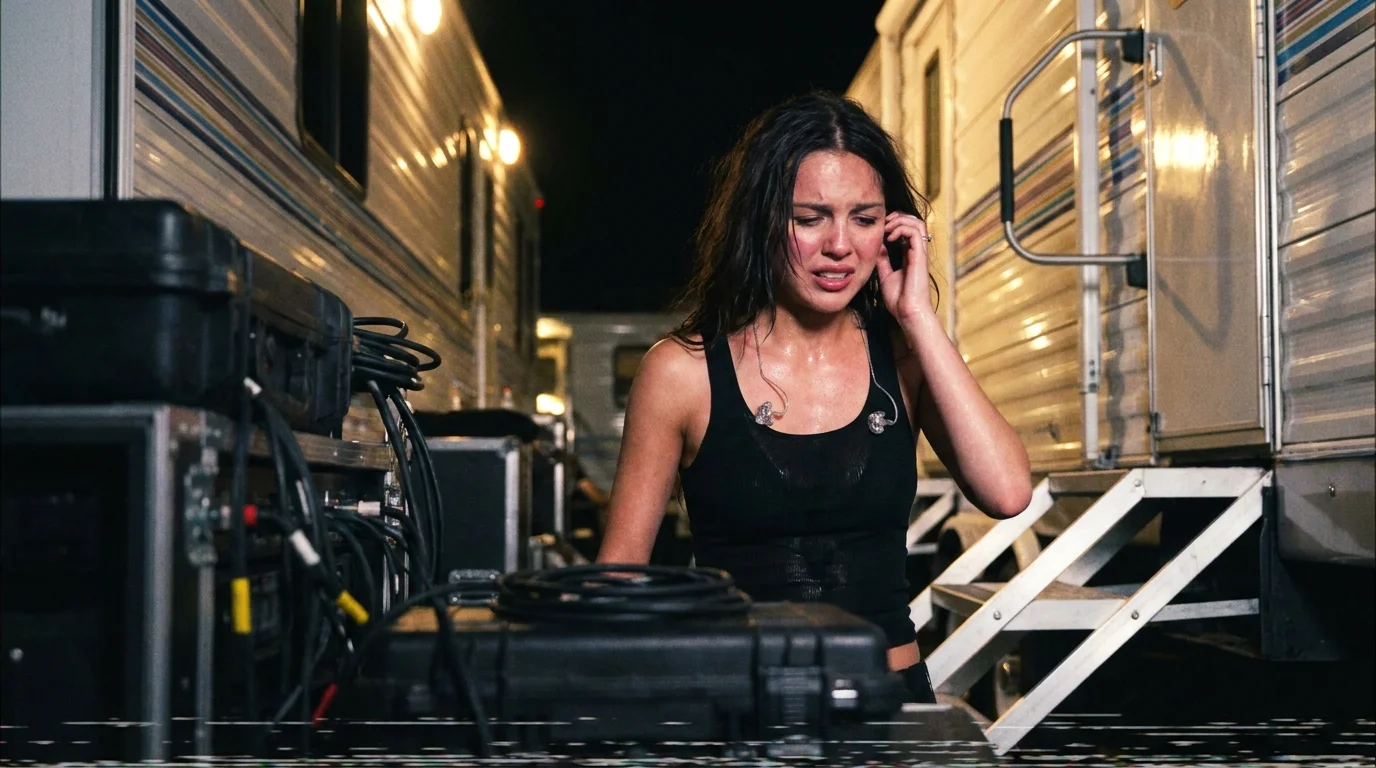
Then the sonic line snaps. A rogue patch routing error or a microphone wandering into the null angle of a side-fill monitor creates an instantaneous runaway feedback loop. A catastrophic acoustic spike—screaming somewhere between 4,000 and 8,000 Hertz—explodes directly against the tympanic membrane with zero air displacement to soften the blow. In a split second, instinct overrules choreography. Olivia Rodrigo freezes mid-syllable, violently tearing the cables outward, leaving her custom moulded acrylic in-ear monitors dangling against a sweaty collarbone while her audio engineers scramble behind the soundboard.
The Razor Wire Behind the In-Ear Vacuum
Pop concerts often fool us into believing stadium acoustics behave like home studio monitors. We assume that modern digital soundboards eliminate unpredictable analog danger through clever software algorithms and digital signal processing. But when an artist steps onto an arena stage, they are essentially walking a tightrope across an invisible electrical minefield. The sealed acoustic environment that enables pitch-perfect singing is the very thing that turns an audio mistake into an acoustic weapon.
Think of an in-ear monitor not as a high-end headphone, but as a miniature syringe injecting sound pressure directly into a tiny sealed cavity. Under normal conditions, ambient stadium noise measures around 105 decibels. To cut through that wall of sound, the volume inside an in-ear monitor often hovers around 90 to 95 decibels. When an uncompressed feedback spike bypasses the soundboard’s digital brickwall limiter, that localized sound pressure can surge past 125 decibels in less than three milliseconds. That sudden spike does not give the stapedius muscle in the middle ear enough time to contract and protect the delicate hair cells of the cochlea.
When Rodrigo cut the performance short, she was not throwing an off-script diva tantrum. She was executing a split-second physiological survival protocol to preserve her career. Protecting inner ear hair cells is not optional for a touring vocalist; once those acoustic nerve endings shear under acoustic trauma, they never regenerate.
- Paul Rudd wholesome vintage tape footage resurfaced to bury tense studio contract disputes
- Selena Gomez unscripted bedroom livestream strips away corporate PR scripts behind manufactured tears
- Austin Butler obsessive vocal method transformation triggers icy isolation across major studio ensembles
- Gwyneth Paltrow tear-streaked podcast confession exposes calculated retail launches behind wellness empires
- Joe Jonas tense red carpet posture sparks fan theories about messy label fallout
The Front-of-House Crucible: A Veteran’s Field Reality
To understand how a pristine arena signal chain turns hostile, talk to someone who lives behind the mixing desk. Marcus Vance, a 44-year-old monitor engineer who has spent two decades running stage sound for world-touring rock and pop acts, knows that feeling of sheer panic in his chest. A monitor engineer does not mix for the audience; they mix exclusively for the people standing on the deck, balancing upwards of sixteen discrete stereo channels while monitoring wireless frequency interference from local cellular towers.
“People imagine digital desks are foolproof, but a stadium is an active radio frequency warzone,” Vance notes quietly during a stage turnaround. “If a stage transmitter drops a digital packet, or an auxiliary send loops back into a hot ambient microphone, you get an acoustic shockwave. You have roughly a tenth of a second to mute the channel before you cause permanent auditory damage to the artist. Seeing a singer yank their mold out mid-chorus is an audio engineer’s worst recurring nightmare.”
Anatomy of Acoustic Shock: Three Failure Modes on Stage
The danger lurking behind live stage sound generally stems from three distinct physical and electronic breakdowns. Understanding how these failures happen changes how you view live arena performances forever.
- The Transducer Seal Failure: Custom acrylic shells isolate outside sound by up to 26 decibels. If sweat breaks that tight acoustic seal, performers instinctively ask the monitor engineer for more volume, pushing driver units right to the edge of digital clipping.
- The Digital Limiter Overrun: Software limiters are designed to clamp down on sudden volume surges. However, complex phase shifts between wireless microphone arrays can slip past digital look-ahead limiters, blasting transient feedback spikes straight into the artist’s ear.
- The Side-Fill Cross-Bleed: High-energy stage choreography brings vocalists close to massive perimeter speakers. Even a microsecond of microphone proximity to a floor wedge can turn a whisper into an ear-splitting howl.
Each of these points demonstrates just how delicate the balance remains between pristine performance and genuine physical risk.
Mindful Audio Preservation: The Tactical Stage Toolkit
Whether you are performing under stadium spotlights or simply working long hours inside studio-grade studio monitors, sound pressure management requires disciplined intention. Protecting your hearing is not about lowering your enjoyment; it is about building safe listening habits that last a lifetime.
To safeguard your ears from unpredictable acoustic spikes, engineers recommend sticking to a strict set of monitoring parameters:
- Calibrate Safe Baseline Levels: Keep your daily listening monitors capped at no more than 75 to 80 decibels. If you cannot hear a normal speaking voice three feet away, your monitors are set dangerously hot.
- Implement Redundant Hardware Limiters: Never rely exclusively on software volume controls. Use physical, analog inline attenuators that mechanically cut audio signals if line voltages spike unexpectedly.
- Schedule Mandatory Ear-Canal Decompression: After ninety minutes of sealed headphone listening, take a minimum of fifteen minutes in ambient, low-volume air to allow the auditory canal to breathe.
- Check Your Ear Seal Regularly: Re-pour custom silicone or acrylic earmolds every two years. Changes in body weight or jaw alignment compromise acoustic seals, forcing you to crank up dangerous volume levels.
By treating volume as a finite daily budget, you preserve high-frequency hearing clarity well into your future.
The Bigger Picture: Reclaiming Humanity on the Arena Stage
We live in a culture that expects artists to perform like flawless, indestructible avatars. We consume stadium spectacles through polished social media clips, forgetting that beneath the glitter and smoke machines sits an organic human nervous system fighting against raw physics. When an artist stops a stadium cold to protect her hearing, the illusion of automated pop music drops away.
That moment when the music cuts and the stadium goes quiet is not a technical failure; it is a victory for self-preservation over corporate spectacle. It shows you that true professionalism is knowing when to drop the microphone, protect your health, and refuse to sacrifice your well-being for an unscripted moment of entertainment. In a world that demands continuous noise, knowing when to choose silence is the ultimate act of authority.
True mastery of live stage sound is not about pushing sheer volume, but building an invisible fortress that keeps the performer entirely safe from the chaos of the room.
| Key Point | Detail | Added Value for the Reader |
|---|---|---|
| Acoustic Shock Hazard | In-ear feedback can strike ear canals at over 125 dB in under 3 milliseconds. | Explains why immediate stage stoppages are genuine medical necessities rather than diva outbursts. |
| The Acoustic Seal Factor | Custom acrylic molds isolate up to 26 dB of outside ambient arena crowd noise. | Shows how sealed listening spaces magnify low-level frequency shifts into dangerous pressure waves. |
| Volume Budget Strategy | Eardrums tolerate 85 dB for eight hours, but 100 dB for under fifteen minutes. | Gives you practical, real-world metrics to protect your hearing while using personal earbuds daily. |
Frequently Asked Questions
Why can’t stadium artists simply use traditional stage monitor wedges?
Floor monitor wedges struggle to cut through the massive, echoing roar of an 80,000-seat stadium. In-ear monitors give singers a crystal-clear, isolated reference track that protects vocal cords from strain and guarantees accurate pitch control.Does acoustic shock from a single audio spike cause permanent hearing damage?
Yes. Intense transient sound spikes can instantly rupture the eardrum or snap microscopic stereocilia hair cells inside the inner ear, causing permanent high-frequency hearing loss or incurable tinnitus.What is an inline audio limiter, and why do stage engineers use them?
An inline limiter is a hardware safety valve wired between the wireless receiver and the artist’s earpieces. It acts as an automatic circuit breaker, muting audio signals that exceed safe decibel limits.Why did she have to pull her earpieces out so quickly?
Because human ears lack a natural defense mechanism against instantaneous audio transients delivered inside a sealed canal. Physically ripping the earpiece out is the fastest way to break the dangerous sound pressure seal.How can casual music fans protect their hearing at live concerts?
Invest in high-fidelity musician earplugs. Unlike cheap foam plugs that muffle music, high-fidelity filters drop volume evenly across all frequencies by 15 to 20 decibels, keeping the mix crisp while protecting your ears.