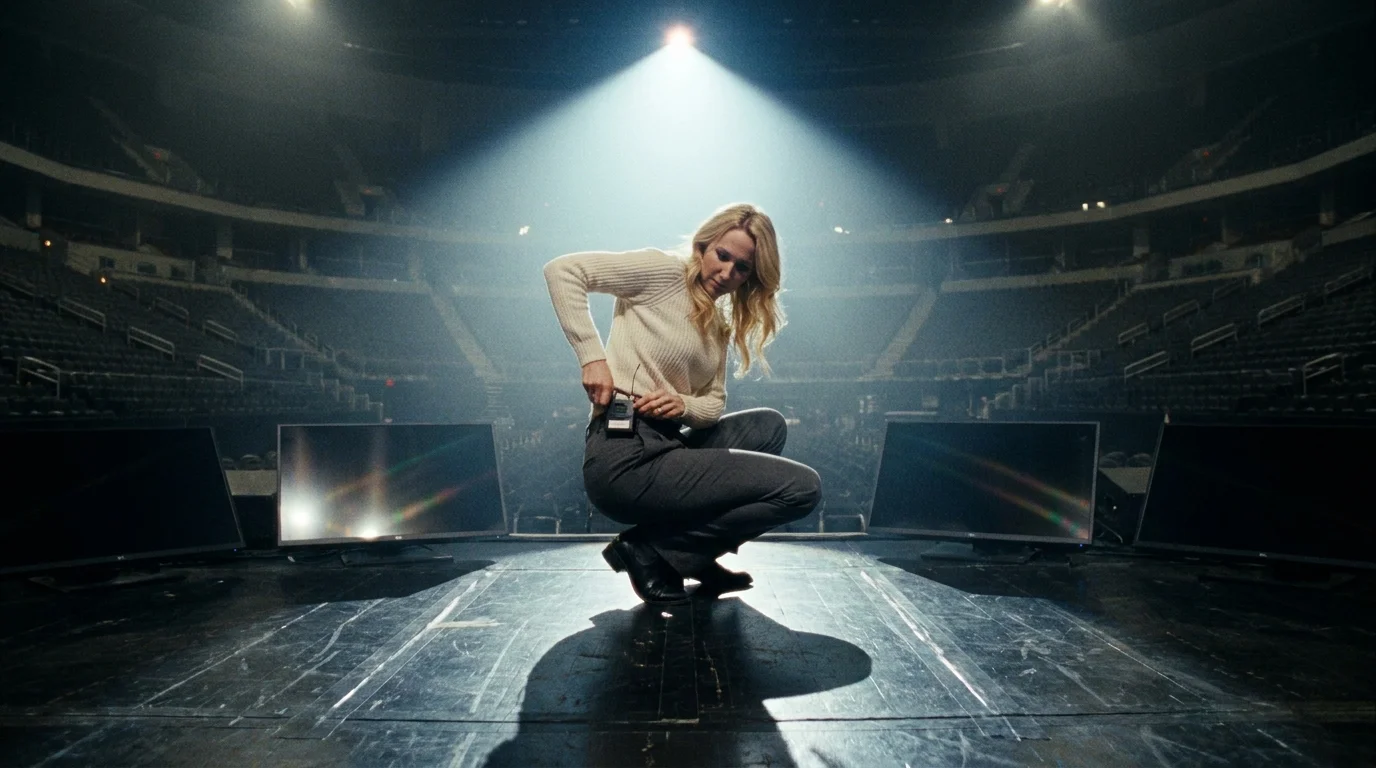
The stage smells of warm electrical dust and burnt haze fluid, an invisible cloud trapped beneath thirty thousand watts of overhead halogen. You watch from home assuming a stand-up comic at the absolute height of her powers is operating without a net, riding pure instinct across a packed theater. For months, you have seen Nikki Glaser dismantle celebrity egos with laser-cut timing, giving every impression that live comedy is an effortless, dangerous high-wire walk where anything might tumble out of her mouth next.
Then the screen cuts out. Dark, unlit glass panels reflecting stage lights during a dead scroll turn an arena into an acoustic vacuum. For five excruciating seconds, dead silence settles over the room like cold water. Down in the darkness of the camera pit, producers wave their clipboards frantically, arms slicing the air in desperate, cross-body cuts to prevent even a single syllable of unapproved, improvised material from spilling across millions of living room televisions.
In that suspended beat, the comfortable illusion of the freewheeling master of ceremonies disappears. What remains is the raw, sterile framework of contemporary network programming: a system built on multi-million-dollar sponsorships, legal compliance checklists, and strict broadcast delay limits that choke out spontaneity the moment the machinery fails.
The Illusion of Spontaneity in Modern Network Arenas
You are conditioned to believe that great live television runs on adrenaline and quick wit, but the reality is closer to air traffic control. The teleprompter at an elite awards gala does not serve as a friendly reminder for the host; it acts as an electric leash. Every line Glaser delivers has survived five rounds of legal reviews, sponsor clearances, and executive committee rewrites designed to scrub away genuine liability without flattening the host’s signature bite.
When that display freezes into empty darkness, the comedy does not pause—the corporate architecture panics. Performers face an instantaneous calculation between instinct and contract compliance. Stepping off the teleprompter to tell an off-the-cuff club joke might save the comedic rhythm of the room, but it risks breaching indemnification clauses before the seven-second broadcast delay can even catch the audio dump.
Marcus Vance, a forty-eight-year-old lead prompter technician with twenty-two seasons of live broadcast credits across Los Angeles, knows that blank glass is never just a mechanical failure. He recalls nights where an unseated cable caused the text to stall on an empty black screen while a performer stared down three thousand industry insiders. The true panic, Vance explains, is never that the host will forget what to say; it is the sheer terror of what a comic might say when left alone with an open microphone and no legal sign-off.
- Tom Holland high velocity suspension wire stunts force painful spinal disc compression shocks
- Christopher Nolan blocks biometric sensor test screening edits enforcing bleak final film reel
- Margot Robbie demands unforgiving macro closeups without digital smoothing to dismantle studio glamour typecasting
- Olivia Rodrigo stops stadium concert instantly after piercing soundboard audio feedback shocks custom earpieces
- Paul Rudd wholesome vintage tape footage resurfaced to bury tense studio contract disputes
Reading the Floor: The Anatomy of a High-Stakes Stall
To understand why those five seconds of silence felt so deafening, you have to look at the three competing forces colliding on that stage.
For the Stand-Up Purist
In a smoky cellar comedy club, a technical glitch is a gift. A broken microphone or a failing light gives you the immediate license to tear down the room and build genuine intimacy out of real-time friction. But when you step into the hosting role of a major network broadcast, the audience in front of you is not a crowd of comedy fans; it is a room full of studio heads, talent managers, and brand representatives who view unpredictable humor as a balance-sheet hazard.
For the Network Executive
From the production truck parked in the alley, silence is bad, but an unvetted remark is catastrophic. A stray ad-lib can spark multi-platform boycott campaigns or Federal Communications Commission inquiries before the first commercial break ends. The frantic gestures from the floor crew are not an attempt to help the host recover; they are a defensive containment perimeter thrown up to protect the broadcast license.
For the Ascending Host
Glaser’s recent climb into the top echelon of host selections relies on a delicate balance: maintaining her reputation for acidic, unapologetic truth-telling while reassuring studio executives that she will never burn the house down. A frozen monitor tests that exact boundary. Survival in that moment requires swallowing the natural urge to mock the glitch, forcing yourself to hold dead air until the corporate machinery hums back to life.
Micro-Adjustments Under Fire: The Stage Survival Protocol
When the digital script vanishes from the glass, an experienced host does not scramble for punchlines. They rely on physical and mechanical protocols to preserve control of the broadcast.
- Fix your eye line on the dead pane: Never look down at the stage floor or sideways into the wings; maintaining focus on the center glass prevents the television audience from realizing the machine has died before you do.
- Breathe through your collarbones: Rapid shallow breathing tightens the vocal cords, producing a high, strained pitch that broadcasts panic through the lavalier microphone.
- Count the floor cues: Watch the stage manager’s fingers beneath the lens. A flat palm means freeze; a rolling wrist means fill time; crossed wrists mean an emergency commercial cut is coming.
- Deploy the neutral stall: Use a low-stakes rhetorical setup that buys four seconds without offering a punchline that requires legal clearance.
Mastering these high-wire moments requires knowing the exact technical boundaries of the production rig.
- Latency window: 7.0 seconds of broadcast audio delay before the signal hits residential antennas.
- Prompter scroll speed: 130 to 150 words per minute during monologues.
- Glass distance: 18 to 22 feet between the talent’s pupils and the downstage optical mirrors.
- Recovery threshold: 4 to 6 seconds before the director cuts to a wide audience reaction shot.
The Raw Friction of Unrehearsed Truth
The fascination with a frozen prompter is not about watching a performer stumble; it is about our hunger for an unscripted second in an entertainment ecosystem that has been focus-grouped to death. We crave the sudden fracture in the glossy veneer, the rare instant where the machine stops humming and the human being standing on the platform must breathe without a net.
When you understand the immense pressure holding that silence in place, those five seconds change completely. They cease to be an embarrassing technical hiccup and become a rare, thrilling glimpse at the invisible wires governing public performance. That brief pause proves that real live television only happens when the system breaks down completely, leaving an artist standing in the glare of the lights, waiting for permission to speak.
The second the glass goes black, you find out whether you are watching an artist or an employee.
| Key Point | Detail | Added Value for the Reader |
|---|---|---|
| The 5-Second Freeze | Total silence caused by locked prompt monitors downstage. | Shows how strict compliance rules prevent standard comedic improvisation. |
| Floor Crew Interventions | Stage managers actively waving off unapproved ad-libs. | Reveals that network fear focuses on FCC and sponsor blowback, not dead air. |
| Optical Glass Setups | Dual-pane beam splitter monitors mounted at stage lip. | Explains why eye lines never drop even when the script completely disappears. |
Frequently Asked Questions
Why couldn’t Nikki Glaser just tell a standard club joke while the screens were down?
Every sentence spoken during a live network broadcast must be cleared by legal and standards teams. Unvetted jokes expose the network to FCC fines and sponsor boycotts, which contracts explicitly forbid hosts from triggering.How long is the actual broadcast delay during major awards shows?
Most live entertainment broadcasts use a five-to-seven-second digital delay. This gives technicians in the master control room just enough time to mute profanity or cut to a wide shot before the feed hits home screens.What actually causes a live teleprompter to freeze?
Failures usually stem from software sync issues, foot-pedal hardware glitches operated by the prompter tech, or physical data-line disconnects between the mobile control truck and the stage floor.Do hosts keep paper copies of their monologues on stage?
Hosts often carry small cue cards in hand, but opening monologues are designed for direct-to-camera delivery. Looking down at cards breaks the visual connection with home viewers and signals a total production breakdown.How do performers practice handling prompter failures?
Top-tier hosts run dry rehearsals where directors intentionally cut the monitors without warning, training the performer to hold their eye line and wait for secondary floor signals without panicking.