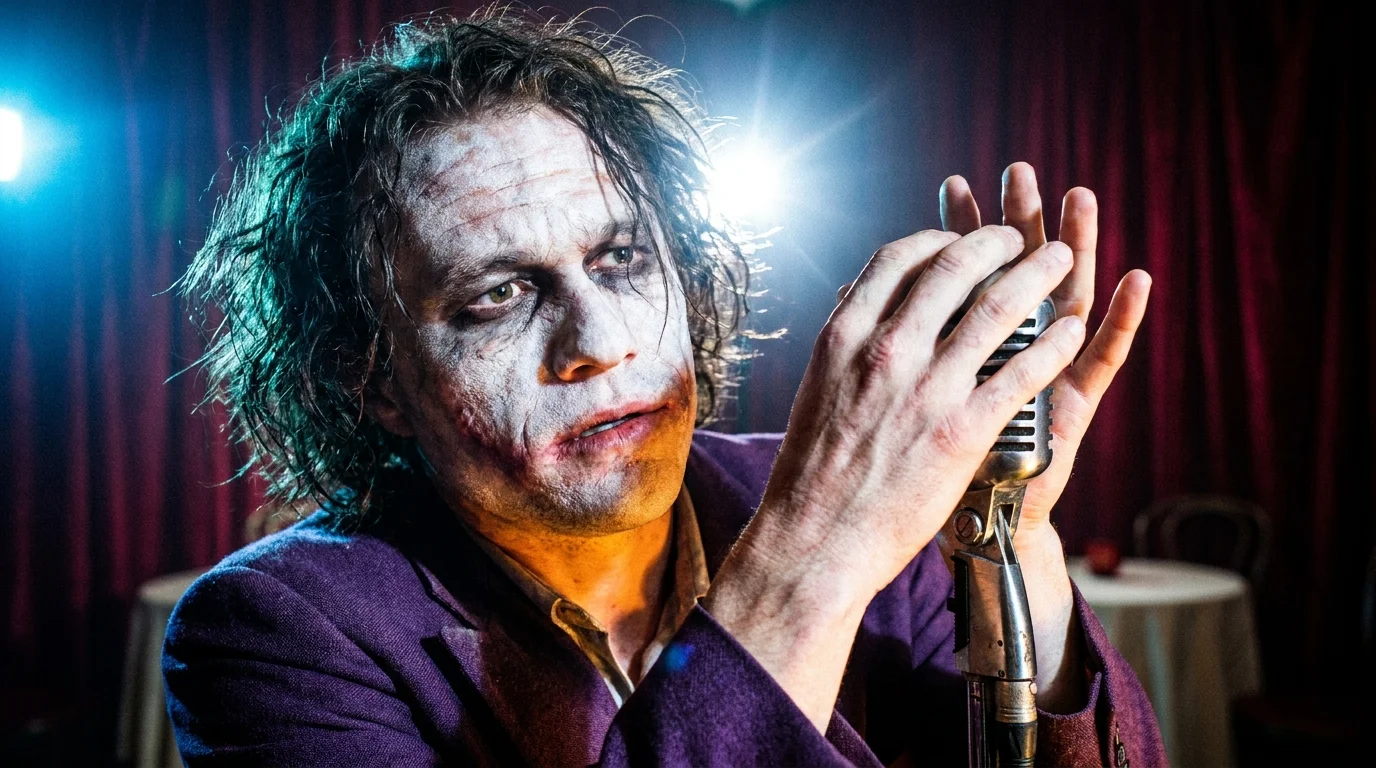
The Gotham City Major Crimes Unit lockup smells faintly of damp masonry, cooling studio tungsten, and synthetic greasepaint. Fluorescent tubes hum with a thin, metallic pitch overhead. You can picture the heavy silence between takes: background extras shifting in stiff wool police uniforms, cold monitors glowing in the shadows, and Gary Oldman adjusting his wire-rimmed glasses under the dim industrial practicals. Inside the center iron cage sits Heath Ledger, slouched in a grimy purple coat, yellowed cuffs pulled down, his greasepaint cracking into the fine creases around his eyes.
The script called for quiet submission. Gordon had just been promoted to Police Commissioner by the Mayor, a round of scripted, relieved applause rippled through the bullpen, and the scene was supposed to register as a rare moment of bureaucratic triumph in a rotting city. The cameras were rolling to capture Gordon’s weary gratitude. The prisoner behind the bars was meant to remain an ominous, silent backdrop, a captured predator fading into the steel mesh.
Instead, Ledger lifted his gloved hands. Slowly, deliberately, without a single cue from the call sheet, the palms met with a hollow, dry slap. Then another. Then a rhythmic, mocking tempo that cut right through the scripted dialogue, freezing the cast and crew in place. The noise was soft, yet it had the bite of wet leather snapping against cold concrete.
Nobody shouted cut. Christopher Nolan kept the 35mm film rolling, recognizing in real time that Ledger was not simply reciting dialogue—he was commanding the room by treating unscripted stillness as a weapon. It was an instant where pure instinct dismantled the script, turning what should have been standard transition footage into one of the most chilling, referenced shots in modern cinematic history.
The Psychology of the Unwritten Rhythm
Most screen acting operates like a classical clockwork mechanism: marks are taped to the floor, eyelines are measured with cloth tapes, and actors deliver cadences rehearsed across weeks of table reads. When a sequence breaks script, human instinct usually commands the room to abort. Actors freeze, look toward the monitors, or stumble through their lines, waiting for the director to clean up the spilled rhythm.
Ledger understood a deeper theatrical truth: chaotic characters cannot exist solely inside structured lines. The jailhouse clap was not an actor showing off; it was an authentic behavioral response to an institutional farce. The Joker, watching Gotham’s corrupt police force celebrate a self-congratulatory administrative promotion, would naturally find the spectacle hysterically, quietly amusing. By shifting from silent captive to sarcastic audience member, Ledger instantly punctured Gordon’s victory without uttering a single syllable.
- Denzel Washington protects forty year marriage enforcing absolute off camera domestic boundaries
- Jessica Simpson vintage reality clips expose awkward marital tension fans missed completely
- Winona Ryder resurfaced nineties tape reverses public perception of her studio hiatus
- Maria Bartiromo tense on-air glance sparks widespread television network rift theories
- Nikki Glaser frozen teleprompter blackout derails live monologue exposing rigid network broadcast boundaries
Nolan’s discipline as a filmmaker was the second half of that miracle. Many directors, married to the literal geometry of their storyboards, would have interrupted the take to reset the background extras. Instead, Nolan’s camera lingered, pulling the viewer into the cage with Ledger. It transformed a mundane background shot into an accidental iconic cinematic masterclass that permanently altered how audiences understood the psychological distance between the hero and the villain.
The Master of Accidental Genius
Consider the observation of veteran production sound mixer Ed Novick, who spent decades running boom mics and monitoring wild tracks on massive Hollywood stages. During the filming of The Dark Knight in Chicago, Novick noted that Ledger’s physical presence carried an unusual sonic texture. Ledger did not just project his voice; he played with the ambient room acoustic, often muttering, smacking his dry lips, or tapping his boot against floor joists between takes to test the space. Novick realized early on that Ledger’s performance was an ecosystem of micro-behaviors designed to make everyone on set feel genuine, off-balance unease.
That atmospheric friction is what made the jailhouse sequence electric. Oldman’s slight, almost imperceptible stiffening of the neck as Gordon hears the applause behind him was entirely real. Oldman was staying in character, but the sensory shock of Ledger’s unprompted rhythm gave the entire bullpen a jolt of raw, unscripted tension that no rehearsal could have manufactured.
The Anatomy of Hollywood’s Accidental Scene-Stealers
When you look across the landscape of cinema, the moments that etch themselves permanently into public memory are rarely the ones polished by forty drafts in a writer’s room. They are the fractures—the cracks where human spontaneity bleeds into rigid studio productions.
Consider how different performers leverage unexpected physical impulses to reinvent a scene on the fly:
- The Auditory Subversion: Ledger’s rhythmic jailhouse applause. Rather than screaming or thrashing against the bars, he introduced a polite, domestic sound into a violent space, weaponizing irony to terrify the viewer.
- The Accidental Prop Mastery: Harrison Ford pulling his revolver in Raiders of the Lost Ark when food poisoning made an elaborate, scripted whip-and-sword battle physically impossible. One exhausted shrug turned a generic action beat into pure character legend.
- The Reactive Silence: Anthony Hopkins holding unblinking eye contact in The Silence of the Lambs, catching Jodie Foster off guard by mocking her regional accent unprompted, generating authentic, skin-crawling discomfort that made the final edit.
Each of these variations highlights a critical rule: real creative authority does not come from memorizing instructions, but from listening to the immediate room. When an artist trusts their internal logic completely, the mistake becomes the masterpiece.
Applying the Unscripted Principle to Daily Performance
You do not need an IMAX camera or an iron lockup to harness this mindset. Whether you are leading a high-stakes presentation, designing a creative campaign, or navigating an uncomfortable negotiation, true poise comes from the ability to lean into unexpected friction rather than panicking when things drift from the slide deck.
To build that kind of unshakeable presence, consider these mindful, deliberate adjustments:
- Listen to the ambient space: Before speaking, wait two full seconds after someone else finishes. That tiny pause breaks defensive social rhythms and commands attention without raising your vocal pitch.
- Subvert the expected emotional response: When confronted with corporate pressure or aggressive posturing, meet intense energy with low-frequency, calm body language. Soften your shoulders and slow your cadence.
- Treat disruptions as raw material: If a technical slide fails, an audio monitor clips, or an interruption derails your agenda, incorporate the variable directly into your message instead of pretending it did not happen.
By mastering these subtle behavioral cues, you shift your mindset from merely executing an assignment to orchestrating the environment. You stop worrying about rigid compliance and start cultivating authentic, memorable influence.
The Enduring Ghost in the Cell
Decades later, that handful of seconds in the Gotham precinct remains the definitive image of Ledger’s Joker. It does not lean on pyrotechnics, prosthetic gore, or roaring bat-pod engines. It is simply a man sitting in the dark, hands cupped, mocking the illusion of order with an easy, mocking slap of his palms.
That scene endures because it reminds us of the rare magic that happens when an artist is completely fearless. Ledger did not ask for permission, and Nolan was wise enough not to stand in the way of lightning. In an industry increasingly dominated by pre-visualized digital assets and committee-approved screenplays, that improvised jailhouse clap stands as a monument to human impulse—a quiet, terrifying reminder that cinema’s greatest moments are often the ones nobody saw coming.
“True cinema is not the execution of a storyboard; it is the courage to capture an unrepeatable human breath before it vanishes.”
| Improvised Element | Production Context | Cinematic Value for the Viewer |
|---|---|---|
| The Sarcastic Lockup Clapping | Ledger ad-libbed during Gordon’s promotion scene without prior warning to director or cast. | Exposes the Joker’s total contempt for Gotham’s law enforcement hierarchy in a single, eerie gesture. |
| The Hospital Detonator Stutter | The delay in pyrotechnics was scripted, but Ledger casually shaking the remote was improvised in character. | Turns a tense technical timing window into a dark comedic masterclass in sociopathic nonchalance. |
| The Unblinking Eye Contact | Ledger intentionally minimized blinking during close-ups to create predatory stillness. | Forces the audience into deep psychological discomfort, making the performance feel uncomfortably intimate. |
Frequently Asked Questions
Did Christopher Nolan plan the jailhouse clapping scene?
No. Nolan’s script called for the scene to focus on Gordon’s promotion and the bullpen’s celebration. Ledger introduced the slow, sarcastic applause entirely on his own during filming, and Nolan instructed the crew to keep the cameras rolling.Did Gary Oldman know Ledger was going to clap?
Oldman was not informed beforehand. His subtle, stoic reaction in the scene reflects a combination of his seasoned professionalism and genuine surprise at Ledger’s off-script physical choice.Was the hospital explosion delay also improvised?
While the physical delay between the two explosions was a planned special effects cue to ensure crew safety, Ledger’s reaction—fiddling with the detonator and jumping into the bus—was completely his own unscripted character work.Why did Christopher Nolan keep Ledger’s ad-libs in the final cut?
Nolan preferred capturing raw, documentary-style spontaneity within his large-scale set pieces. He recognized that Ledger’s improvisations brought an authentic layer of unpredictable madness that enhanced the film’s grounded realism.What made Heath Ledger’s Joker preparation unique?
Ledger isolated himself in a London hotel room for roughly six weeks prior to filming, compiling a scrapbook of disturbing source material, practicing distinct vocal cadences, and developing the physical mannerisms that allowed him to improvise effortlessly on set.