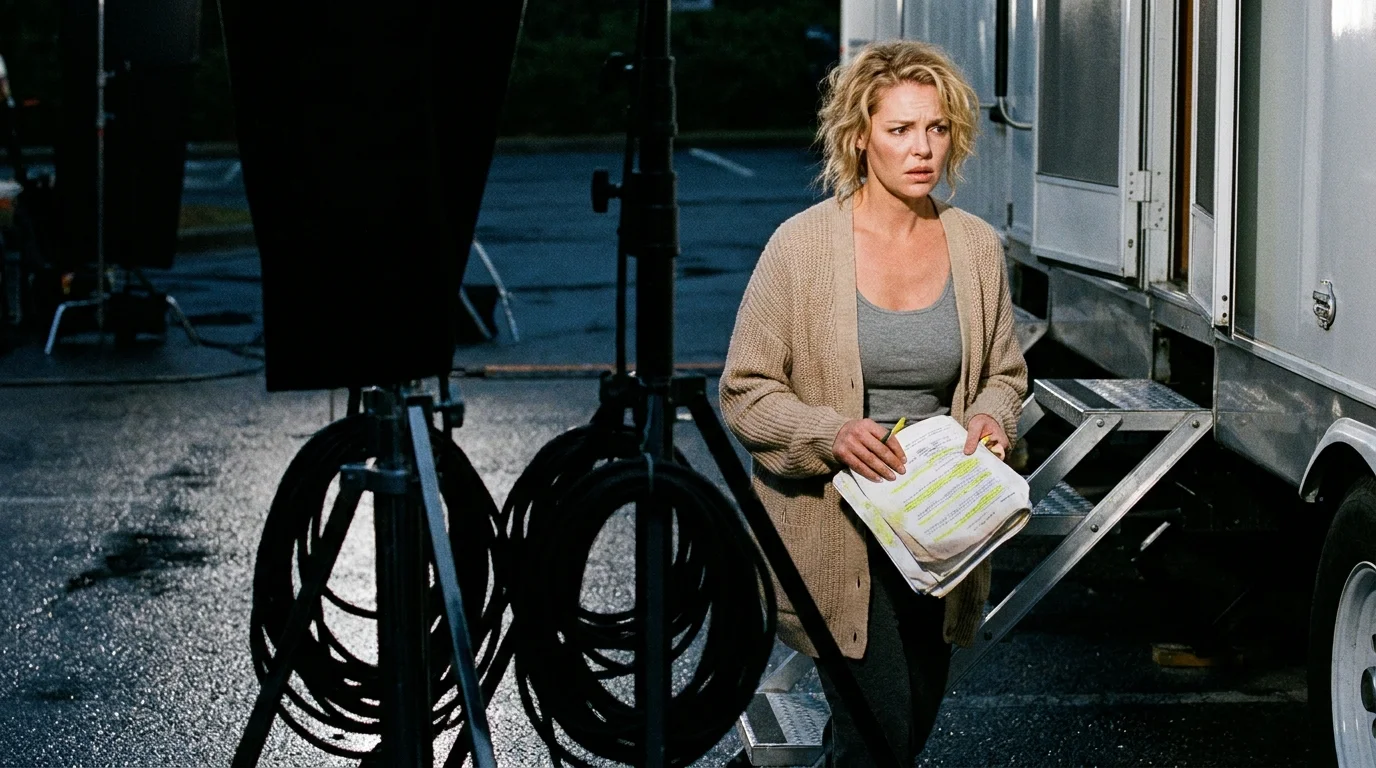
You are lying in bed with the lights off, your thumb tracing the glass screen of your phone as the clock ticks past midnight. A clip surfaces on your feed: Katherine Heigl in 2008, sitting under the warm glow of an afternoon talk show lamp, laughing with an open-throated honesty that feels rare today. She looks radiant, witty, and completely disarming as she deflects a host’s clumsy question with razor-sharp comedic timing.
You swipe up, and another one appears. This time, it is a low-resolution outtake from the set of Grey’s Anatomy, where she accidentally drops a prop medical chart, bursts into giggles, and wraps her arms around a crew member. The comments beneath it read like a choir in unison: Hollywood owed her an apology, and She was simply ahead of her time. It feels like an organic awakening, a spontaneous cultural reset born from the collective warmth of everyday viewers.
Yet nothing on your feed arrives by chance. Behind that soft grain of archival video sits a quiet, highly organized public relations machine running cold calculations at three in the morning. What appears to be an innocent wave of late-aughts fondness is actually a deliberate operation designed to overwrite history.
When you map the timestamps of these sudden viral surges, you find they appear with rhythmic precision just weeks before new contract announcements or project premieres. The trade refers to this practice as algorithmic memory laundering, a technique where wholesome nostalgia floods the system to bury decades-old whispers of production friction beneath millions of fresh, warm impressions.
The Laundromat of Digital Memory
Think of your social feed as an old acoustic chamber. If a room has an unpleasant echo—in this case, years of lingering headlines about 2008 Emmy ballot withdrawals, outspoken press interviews, and rumors of difficult working relationships—you do not tear down the walls. Instead, you fill the space with a sudden, overwhelming hum of sweet white noise until the echo can no longer be heard.
The mechanics of modern search indexing reward velocity above all else. When a digital agency seeds dozens of high-definition, endearing clips of an actor across secondary accounts, the platform’s search suggestions shift within seventy-two hours. Where an autocomplete once pulled up words like ‘dispute,’ ‘demands,’ or ‘blacklisted,’ it now populates with ‘iconic fashion,’ ‘comfort movies,’ and ‘relatable moments.’
You are not merely watching an old interview clip; you are participating in a carefully timed search engine scrub that replaces complex industry friction with harmless sentimentality.
- JoJo Siwa staged bedroom livestream unmasks agency scripted antics sparking massive fan skepticism
- Shia LaBeouf extreme method preparation alienated war movie crew and halted franchise casting
- Bethenny Frankel rehearsed podcast breakdown exposes the calculated formula driving commercial launches
- Sydney Sweeney sporty street style reveals custom designer athleisure and vintage layers
- Heath Ledger unscripted jailhouse applause sparked an accidental iconic cinematic masterpiece
The Quiet Hand Behind the Feed
Marcus Vance, a 41-year-old digital strategist based in Century City, spends his workweeks managing these exact narrative shifts for high-profile talent. He calls the process sentiment re-anchoring. ‘When a star is ready to sign on for a major studio package, the front page of Google and the top search loop on TikTok cannot look like an active courtroom,’ Vance explains while scrolling through a dashboard of engagement curves. ‘We don’t issue defensive statements anymore. Statements invite debate. Instead, we distribute forgotten, charming moments from fifteen years ago to third-party curation channels. The audience thinks they discovered the clip themselves, and the old trade disputes vanish off the first page of search results without us ever typing a denial.’
Decoding the Three Layers of Archival Resurfacing
The campaign behind Heigl’s recent wave of public goodwill is not a one-size-fits-all broadcast. It targets distinct audiences through three carefully separated digital tracks.
The Millennial Re-Evaluation Layer
For viewers who grew up watching Heigl rule the box office in the mid-2000s, the content focuses heavily on vindication. These clips highlight her past critique of romantic comedies as an early example of feminist authenticity. By reframing past public controversies as heroic truth-telling, the campaign invites older fans to feel a sense of moral justice, turning simple movie nostalgia into an emotional defense of her career.
The Next-Generation Discovery Layer
Younger viewers on short-form platforms have no living memory of the 2007 Vanity Fair fallout or cast tensions. For this demographic, the agency circulates clips focused on styling, comedic charisma, and effortless vintage red carpet glamour. Without the baggage of past trade reporting, these viewers adopt her as a retro style icon, generating organic reposts that studio executives watch closely when evaluating her commercial appeal.
The Executive De-Risking Layer
Studio heads do not consult gossip columns; they look at cold sentiment analysis dashboards provided by data agencies. When a sudden surge of positive video metrics suppresses negative historical queries, the perceived risk of casting an actor plummets. The sanitized feed serves as an insurance policy for producers who want to greenlight high-budget projects without facing legacy press questions.
Spotting the Machine Behind the Throwback
Learning to see the invisible wires behind your screen gives you your attention back. You can identify when a nostalgic trend is an authentic grassroots wave or an agency push by paying attention to a few quiet indicators.
Keep an eye out for these telltale technical signs:
- Audio uniformity: Watch if multiple unrelated accounts post different archival clips using the exact same newly uploaded, non-trending audio snippet within a forty-eight-hour span.
- The two-week anticipation window: Notice whether the wave of warm memories hits your screen precisely two to three weeks before a new production deal, casting announcement, or streaming premiere is revealed in the trade press.
- Watermark clearing: High-definition clips pulled directly from original master tapes, rather than blurry screen recordings from broadcast television, indicate that studio archives were quietly opened to outside digital agencies.
- Account age anomalies: Check the accounts sharing the clips; coordinated pushes frequently use dormant pop-culture profiles that suddenly awaken to post identical aesthetic edits.
When you recognize these patterns, you stop being a passive recipient of digital engineering and start viewing your feed with the clear eyes of an informed observer.
Reclaiming Your Algorithmic Autonomy
There is nothing wrong with enjoying an old movie clip or laughing at a brilliant piece of acting from twenty years ago. Heigl built an undeniable legacy as a comedic talent, and her work holds up on its own merits without needing a digital spin team to prop it up.
The value lies in understanding why that memory appeared on your screen at this precise second. When you realize that publicists use your natural affection for the past to sweep away difficult creative histories, you gain a quiet power over your own attention. You can appreciate the artistry while remaining entirely awake to the machinery running behind the screen.
The sharpest public relations campaigns never try to change your mind; they simply replace what you were looking at with a warmer picture from the past.
| Key Point | Detail | Added Value for the Reader |
|---|---|---|
| Search Suppression | High-volume wholesome clips suppress legacy articles about set disputes. | Helps you understand why negative career reporting disappears without retractions. |
| Targeted Micro-Edits | Different edits target Millennials for vindication and younger fans for aesthetics. | Allows you to recognize which demographic group a viral clip was constructed to influence. |
| Executive Sentiment Scoring | Agencies use positive social metrics to ease studio hesitation before new deals. | Shows you how online views directly translate into multi-million dollar casting decisions. |
Frequently Asked Questions
Why do agencies use old footage instead of new interviews?
Archival footage carries no immediate promotional baggage. A fresh interview feels like a sales pitch, while an old clip feels like a pure, uncalculated discovery made by fans.Did Katherine Heigl actively coordinate these specific clip drops?
Major talent rarely handles the technical distribution themselves. Their representation hires specialized digital strategy firms whose sole job is to monitor and optimize online sentiment metrics ahead of career announcements.How long does an algorithmic scrub take to work?
A concentrated push can noticeably shift search engine suggestions and video recommendation priority within three to five days if engagement velocity is high enough.Are past reports about set disputes actually false?
Past reports documented real friction between actors, showrunners, and studios during intense shooting schedules. The nostalgia push does not disprove past events; it simply renders them irrelevant to modern viewers.How can I stop my feed from showing coordinated agency content?
Use the ‘Not Interested’ prompt on repetitive clips, avoid engaging in the comment section of third-party curation pages, and clear your search history of the specific actor’s name.