The air inside the ballroom always smells faintly of dry ice, expensive floral arrangements, and lukewarm champagne. Under the glare of multi-million-dollar overhead rigs, the ambient temperature hovers in that crisp, synthetic chill engineered to keep nervous faces from shining on high-definition monitors. You can hear the low murmur of A-listers settling into banquet chairs, their laughter polite and guarded, waiting for the safety of a practiced routine.
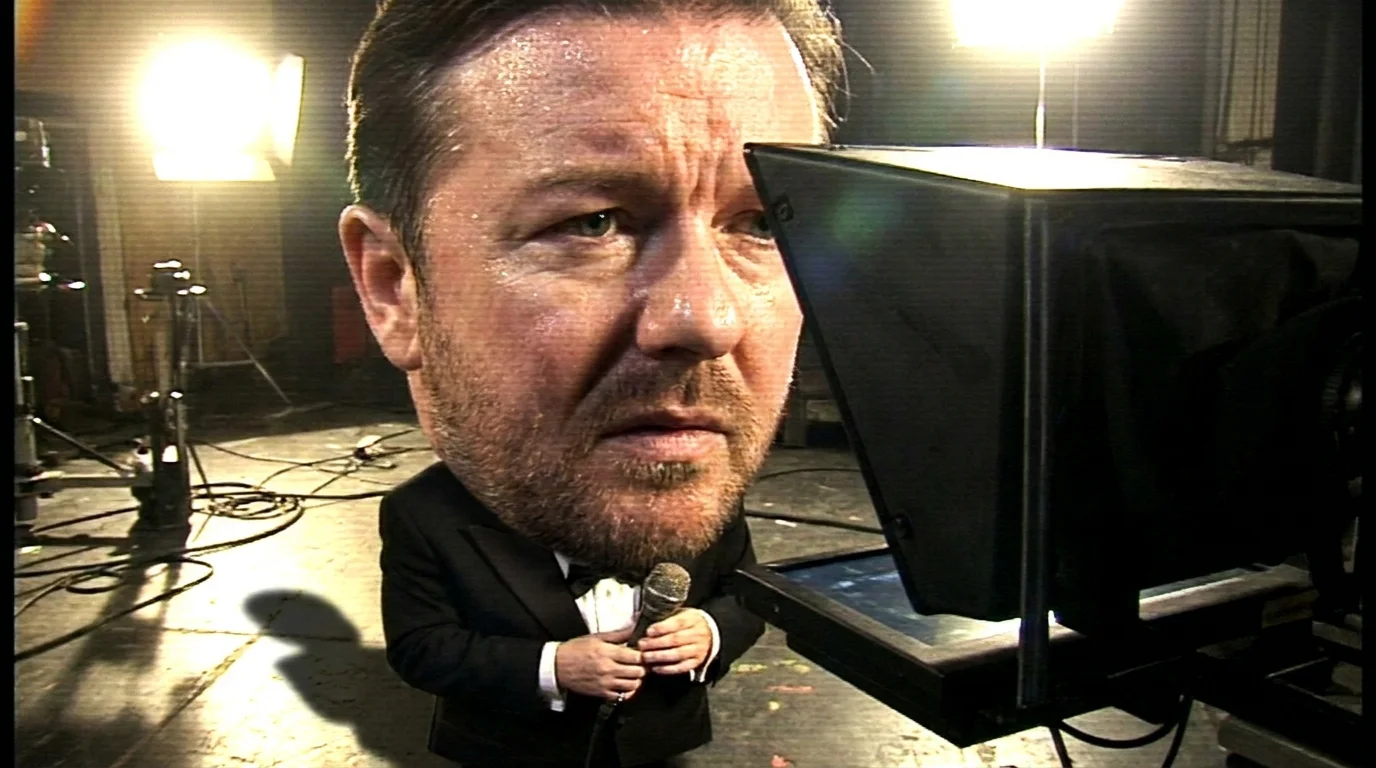
Then the camera crane swings wide, the floor manager drops his hand, and the teleprompter glass cuts dead. Instead of the steady, rolling green text that smooths over every pause in network television, the monitor suspended directly beneath camera one goes entirely pitch black. You might expect an immediate panic, an apologetic glance at the floor, or a hasty recovery joke. Instead, Ricky Gervais simply stops, leans his weight onto the lacquered podium, and stares straight through the dead glass toward the production control deck.
For five unbroken seconds, nobody breathes. In a live broadcast format measured in micro-fractions of a second, five beats of dead air feels like holding an iron kettle by the bare handle. It is the unscripted moment where the polished sheen of award-season choreography collides with raw corporate anxiety, exposing the invisible tether connecting the host to the broadcast truck.
The Illusion of the Open Microphone
You are trained to believe that when an iconic comedian takes a live microphone, they possess total command of the room. We treat the dais like an open comedy cellar where spontaneity reigns supreme, but live network television operates under the strict rules of an airlock. Every sentence you hear has passed through legal screenings, standards-and-practices reviews, and corporate sponsor clearances before its syllables ever graze an audio mixer.
Think of live broadcast hosting less like delivering a speech and more like breathing through an oxygen tube that an unseen technician can pinch shut whenever your targets stray. When Gervais stepped beyond the agreed boundary, targeting studio heads and multi-national parent companies rather than the usual lightweight vanity jabs, the reaction from the truck was not verbal. It was mechanical. The sudden blanking of the monitor was a physical emergency brake, an effort to force the host back onto the sanctioned slate.
What audiences witness in those frozen seconds is not a technical malfunction. It is an editorial stare down. When the teleprompter stops feeding words, the production team expects the host to fold into canned apologies or default banter, effectively surrendering their leverage back to the control booth.
- Tom Cruise harness rig deceleration shocks trigger hidden spinal disc compression
- Guillermo del Toro halts reshoots after studio tracks test audience skin sweat
- Florence Pugh demands zero digital smoothing exposing raw skin flaws on camera
- Billie Eilish halts stadium tour set after sudden in-ear frequency burst
- Stella Parton freezes unscripted red carpet exchange exposing quiet Nashville rift
Marcus Finch, a fifty-four-year-old live broadcast prompter technician with three decades of network experience across Los Angeles, knows this exact silence from the driver’s seat. He recalls an unscripted moment during a national awards show where the control room line went dead-silent before a floor director screamed into his headset to kill the feed. As Finch explains it, the prompter operator is never an independent agent; their fingers rest on a foot pedal, and the second unapproved targets surface in an opening gambit, the order comes down to deliberately starve the stage of text to force the talent to look down at their approved cue cards.
Anatomy of the Deadlock: Three Layers of Network Control
To understand why this specific freeze rattled network executives so thoroughly, you have to look at the invisible architecture that governs every minute of prime-time award broadcasts.
1. The Seven-Second Safety Margin
Every live telecast carries a digital buffer designed to catch profanity or actionable slander. However, standard network latency cannot save an executive when a host weaponizes calculated truth rather than crude language. Because Gervais avoided four-letter words and opted instead for precise structural critiques of studio hypocrisy, the dump button was useless. Cutting the feed entirely would create a catastrophic public relations firestorm, leaving the teleprompter kill-switch as the truck’s only passive-aggressive defense.
2. The Eyeline Coercion Dynamic
When a prompter goes dark, an untrained speaker reflexively drops their chin to look at paper cards laid out on the wooden stand. This downward gaze breaks eye contact with the home audience, subtly signaling weakness and submission. By refusing to drop his eyes to the safety notes, Gervais held the lens hostage, forcing viewers to share his uncomfortable awareness that something backstage had snapped.
3. The Corporate Shielding Reflex
Network legal teams do not care about artistic edge; their entire existence revolves around protecting the advertising roster seated at the prime center-stage tables. The instant a monologue pivots from roasting individual actor egos to dissecting institutional greed, the invisible corporate perimeter alarm trips. The frozen monitor was the visible scar of that tripwire being snapped in real time.
Reading the Silent Signals: The Off-Script Playbook
When you watch live media, learning to identify the subtle technical cues reveals an entirely separate show happening behind the scripted dialogue. Modern television is an ongoing negotiation between corporate risk managers and unpredictable human talent.
Recognizing these friction points does not require inside clearance. You only need to track the physical tells that broadcast engineers cannot hide when a segment goes off the rails.
- The Fixed Eyeline Lock: Watch for the host staring directly into the lens barrel without shifting their pupil focus up or down by a single millimeter, proving they are no longer reading text.
- The Control Deck Cutaway: Notice when the director abruptly switches to a sweeping balcony crane shot to diminish the performer’s physical presence on screen.
- The Audio Channel Clamp: Listen for sudden reductions in ambient audience microphone levels as sound mixers rush to dampen nervous crowd reactions.
- The Prop Anchor: Observe how seasoned performers use physical objects—like a glass of beer or a microphone stand—to ground their balance when the teleprompter scroll vanishes.
Mastering this perspective changes how you consume live entertainment. Rather than passive viewing, you begin to evaluate the tension between what an institution permits and what a speaker refuses to leave unsaid.
Why Unrehearsed Friction Matters in a Polished World
We live in an entertainment landscape that has been focus-grouped, smoothed down, and polished until it reflects nothing but safe commercial interests. Every public appearance, press junket, and social clip is usually designed to comfort advertisers and maintain frictionless corporate relationships. When a blank teleprompter forces an unscripted stare down on live television, the smooth veneer violently cracks.
That brief, frozen pause offers something extraordinarily rare in modern culture: authentic human friction against corporate machinery. It demonstrates that genuine credibility cannot be scrolling across a monitor; it exists solely in the space where someone is willing to endure uncomfortable dead air rather than read a sanitized script.
When you understand the mechanisms meant to silence unapproved dialogue, the silence itself becomes the most articulate statement in the room. The moment the screen went dark, Gervais did not lose his footing; he exposed the boundaries of the cage.
True authority on a live stage begins the exact second you stop depending on the words scrolling beneath the lens.
| Key Point | Detail | Added Value for the Reader |
|---|---|---|
| The Prompter Kill-Switch | Deliberately blanking the monitor to disrupt unapproved monologue momentum. | Helps you distinguish between authentic technical failures and editorial censorship. |
| The Eyeline Anchor | Refusing to drop gaze to cue cards, keeping direct connection through the camera. | Reveals how veteran speakers use body language to retain psychological control. |
| The Seven-Second Buffer | Audio dump mechanisms that fail against legal, non-profane corporate critique. | Explains why networks feel helpless when criticism is framed intelligently. |
| The Audio Ducking Reflex | Sound technicians dampening room mics to suppress audience gasps and laughter. | Trains your ear to hear network manipulation of collective public reactions. |
Frequently Asked Questions
Did the teleprompter actually break down during the monologue?
Prompter hardware in high-budget network telecasts utilizes redundant backup engines that virtually never fail simultaneously. A blank monitor during contentious monologue segments is almost always an intentional operational pause initiated by the production booth to slow down the speaker.Why couldn’t the network simply cut to a commercial break?
Cutting to a commercial break outside of predetermined ad windows triggers massive contractual penalties with advertisers and signals outright panic to millions of live viewers, causing a worse PR fallout than letting the monologue finish.How do hosts prepare when their teleprompter fails on live television?
Experienced hosts keep handwritten bullet-point cards on the podium, but elite performers memorize their thesis targets completely so they can hold direct eye contact with the camera lens if the screen is disabled.What is the legal difference between profanity and corporate criticism on broadcast TV?
The FCC heavily fines broadcast networks for vulgarities, giving technicians the legal right to hit the dump switch. Corporate criticism, however, is constitutionally protected speech, leaving the control truck with no legal mandate to censor it beyond their own financial fears.Why do audience reactions sound muted during tense live moments?
Audio engineers frequently ride the room faders, pulling down ambient audience microphones when a joke sparks nervous shock, preventing the home viewer from realizing how deeply a target landed inside the hall.