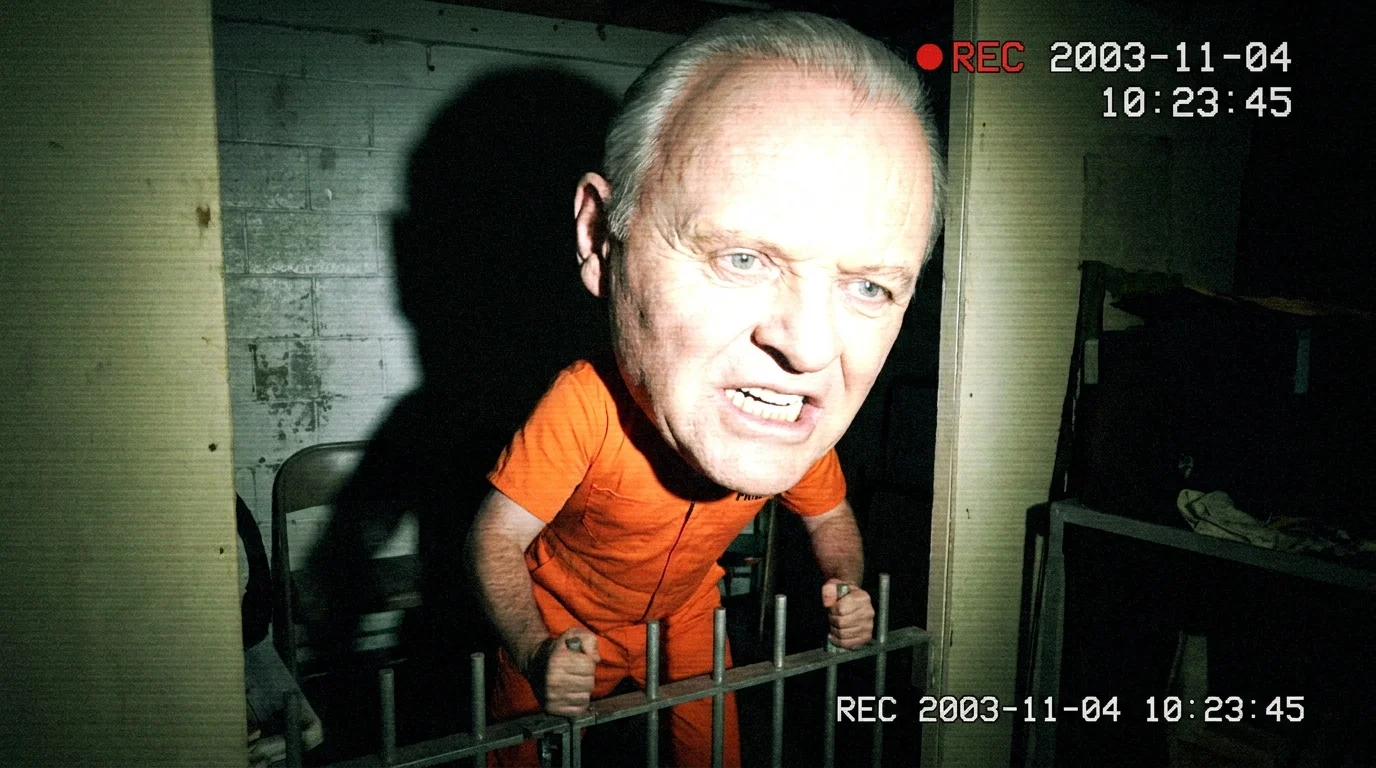
The soundstage in Pittsburgh smelled of damp limestone, industrial paint, and the faint metallic tang of overheating quartz lamps. You can picture the floor: gray concrete scrubbed bare, dead silent except for the faint hum of a cooling fan high in the rafters. Jodie Foster stood on her marks as Clarice Starling, leather bag gripped tightly against her trench coat, peering across the corridor toward a partition of clear plexiglass. Behind it stood Anthony Hopkins, utterly motionless, breathing so quietly that the sound mixer had to push the gain on his boom mic just to confirm the actor had a pulse.
The script called for a clean, chilling sign-off. Thomas Harris had penned the chilling recount of a bureaucrat consumed with fava beans and a fine wine, a line meant to end with a cold, aristocratic stare. But as the final word left Hopkins’ lips, the silence in the cavernous warehouse did not hold. Instead, Hopkins tilted his chin upward, narrowed his gaze, and sucked air violently through clenched incisors—an acoustic shiver that sounded like a starved animal savoring marrow through a cracked straw.
Foster’s shoulders hitched by half an inch. Her jaw tightened, the blood draining from her cheeks in an authentic physiological reflex that no director could ever coax through rehearsal. Hopkins had invented the predatory slur right there in the take, pulling the noise from a private childhood game and weaponizing it on the spot. When Jonathan Demme yelled cut, the sound technician simply stared at his meters, while Foster admitted her skin had erupted in goosebumps.
The Anatomy of the Unscripted Rupture
Most screen performances rely on careful choreography, where every glance and pause is calculated long before the slate claps shut. But true screen magnetism happens when an artist tears open the canvas to let raw life spill through the seams. Hopkins understood that a hyper-intelligent cannibal wouldn’t merely describe violence like an academic; he would experience the sensory memory of the meal in real time, right in front of an impressionable young agent.
Think of it as the difference between looking at an antique clock and hearing its mainspring suddenly snap. When an actor stays trapped inside the lines of a script, you remain comfortably aware that you are watching a simulation. The moment Hopkins broke the rhythm with that guttural, wet hiss, he shattered the protective fourth wall, transforming a standard dramatic interview into an immediate physical threat.
The Dailies Room Discovery
In late November of 1990, veteran film editor Craig McKay sat in a dim cutting room in New York, running the 35mm dailies of the dungeon sequence through his flatbed Steenbeck machine. McKay, who had cut decades of razor-sharp cinema, rewound the take three times in utter disbelief. The production team had initially worried the strange sound might register as an audio glitch or a microphone scratch against Hopkins’ jumpsuit collar, but McKay saw the truth instantly: Foster’s dilated pupils and rigid throat muscles told the entire story.
- Steve Carell protects thirty-year marriage enforcing a strict zero-scandal Hollywood perimeter rule
- Courteney Cox awkward red carpet glances exposed glaring relationship fractures before split
- Alicia Silverstone resurfaced nineties press junket reverses decades of unfair media criticism
- Jenna Dewan tense step-and-repeat posture triggers viral speculation over hidden industry fallout
- M. Night Shyamalan executives deliberately leak divisive cuts triggering massive ticket surges
Demme and McKay recognized that the unvarnished reaction was gold. Had Foster known the hiss was coming, her defensive training as an actress would have smoothed over her terror, turning an involuntary biological shudder into polite scene work. By catching his co-star completely off-guard, Hopkins gave the film its signature moment of dread—a brief, unwritten spasm that permanently altered how modern thrillers build tension.
Deconstructing the Performance Architecture
Understanding why that single second reverberates across cinema history requires examining how Hopkins built the character from the floor up. You can dissect his method through three distinct creative layers:
The Economy of Motion
Hopkins eliminated all nervous physical behavior. He refused to blink on camera during intense exchanges, mimicking the hyper-focused predatory gaze of reptiles. By withholding standard human micro-movements, he created a vacuum of stillness that made any sudden sound hit with the force of an artillery shell.
The Vocal Modulation
Rather than leaning into a monstrous, theatrical baritone, Hopkins pitched Lecter’s cadence between high-society refinement and mechanical detachment. He blended the flat delivery of HAL 9000 from 2001: A Space Odyssey with the barbed cadence of an exacting boarding school master, rendering the sudden wet intake of breath even more shocking against his pristine diction.
The Psychological Ambush
Hopkins deliberately avoided socializing with Foster between takes on the set. By keeping their off-screen relationship cold and distant, he preserved an aura of genuine unpredictability. When they finally stood across from each other in that basement corridor, every gesture carried genuine edge.
How to Practice Radical Creative Presence
You do not have to be an Oscar-winning performer to harness the power of disciplined restraint and sudden intuition. Whether you are delivering a keynote, pitching a room, or directing creative work, the principle remains identical: strip away the clutter so your instincts have room to strike.
Apply these precise steps whenever you need to command a room without shouting:
- Anchor your peripheral sight: Stop scanning the room constantly. Pick a steady line of focus and allow your breath to settle low in your diaphragm before you speak.
- Strip away filler gestures: Avoid fidgeting with pens, adjusting your collar, or shifting weight between your feet. Stillness commands attention far faster than frantic motion.
- Listen for the open seam: Wait until the other person finishes their entire thought before you begin formulating your own. Real timing requires resisting the urge to rehearse your reply.
- Trust the unscripted pause: If an instinctive pivot strikes you in the moment, take the risk. Safe execution breeds forgotten work; deliberate friction creates impact.
The Lasting Resonance of the Human Glitch
We live in an entertainment landscape choked with digital smoothing, predictive algorithms, and scenes calibrated by corporate committees. You can feel the sterility in modern projects where every rough edge has been sanded down before release. Hopkins’ sudden, wet hiss remains legendary precisely because it was an accident of spontaneous genius—a human glitch that slipped past the perimeter of the script.
When you look back at that dungeon corridor, you aren’t just watching two icons exchange dialogue. You are witnessing the exact instant where preparation gave way to lightning, proving that the most enduring art is always found in the uncalculated spaces between the words.
“True technique is something you must master entirely, and then completely forget the moment the camera rolls.”
| Key Point | Production Detail | Added Value for the Reader |
|---|---|---|
| The Origin | Hopkins drew the hiss from an old schoolyard impression of Dracula that he used to rattle classmates. | Shows how personal, unpolished memories can be repurposed into high-impact professional moments. |
| The Co-Star Reaction | Jodie Foster had zero advance warning that Hopkins planned to break script after the Chianti line. | Demonstrates that authentic surprise produces physiological reactions impossible to manufacture artificially. |
| The Mechanical Discipline | Hopkins maintained a rigid, unblinking stare throughout long takes to keep the camera locked on his eyes. | Illustrates how ruthless physical economy makes small deviations feel explosive. |
Frequently Asked Questions
Did Jonathan Demme instruct Anthony Hopkins to make the hissing sound?
No. The direction simply called for Hopkins to deliver the dialogue and hold an unsettling stare; the hissing flourish was entirely Hopkins’ spontaneous invention during the take.Was Jodie Foster genuinely frightened during the scene?
Foster later recounted in interviews that the sudden unscripted noise rattled her deeply, producing the visible flush and physical recoil captured in the final cut.How much total screen time did Anthony Hopkins have in the film?
Despite winning the Academy Award for Best Actor, Hopkins appeared on screen for less than twenty-five total minutes throughout the entire duration of the movie.Did the studio try to cut the improvised noise during editing?
Editor Craig McKay and director Jonathan Demme recognized its brilliance immediately in dailies and protected the take from being trimmed or dubbed over.Why did Hopkins choose that specific sound?
He wanted a guttural, sensory gesture that signaled Lecter was actively tasting the memory of his victim, shattering the character’s intellectual facade.