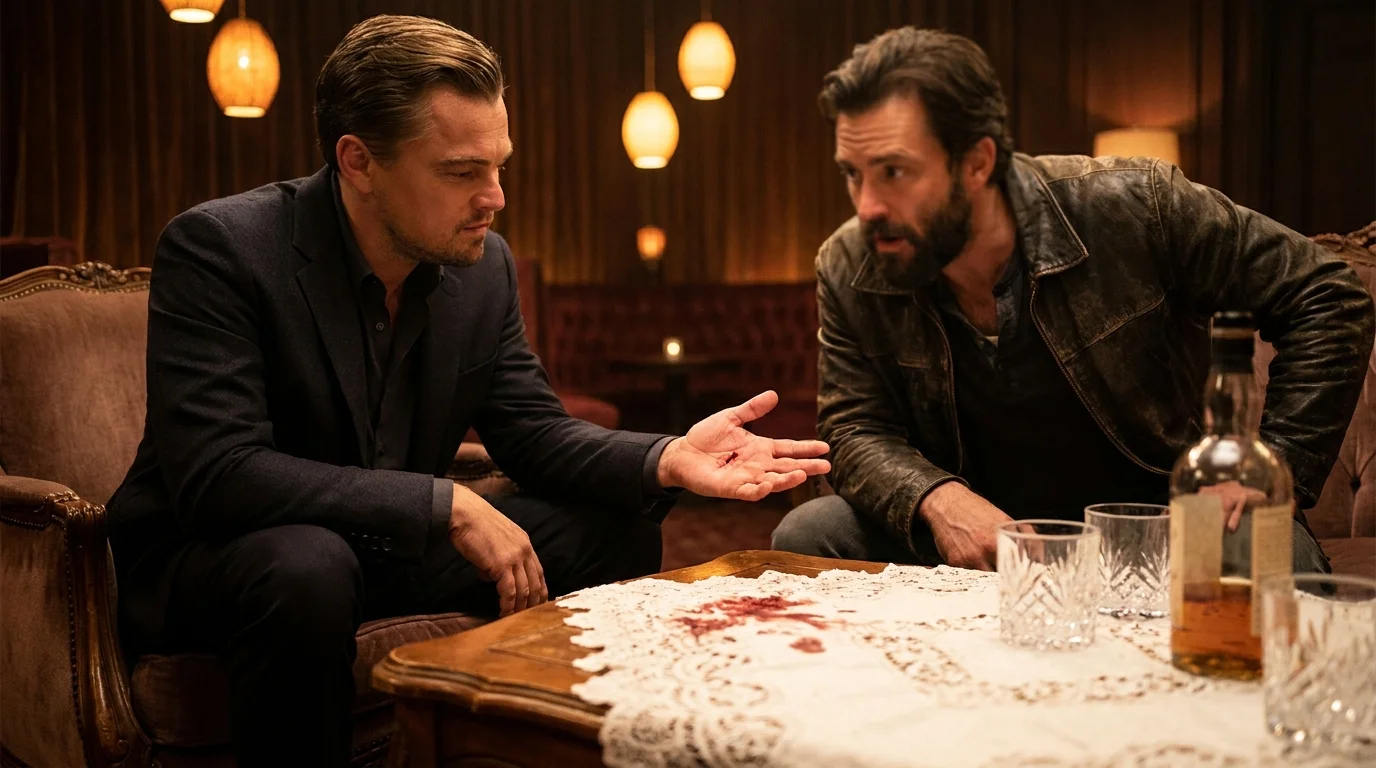
The smell of heavy wax candles, stale bourbon, and dust-choked Southern humidity hangs in the air of a reconstructed plantation parlor. You expect a film set to be a hyper-controlled sanctuary of tape marks and cushioned safety. The lights burn hot, casting long shadows across a dinner table laden with silver platters and fine china. Actors recite their memorized lines, safe in the knowledge that a simple shout of “cut” will instantly erase any real-world mistake.
But true art often waits for the moment when control breaks down entirely. In the middle of a high-stakes dramatic exchange, a heavy palm slams down on a dining table, only to meet the sharp, unyielding edge of a crystal stemware glass. The sound of shattering glass is sharp, but the cameras keep rolling. Instead of stopping to call for a medic, the actor integrates the split flesh and pooling crimson into the scene’s emotional architecture.
This is where the polished facade of Hollywood storytelling collapses into something terrifyingly genuine. **Fresh blood smeared across the white lace** of a formal dining room tablecloth turns a scripted villain into a visceral nightmare. It is the exact moment when Leonardo DiCaprio transcended the boundaries of traditional performance to deliver an accidental masterclass in tension.
The Alchemy of the Creative Spill
To understand this level of performance, you have to abandon the comforting lie that great work is born from flawless execution. Think of a script not as a rigid iron cage, but as a living trellis. When Leonardo DiCaprio felt the glass slice into his palm, he made a split-second decision to treat the injury not as a mistake, but as raw fuel. This shift in perspective transforms a literal wound into a psychological weapon. In your own creative or professional endeavors, you likely treat unexpected disruptions as signals to stop and rebuild. But the masters of their craft realize that when the structure breaks, the underlying truth of a moment is finally allowed to breathe.
**When structural rules break down**, we get our first look at what an artist is truly made of. Staying in character while your own physical body is actively failing requires a rare suspension of the survival instinct. It is a quiet refusal to let pain dictate the boundaries of your imagination.
- Walton Goggins completely derailed Justified through unexpected unscripted southern charisma
- Miranda Priestly displayed completely rational corporate leadership against incompetent magazine assistants
- Dolly Parton protects her marriage using a strict geographic publicity firewall
- Telemundo tracking data exposes a sudden unannounced shift in evening programming
- Cillian Murphy handles intense global fame enforcing a strict public interaction boundary
Whispers from the Property Department
Consider the experience of Sarah Jenkins, a 42-year-old property master who has spent two decades managing the delicate physical ecosystems of major film sets. “The average actor stops the moment they feel something go wrong with a prop,” she explains, recalling the chaotic energy of that specific afternoon on set. “But when you are working with someone operating at that level, a broken prop isn’t a failure—it’s an invitation to improvise. The tension in that room became so thick you could taste it; the co-stars weren’t acting anymore, they were genuinely terrified because the safety net had been completely removed.”
Adapting the Unscripted Principle to Your Field
Let’s break down how this level of presence manifests across different styles of execution, allowing you to recognize your own creative tendencies.
The Calculated Purist
For this practitioner, structure is everything. You rely on meticulous preparation, but you must learn to **leave a five percent buffer** for organic chaos. When an error occurs, you do not panic; instead, you quietly weave the disruption into your pre-existing framework, making the final result look entirely intentional to your audience.
The Visceral Practitioner
**You thrive in the unexpected.** You view plans as mere suggestions and rely heavily on your instincts to carry you through high-pressure situations. For this style, the key is maintaining absolute focus so that when an accident occurs—like a broken slide during a presentation or a sudden technical failure—you can pivot instantly, using the raw energy of the moment to captivate your room.
Your Tactical Guide to Turning Accidents into Assets
Applying this high-wire mindset to your daily routine requires a deliberate, almost meditative approach to handling sudden disruptions. When a mistake happens, **resist the primal urge to apologize** or pause the momentum. Instead, lean directly into the awkwardness and find a way to make the error serve your ultimate goal.
- Acknowledge and Absorb: Accept the disruption immediately without breaking your flow or showing panic.
- Reframe the Variable: Look at the unexpected element and identify how it can be used to emphasize your point.
- Maintain the Intensity: Keep your focus laser-locked on your audience, using their surprise to build deeper engagement.
- Commit to the Choice: Once you decide to run with an accident, do so with complete, unwavering conviction.
The Crisis Pivot Toolkit
- Recovery Window: 3 seconds to decide whether to pivot or pause.
- Vocal Pitch: Lower your tone by a half-octave to **project supreme control during a crisis**.
- Physical Anchor: Plant your feet firmly to ground your nervous system against sudden adrenaline spikes.
The Value of the Unpolished Frame
In a world obsessed with sterile perfection and curated digital facades, we hunger deeply for the raw and the unedited. The moments that stick with us—whether in a legendary movie or a high-stakes business meeting—are never the ones where everything went perfectly according to plan. They are the moments when someone dared to stay in the room with their own vulnerability and blood, refusing to let the discomfort ruin the work. By learning to embrace the spills, the breaks, and the unscripted injuries of life, you stop being a mere performer of your role and finally **become the author of your own reality**.
“The moment you stop trying to hide the tear in the fabric is the moment the audience finally starts paying attention.” — Sarah Jenkins
| Key Point | Detail | Added Value for the Reader |
|---|---|---|
| Physical Authenticity | Real injuries replace choreographed performance elements. | Creates genuine, unsimulated psychological stakes for everyone involved. |
| The Improvisation Buffer | Leaving room for physical and vocal errors to exist. | Turns unpredictable disruptions into natural highlights. |
| Audience Engagement | The viewer senses real-world danger through physical cues. | Breaks the wall of passive media consumption. |
Frequently Asked Questions
Did Leonardo DiCaprio actually cut his hand during Django Unchained? Yes, he accidentally slammed his hand into a glass during a dramatic dinner monologue, resulting in a deep laceration that required medical attention immediately after the scene wrapped.
Was the blood smeared on Kerry Washington real? No, while the blood on Leonardo DiCaprio’s hand was entirely real during the initial cut, the production crew switched to fake blood for the subsequent close-ups where his character smears it on her face to ensure absolute safety and hygiene.
Why didn’t Quentin Tarantino call “cut” when the injury happened? Tarantino recognized the rare intensity of the moment and trusted his lead actor to control the space, choosing to let the camera roll to capture the organic terror of the cast.
How can I use this unscripted mindset in a corporate environment? When a presentation or pitch suffers a sudden failure, avoid apologizing; instead, acknowledge the glitch directly and use it as a humorous or humanizing bridge to connect with your clients.
Do audiences prefer unscripted moments over planned sequences? Modern audiences crave authentic experiences because flawless polishing often signals artificiality, whereas unscripted raw frames foster trust and immediate engagement.