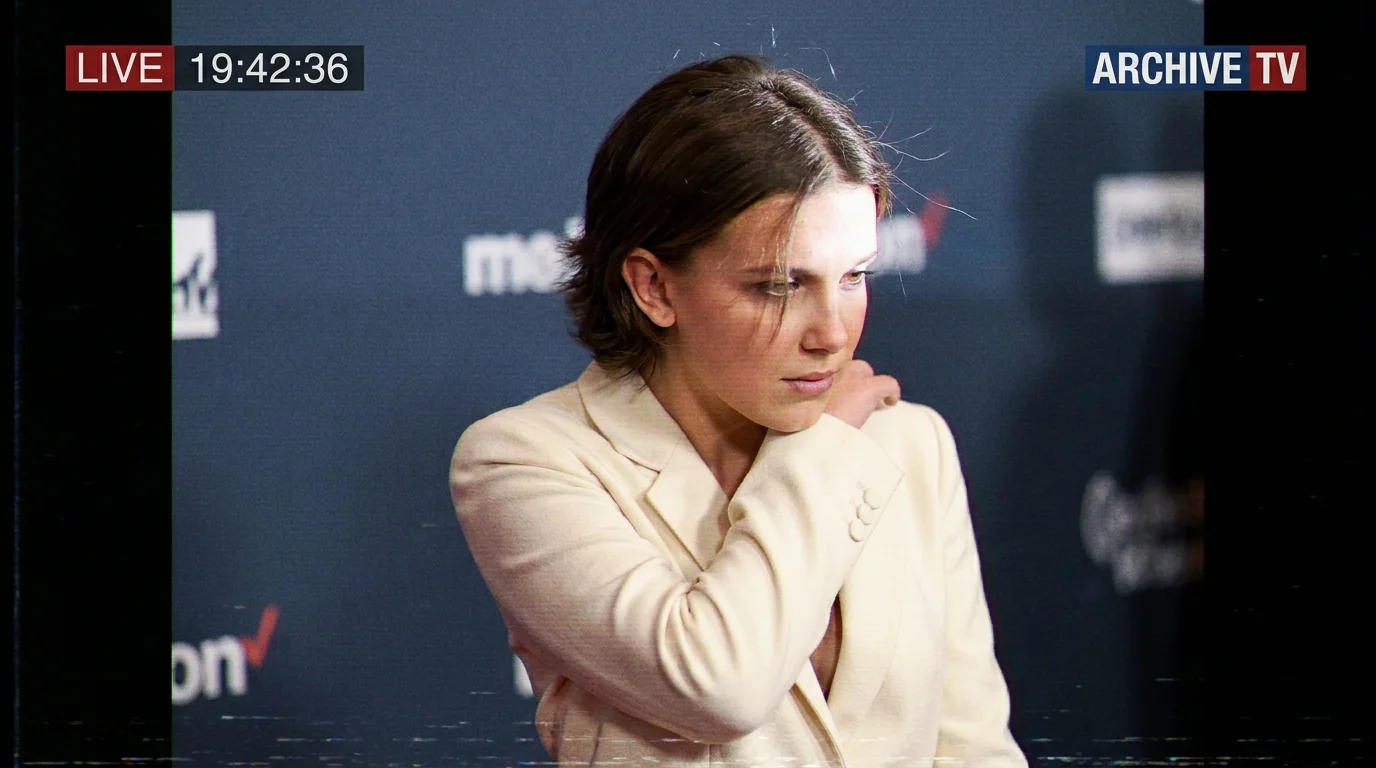
The strobe of four dozen synchronized flashbulbs carries a dull, percussive warmth against bare skin. You hear the deafening clatter of motorized shutters before you register the shouting—photographers barking first names from behind silver barricades, demanding a turn of the chin, a dropped shoulder, or a flash of teeth. On the carpet, the air smells sharply of ozone, industrial velvet spray, and hair lacquer setting under hot tungsten fixtures. To anyone watching a standard broadcast, the spectacle looks effortlessly polished.
Yet when raw footage of Millie Bobby Brown hit video algorithms last Thursday, nobody watched the tailoring of her custom gown. Instead, millions of viewers slowed down a three-second micro-moment: a sharp, four-millimeter hitch in her right clavicle, an averted gaze toward the press line, and a rigid, defensive shoulder angle that never relaxed. Within forty-eight hours, comment feeds spun that tiny physical freeze into fierce speculation about impending corporate divorces and franchise splits.
We have grown accustomed to seeing performers glide through public engagements like water pouring over smooth stone. But when an actor stops moving like an image and begins reacting like a person pressed into an iron frame, the internet reads the tension as a corporate breakdown. Before assuming this viral freeze signals the end of a multi-million-dollar studio partnership, you need to understand what actually happens to the human nervous system when legal friction meets the red carpet.
The Architecture of the Somatic Shield
When you watch someone walk a premier press wall, you are not watching a casual evening stroll; you are watching an athlete hold an isometric contraction under extreme psychological load. The industry teaches performers to view their bodies as billboards, yet the mammalian brain still treats blinding flashes and disembodied screaming as an imminent predatory strike. When contracts grow contentious behind the scenes, that subconscious panic bleeds through the seams of designer silk.
Think of the human shoulder girdle as an emotional pressure valve. Under normal circumstances, an experienced celebrity drops the scapula, allowing the collarbones to widen in an open, welcoming posture that registers on camera as warmth. However, when an individual faces ongoing corporate interrogation or high-stakes negotiations, the body builds a wall before the conscious mind can intervene. The trapezius tightens, lifting the ribs into a subtle armor plate designed to shield the carotid artery.
In Brown’s viral three-second clip, her right side angles sharply away from the step-and-repeat backdrop, creating a physical buffer between her torso and the production executives flanking the rope line. That tiny defensive angle sparked wildfire rumors of an off-camera contract dispute, because observers instinctively recognized that her physical posture was no longer aligned with the studio brand she was hired to represent.
- Ed Sheeran halts stadium show when piercing monitor feedback ruptures audio
- Craig Melvin stalls live broadcast when sudden teleprompter blackout traps unscripted monologue
- John Travolta resurfaced late night interview shatters early career disco mythology
- NSYNC viral reunion video surge launders bitter backstage licensing disputes before tour
- Charli D’Amelio unscripted tearful livestream sparks intense backlash over visible agency teleprompter
Elena Vance, a 48-year-old entertainment litigation advisor based in Century City, spends her weeks parsing the body language of young stars trapped between multi-picture obligations and corporate restructuring. She notes that an actor locked in contentious studio audits will often exhibit “scapular freezing”—a posture where the shoulders lock into place because taking a full, diaphragmatic breath feels dangerous in front of an employer you no longer trust.
Decoding the Micro-Mechanics: Frame-by-Frame Realities
To understand why this footage went viral, you have to separate physical exhaustion from calculated institutional friction. The human eye catches mechanical stiffness instantly, even if the brain cannot immediately name the cause.
The Asymmetric Shoulder Lock
In the video, Brown’s left side remains posed toward the primary camera bank, but her right shoulder drops into an interior roll. This asymmetry suggests a split focus: one half of the body is performing the contractual photo call, while the other half prepares to pivot away. It indicates divided intention, a hallmark of talent caught between publicity duties and active legal disputes.
The Ocular Disconnect
Instead of tracking the center lenses where the press pool congregates, Brown’s eyeline fixes on a point four feet above the flash heads, lingering there for two full seconds. This specific micro-expression—avoiding direct optical locking while maintaining a rigid jaw—is a classic de-escalation response. When an actor cannot speak their mind due to nondisclosure agreements, the gaze refuses to perform false intimacy with the lens.
The Torso Deflection Angle
Standard red carpet coaching instructs talent to maintain a forty-five-degree tilt toward the interviewer to signal accessibility. Here, Brown’s sternum remains locked at a blunt ninety degrees to the approaching production liaisons. That single boundary communicates an unmistakable professional distance, turning a standard photo call into an unspoken standoff.
Reading the Physical Toll: A Field Guide to Public Strain
You do not need an agent or a legal team to decode high-pressure body language. Whether evaluating an A-list star or navigating a hostile boardroom review in your own daily life, the somatic markers of institutional friction always follow a measurable rhythm.
Observe the breathing pattern rather than the smile. When someone performs under severe contractual strain, the abdomen stays flat and immobile, forcing shallow respiration into the upper third of the chest. This creates a visible trembling along the clavicle line that heavy makeup cannot disguise.
- Watch the fingers: A clenched thumb tucked beneath the index finger signals a conscious suppression of anger or defensive speech.
- Track the pivot speed: Natural transitions between camera banks take roughly 1.5 seconds; forced, defensive rotations occur in under 0.8 seconds as the subject rushes to complete the line.
- Notice the baseline stance: Feet planted narrower than shoulder-width indicate an instinctive impulse to occupy minimal space and minimize exposure.
By shifting your focus away from the gossip headlines and onto these concrete physical mechanics, you see the raw friction beneath the public relations glaze.
The Bigger Picture: Beyond the Soundstage
The viral reaction to three seconds of footage reveals far more about our modern viewing habits than it does about any single studio contract. We live in an era where candid moments have become so scarce that audiences treat a split second of natural human tension as definitive proof of a massive corporate war. We analyze micro-movements because we are starved for anything unscripted.
When you see a young woman who has worked inside the Hollywood machine since childhood lock her shoulders and pull her eyes away from the lights, you are not watching a juicy tabloid scandal. You are watching the quiet, necessary boundary of an artist learning how to hold her ground against institutional pressure. Recognizing that difference allows you to stop consuming the manufactured drama and start appreciating the resilience required to survive in the brightest rooms on earth.
“True composure on a press line is rarely about looking relaxed; it is about knowing precisely how much of yourself you are willing to surrender to the cameras.”
| Key Point | Detail | Added Value for the Reader |
|---|---|---|
| Shoulder Angle Deflection | Asymmetrical scapular lock angled away from studio representatives. | Clarifies how physical positioning reveals hidden professional boundaries. |
| Averted Eyeline | Two-second fixed gaze above camera lenses instead of direct contact. | Distinguishes authentic boundary-setting from mere red-carpet fatigue. |
| Respiration Restriction | High thoracic shallow breathing visible around the clavicle. | Provides a practical tool for spotting high-stress suppression in any public setting. |
Did Millie Bobby Brown comment on the viral red carpet clip?
Neither Brown nor her legal representatives have directly addressed the clip, letting her continued filming schedule serve as her sole public response.Why did fans assume the stiff posture was linked to a contract dispute?
The tension coincided with industry reports regarding renegotiations for her upcoming slate, causing viewers to interpret her body language as friction with franchise executives.Can stiff posture simply be the result of a tight dress?
While structured couture and corsetry certainly limit mobility, the specific asymmetry of her shoulder lock and ocular avoidance point toward stress rather than wardrobe constraints alone.What is ‘somatic freezing’ in high-profile performers?
It is an instinctual nervous system freeze where an individual locks their posture to retain control when confronted with overwhelming sensory and institutional demands.How can I spot the difference between shyness and professional friction?
Shyness typically involves downward head tilts and nervous self-soothing gestures, whereas corporate friction produces rigid spines, fixed eyelines, and defensive territorial angles.