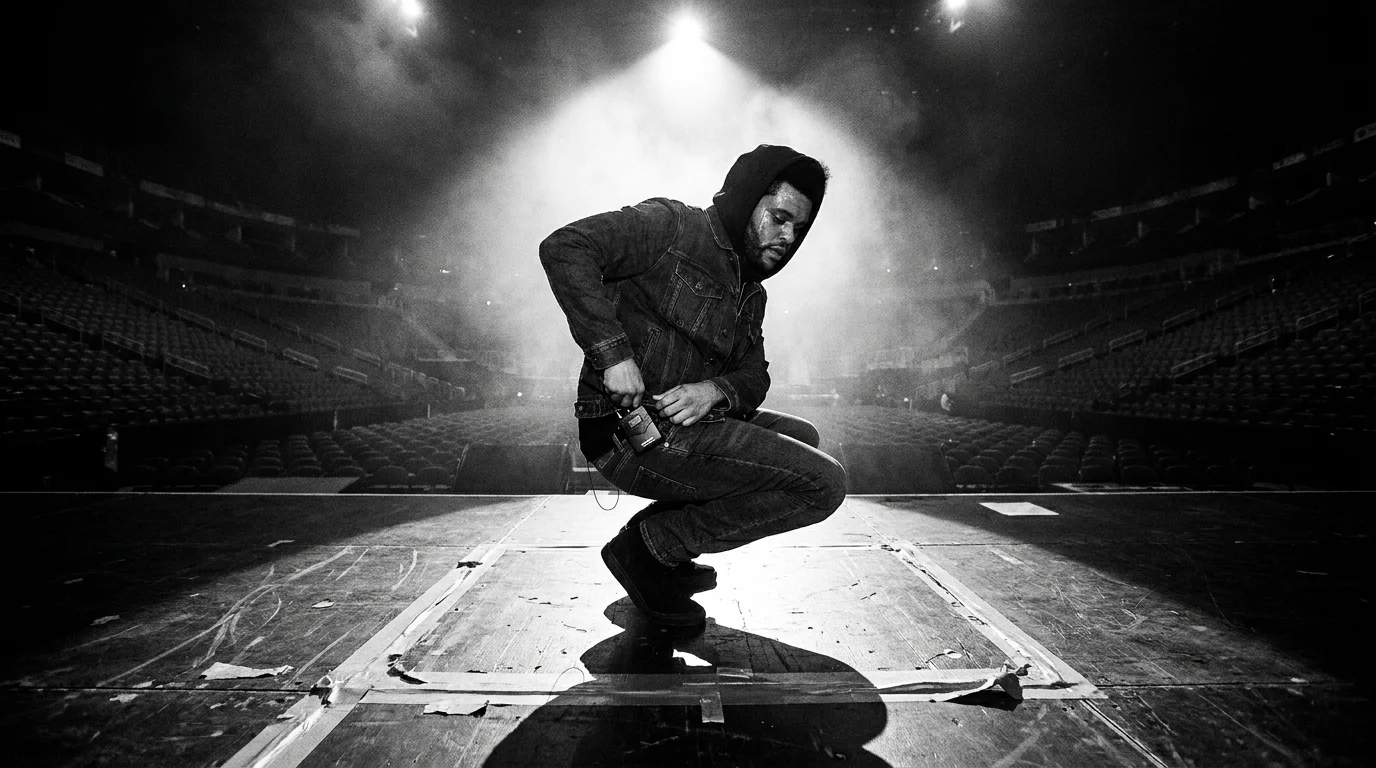
Stand in the center of an eighty-thousand-seat NFL arena on a brisk October evening, and the air smells like glycol fog machine fluid, rain-slicked concrete, and damp denim. When Abel Tesfaye steps onto the illuminated catwalk under the blinding stadium arrays, the expectation hanging over you is absolute sonic clarity. You expect the crystal-edged, soaring head voice of ‘Blinding Lights’ or ‘Save Your Tears’ to slice through the cold open air just as smoothly as it did through your studio headphones.
Then the chorus detonates, and something visceral takes over. The notes sound immaculate, yet your ribcage vibrates so violently against your spine that you can barely draw a full breath. You assume you are witnessing vocal gymnastics that defy human biology, delivered with effortless studio sheen while sprinting across ninety yards of staging.
Look toward the soundboard sitting dead center behind the floor seats, however, and you see a wildly different story unfolding on the spectral analyzers. What feels like emotional sonic power is actually a masterclass in acoustic masking, engineered to solve one of touring pop music’s oldest dilemmas: keeping a fragile, fatigue-prone falsetto sounding infallible when human vocal cords inevitably begin to waver.
The Psychoacoustic Blanket: Why Your Ribcage Hears What Your Ears Miss
To grasp what happens during these massive stadium choruses, you have to abandon the romantic idea that live sound reinforcement is simply about turning up a singer’s microphone. Think of an arena sound mix not as a transparent pane of glass, but as a deliberate architectural dam. When a vocalist pushes their instrument through two hours of demanding melodic lines night after night, pitch drift is not a failure; it is basic human physiology.
Instead of exposing every microscopic flat note or vocal crack to fifty thousand paying fans, touring sound directors exploit a fundamental quirk of human hearing known as auditory masking. When a massive, low-frequency sound wave hits your ear at an overwhelming volume, your brain’s auditory processing centers literally cannot resolve subtle frequency discrepancies happening higher up the sonic register. The sensory system chooses the physical shockwave over micro-tonal precision.
By flooding the floor with brutal sub-bass pulses calibrated right around fifty hertz, the production crew creates an acoustic shock absorber. The sheer kinetic force of the subwoofers acts like breathing through a heavy pillow, smothering the ragged edges of vocal drift before your brain can isolate them.
- Henry Cavill exposes violent suspension rig drops compressing spine during action shoot
- Joaquin Phoenix confronts studio brass after biometric screen tests force sanitized reshoots
- Charlize Theron rejects digital skin smoothing demanding unforgiving raw macro framing
- Millie Bobby Brown stiff red carpet posture sparks viral split speculation
- Ed Sheeran halts stadium show when piercing monitor feedback ruptures audio
The Arena Soundboard Secret
Marcus Vance, a 48-year-old touring systems engineer who has spent twenty-four years balancing line arrays for stadium-tier pop and R&B acts across North America, knows the boundary between technical reality and fan perception better than almost anyone. ‘People think stadiums sound like giant recording studios,’ Vance explains while pointing to a low-frequency analyzer glowing red during a pre-show line check. ‘In reality, an open-air stadium is an acoustic dumpster fire. A fragile tenor falsetto has zero mass to fight thirty-mile-per-hour wind gusts or twenty thousand fans screaming at 105 decibels. If you don’t park thirty dual-eighteen-inch subwoofers under the downstage lip to anchor the dynamic floor, your singer is going to sound paper-thin and noticeably sharp or flat within three songs.’
Anatomy of the Low-End Shield
The illusion is not an accident; it is built on deliberate frequency tiering that dynamically alters the balance between the vocal track and the building’s physical structure.
The Falsetto Vulnerability Zone sits squarely between 1.5 kHz and 4 kHz. This is where vocal presence lives, but it is also where pitch imperfections, dry mouth clicks, and breath exhaustion become immediately glaring. If an engineer runs this vocal dry and unassisted at full stadium volume, every minor microtone slip feels agonizing.
The Sub-Array Deployment answers this vulnerability from below thirty-five to eighty hertz. Rather than using bass strictly for rhythmic groove, modern touring rigs deploy cardioid subwoofer arrays stacked beneath the catwalk. When the chorus hits, these cabinets pump massive kinetic energy that travels through the stadium concrete directly into your feet and sternum, physically overwhelming your nervous system and masking high-register pitch drift with pure physical presence.
Dynamic Side-Chain Compression acts as the invisible glue. The moment the live vocal microphone detects erratic pitch stabilization or volume drops from physical fatigue, automated mixing algorithms instantly bump the low-end synth bass and 808 hits by two to three decibels. The audience interprets this as a dramatic surge in song energy, never realizing the mix just stepped in front of a tiring voice.
Listening Past the Shockwave: A Field Guide
If you want to experience live arena audio like an acoustic designer rather than a passive observer, you can train your senses to hear behind the production curtain during your next concert.
Step out from the center axis of the main speaker line arrays. The heaviest low-frequency summation happens directly on the stadium turf between the mix position and the stage.
- Position yourself twenty rows up on the lower stadium bowl, slightly off-axis from the stage edge, where subwoofer coupling drops by roughly six decibels.
- Insert flat-response acoustic earplugs rated for sixteen to twenty decibels of attenuation to cut the sensory overwhelm of room reflections.
- Focus your attention on the tail ends of long, sustained vowel phrases rather than the explosive downbeat of the hook.
- Watch the performer’s throat and posture during high-octave transitions, comparing their physical exertion to the steadiness of the audio.
By dampening the chest-thumping room resonance with proper hearing protection, the acoustic mask thins out. You suddenly hear the human instrument working beneath the machinery: the natural grain, the vocal micro-corrections, and the moments where pure technology rescues an exhausted voice.
The Industrial Illusion of Pop Perfection
Understanding this acoustic trickery does not diminish the show; it reframes it. Pop culture has conditioned us to demand impossible robotic consistency from human artists who must sprint across stages the size of aircraft carriers while singing demanding melodies. In response, modern production has transformed sound design into a high-stakes safety net.
The sub-bass blast is not an act of deception so much as an unspoken contract between the entertainer and the crowd. We want the myth of flawless vocal perfection under the blinding lights, and the sound engineers build the acoustic armor required to deliver it. When you feel that rumble hit your chest during the next arena anthem, you are not just hearing music—you are feeling the sound of human limitation protected by pure engineering.
‘The modern stadium pop show is less about pure vocal transmission and more about managing physical acoustics so the human being on stage survives the night.’
| Acoustic Mechanism | Technical Execution | Perceptual Payoff |
|---|---|---|
| Auditory Masking | Pumping high-SPL 40-70Hz sub frequencies during demanding choruses. | Conceals pitch drift and vocal fatigue behind tactile low-end impact. |
| Cardioid Array Directionality | Directing bass energy into the crowd while cancelling it on stage. | Keeps the singer’s in-ear monitors clean while shaking the audience floor. |
| Dynamic Side-Chain EQ | Triggering lower-octave synth boosts whenever vocal intensity wavers. | Replaces lost vocal power with perceived musical momentum. |
Frequently Asked Questions
Is Abel actually singing live during these stadium shows?
Yes. The vocal microphone is live and running through active processing, but the raw input is heavily augmented by backing stems, pitch correction inserts, and aggressive low-end instrumentation designed to blend the performance together.Why don’t arena sound engineers just turn up the vocal microphone?
Cranking a microphone in a reflective concrete stadium causes massive acoustic feedback and catches unwanted stadium reflections, instantly muddying the mix.Does wearing earplugs make vocal masking easier to spot?
Yes. High-fidelity earplugs reduce the overwhelming sound pressure levels that induce psychoacoustic masking, letting you hear the singer’s unadorned pitch more accurately.Is sub-bass masking unique to The Weeknd?
No. Almost every stadium-level pop, hip-hop, and R&B touring act uses low-frequency room saturation to mask dynamic vocal variance and vocal cord exhaustion.Can sound engineers fix off-key notes in real time without bass?
Modern digital consoles use live pitch tracking, but if a singer drifts sharply outside the targeted scale, the software can glitch or produce audible artifacts, making a sonic bass shield much safer.