Fifty thousand people are shouting in unison, the warm night air thick with the smell of sweet draft beer, ozone, and spent pyrotechnics. You see Dave Grohl planting his boots center stage, swinging his blue Gibson Trini Lopez into position, teeth bared as the opening chords tear through the stadium array. To everyone standing on the turf, the machine of arena rock appears completely indestructible, an iron locomotive running on pure adrenaline.
Then, the invisible circuit snaps. Inside the tiny acrylic canal molded directly to Grohl’s inner ear, a stray frequency loop turns feral. It is not the warm roar the crowd hears; it is a surgical, needle-sharp spike of high-pitch monitor feedback blasting at an ear-splitting volume, hitting the eardrum without warning. In an instant, that internal soundscape goes from balanced mix to pure physical assault.
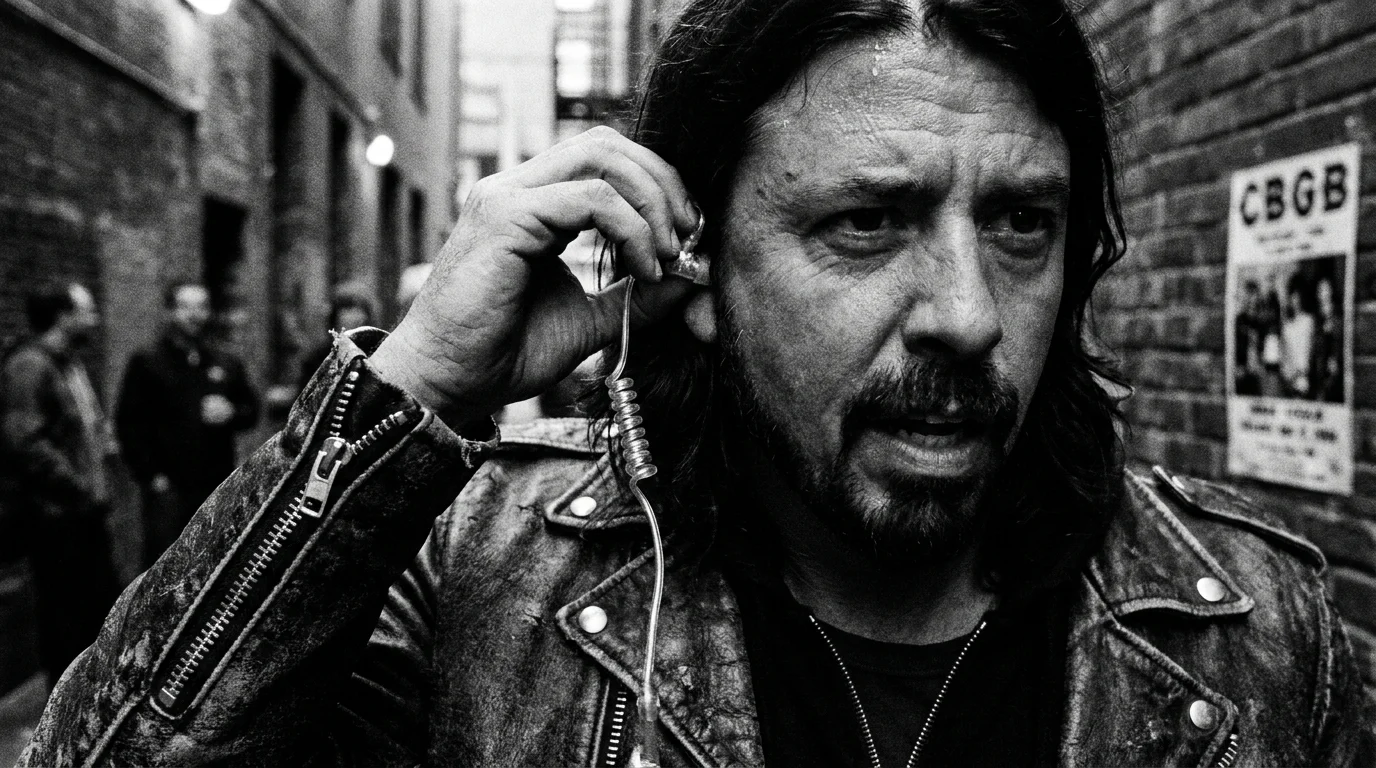
Grohl does not wave off a tech or try to play through the measure. His right hand instantly leaves the strings, clutching his ear as he wrenches the molded monitors free, letting them dangle down his sweat-soaked shirt collar. The guitar chokes mid-riff, replaced by the hollow thump of muted pickup coils. For three bizarre, unscripted seconds, tens of thousands of fans hold their collective breath as the loud frontman stops the entire show in its tracks.
The Fragile Architecture of Stadium Silence
You might imagine a stadium concert as a monument of brute acoustic force, but beneath the surface, it functions more like open-heart surgery performed inside an airport hangar. The musicians on that stage are not listening to the towering wall of speakers facing you; they are living inside a closed-loop audio bubble. Modern in-ear monitors (IEMs) isolate the performer almost completely from the outside world, replacing the deafening stadium echo with a pristine, low-volume studio mix.
That isolation is a double-edged sword. When a wireless radio frequency drops, or an analog microphone picks up its own amplified signal through a boundary monitor, the result is instantaneous. Because custom-molded sleeves seal the ear canal completely, high-frequency transients have nowhere to dissipate, transferring explosive acoustic shock directly to the delicate cilia of the cochlea.
Marcus Vance, a 44-year-old touring radio frequency coordinator who has spent two decades managing wireless rigs for global stadium tours, knows that terror intimately. “People think rock stars are being dramatic when they rip an earpiece out mid-song,” Marcus explained during a Nashville sound check. “They don’t realize an uncompressed feedback runaway can hit 120 decibels inside a quarter-inch space in under eight milliseconds. It feels like someone drove a red-hot finishing nail straight into your brain stem. Stopping the band isn’t an ego trip; it’s basic biological self-defense.”
- Alix Earle bedroom livestream leaks agency script sparking intense fan skepticism
- Camila Cabello podcast breakdown precedes massive commercial cosmetic rollout
- Ezra Frech debuts structured tailored houndstooth blazer during Manhattan gala appearance
- Robin Williams unscripted Good Will Hunting monologue shattered emotional rehearsal boundaries
- Kevin Bacon protects four decade marriage enforcing strict off camera living rules
Three Distinct Layers of Stage Shock
Every audio breakdown inside a massive venue carries its own signature panic. Recognizing what went wrong reveals the precise mechanics of live sound production.
For the Wireless Signal Specialist: Radio Intermodulation
Modern stadiums sit in the middle of dense metropolitan RF fields saturated by digital television signals, emergency radio dispatch, and thousands of personal cellular hotspots. When two discrete frequencies cross paths, they spawn ‘ghost’ artifacts that can inject full-scale digital clipping into an artist’s receiver pack, transforming a gentle click track into a harsh acoustic buzzsaw.
For the Front-of-House Mixer: Stage Bleed Feedback
When an energetic performer roams past the physical boundaries of the main speaker line, raw sound from front-fills can wash back into an open vocal condenser mic. The microsecond delay between the speaker cone and the capsule triggers an exponential feedback loop that punishes sensitive monitoring systems instantly before an operator can tap a mute group.
For the Frontman: The Neurological Jolt
When you are singing at peak physical output, your throat tissues, jaw, and skull conduct immense internal volume. An unexpected monitor blast disrupts your vestibular system, instantly stripping away your pitch reference and spatial balance. Tearing out the hardware mid-riff is an involuntary reflex, an instinctive move to protect lifelong hearing over stage momentum.
The Safe Protocol for High-Fidelity Listening
Whether you are performing under stadium floodlights or tuning a pair of custom monitors in your home studio, protecting your ears from rogue frequency spikes requires deliberate, disciplined setup habits.
- Engage brickwall hardware limiters: Always ensure your wireless receiver or headphone amplifier includes an analog output ceiling calibrated well below threshold danger levels.
- Never wear both drivers loose: Leaving one mold half-inserted breaks the acoustic seal, tempting you to crank the master volume up to drown out stage noise.
- Maintain clean frequency sweeps: Scan the local radio spectrum minutes before downbeat to catch intermittent interference from broadcast towers.
- Establish a visual distress cue: Agree on a clear physical gesture with your monitor engineer to communicate audio issues without killing the performance.
When Grohl stepped up to his mic to tell the crowd what happened, he was not apologizing for a glitch—he was reclaiming control over an unpredictable analog environment. He waited until the front-of-house engineer resolved the hot channel, laughed off the shock with self-deprecating humor, and counted the band back in with twice the fire.
The Value of Acoustic Presence
We often demand flawless, automated perfection from the cultural icons we watch under the lights, forgetting that stadium concerts are volatile physical feats. That split second where Dave Grohl silenced fifty thousand people reminds us that real performance requires living on the edge of technical chaos.
When you encounter a sudden, jarring disruption in your own craft, the most professional move is rarely to grit your teeth and endure unnecessary injury just to save face. Real authority knows when to stop the music, clear the interference, and start the song again on your own terms.
“You can replace an amplifier, a microphone, or a stadium cable in thirty seconds, but you only get one set of eardrums for an entire lifetime.”
| Stage Failure Variable | Root Cause Mechanism | Practical Takeaway |
|---|---|---|
| In-Ear High Frequency Spike | Analog microphone feedback looping into an unconstrained monitor mix | Always employ brickwall limiting to cap transient spikes at 85 dBA |
| Wireless Pack Dropout | RF intermodulation caused by local broadcast interference | Scan and coordinate spare transmission bands before every live set |
| Mid-Song Performance Halt | Artist self-preservation response to protect hearing and regain pitch | Prioritize physical safety and technical clarity over maintaining appearances |
Frequently Asked Questions
Why don’t rock musicians use floor monitors instead of in-ear monitors?
Floor wedges produce immense stage volume that bleeds into open vocal microphones, creating a muddy sound for the audience and increasing long-term hearing damage risks for the band.Can a sudden feedback blast in an ear monitor cause permanent hearing damage?
Yes. Sound spikes exceeding 115 decibels delivered directly into a sealed ear canal can instantly fatigue or destroy the tiny hair cells of the inner ear, leading to tinnitus or acute acoustic trauma.What does a brickwall limiter actually do in an audio pack?
A brickwall limiter acts as an unyielding ceiling for audio signals, instantly compressing or cutting off any volume that exceeds a pre-set threshold before it can reach your ears.Why did Dave Grohl stop the whole song instead of just taking the ear piece out?
Without hearing his monitor mix, an artist in a massive stadium hears only delayed, echoing venue sound, making it virtually impossible to maintain correct pitch, tempo, and band coordination.How can independent musicians avoid dangerous monitor feedback on stage?
Keep vocal microphones pointed directly away from monitor speakers, avoid over-boosting high frequencies in the monitor EQ, and set strict gain structures during pre-show soundchecks.