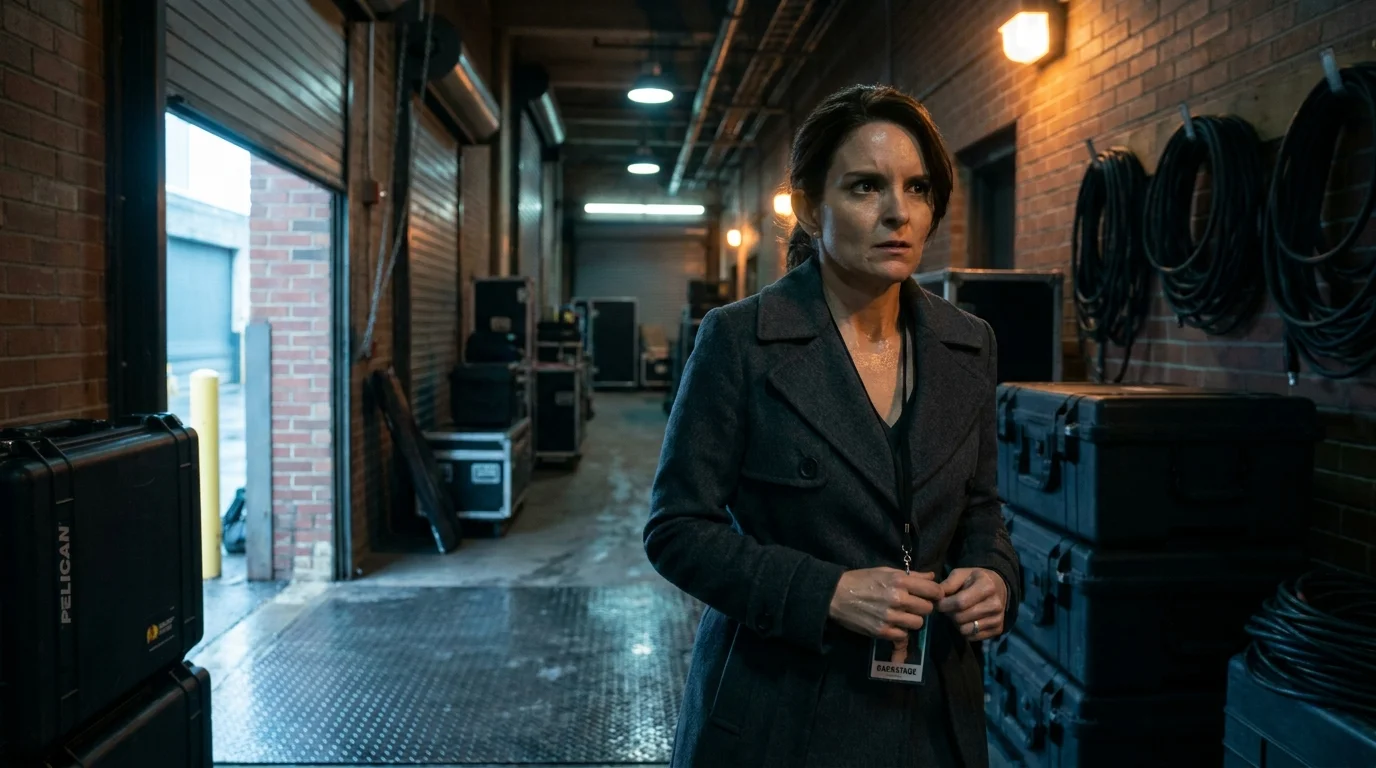
The floor of a live network broadcast runs on dry ice, cold coffee, and an aggressive sixty-two degrees Fahrenheit engineered to keep massive camera pedestals from overheating. Under the blistering throw of overhead halogens, your collar clings damply to the nape of your neck while the countdown hums inside an earpiece. You watch a seasoned veteran like Tina Fey plant her heels exactly on the spike mark, waiting for the smooth, rhythmic crawl of bright green 56-point font across a mirrored pane of glass.
Then the text stutters. It shudders upward two erratic inches, jerks sideways, and drops into complete, empty blackness. In an arena packed with three thousand restless industry peers and an invisible audience of eight million live viewers, silence does not arrive gently; it crashes like a dropped tray of glassware.
For five agonizing seconds, you are witnessing the absolute breakdown of network television’s most guarded illusion. Fey stands locked in a silent standoff with the control room booth, her eyes narrowing at the dark lens while executive producers scramble through the intercom, terrified of what happens when an elite improviser is left alone with an open microphone.
The Glass Tether: Why Corporate Television Fears the Unwritten Word
We are conditioned to believe that live comedy on network primetime is an act of spontaneous wit, a high-wire display of nerve and timing. The reality is far colder: commercial broadcasting is an industrial conveyor belt calibrated down to the third decimal of a second, where every syllable has been pre-cleared by standards, legal counsel, and network brand partners.
When a teleprompter dies, the invisible machinery of corporate risk management instantly reveals its teeth. You might expect a celebrated alumnus of improvisational theater to seamlessly launch into crowd work, but inside the acoustic vacuum of a major awards broadcast, unscripted humor represents a catastrophic commercial liability.
The teleprompter is not merely an aid for memory; it is a legal perimeter that shields the network from unpredictable FCC fines, advertiser boycotts, and sudden corporate friction. The moment that glowing monitor freezes, the artist faces an immediate psychological conflict: rescue the dead air with raw instincts, or respect the rigid corporate leash that keeps the broadcast on air.
- Jason Statham endures debilitating spinal compression from brutal suspension wire deceleration drops
- Neill Blomkamp halts studio reshoots after executives weaponize biometric audience screening data
- Nicole Kidman rejects digital skin smoothing demanding raw unforgiving macro closeups
- Dave Grohl halts stadium concert after high pitch monitor feedback spike
- Alix Earle bedroom livestream leaks agency script sparking intense fan skepticism
David Halpern, a fifty-four-year-old veteran audio patch engineer who spent two decades inside network control trucks at Rockefeller Plaza, describes the room the second a glass rig fails as pure organizational vertigo. “The instant the scroll halts, the control truck screams like an aircraft cockpit losing hydraulic pressure,” Halpern explains. “Directors don’t look at the stage; they glare at the red standards-and-practices button, terrified the talent is about to say something true.”
The Anatomy of the Deadlock: Control Room vs. Stage Reflexes
To understand why Fey’s frozen posture became such an electrifying cultural artifact, you have to dissect the split-second calculus taking place between the stage boards and the production truck parked in the alleyway.
When the screen goes dark, two fundamentally opposed philosophies collide within a fraction of a heartbeat:
- The Improviser’s Instinct: Rooted in stagecraft, this reflex demands that dead air be killed immediately using local irony, physical observation, or self-deprecating commentary to bridge the technical void.
- The Network Containment Protocol: Driven by compliance monitors, this reflex demands silence or an immediate pivot to a pre-packaged commercial pod, neutralizing any possibility of unscripted slander or controversial ad-libbing.
Fey’s calculated stillness on that stage was not stage fright; it was an unspoken negotiation conducted under thirty-thousand watts of studio lighting. By withholding an easy, unvetted joke, she forced the broadcast machinery to sit in its own mechanical failure rather than using her sharp comedic reflex as free corporate spackle.
Navigating the Freeze: The Mechanics of Grace Under Studio Fire
You do not need to host a prime-time telecast to experience the suffocating shock of an uncued system failure. Whether an executive deck crashes during an all-hands boardroom meeting or a public microphone cuts out mid-pitch, the physiology of dead air is universal.
Surviving that sudden vacuum requires unlearning the frantic impulse to immediately fill the space with nervous sound. Mastery lies in controlling the baseline tempo before you utter a single word.
- Anchor your peripheral field: Never look down at your notes or scan the floor. Keep your gaze locked firmly on the principal lens or the back row of your audience, signaling complete composure.
- Regulate the micro-pause: Inhale through your diaphragm for four deliberate seconds; deliberate silence reads as dramatic tension rather than technical panic.
- Acknowledge the frame, not the fault: If speech is necessary, identify the technical breakdown with minimalist irony rather than frantic apologies.
The Tactical Toolkit for Unscripted Friction
Executing high-stakes communication when your external support structures evaporate demands a deliberate, physical approach to human attention:
- The 3-Second Rule: Count three internal beats before reacting to an audio or visual glitch to allow production switches to resolve.
- Focal Plane Anchoring: Select an off-camera lighting tech or physical rig point thirty degrees off-center to ground your eyes without breaking character.
- The Neutral Vocal Floor: Lower your speaking pitch by roughly half an octave to prevent stress-induced vocal cord tightening.
- The Tactical Micro-Nod: A slight, steady acknowledgment toward the floor manager establishes that you are waiting out the system on your own terms.
The Vanishing Edge of Live Entertainment
There was a time when television drew its vitality from the ever-present danger of human error, the thrill of knowing that an actor might slip, an unapproved sketch might air, or an unscripted truth might leak through the cathode-ray tube. Today, that edge has been polished away by multi-tiered corporate syndicates and algorithmic safety checks.
When a teleprompter monitor cuts out on Tina Fey, the sudden chill is intoxicating because it briefly tears the shrink-wrap off our over-sanitized media landscape. It reminds you that underneath the layers of institutional legalism, sponsored segments, and corporate gloss, live performance is ultimately just a solitary human being standing before thousands of strangers, deciding whether to follow the script or speak their mind.
“When the screen dies, you finally see who owns the silence: the person holding the microphone, or the corporation running the wire.”
| Key Point | Detail | Added Value for the Reader |
|---|---|---|
| The Mechanical Failure | Uncued monitor freeze on live national broadcast. | Illustrates how fragile expensive production infrastructure truly is. |
| The Strategic Pause | Refusing to immediately ad-lib unauthorized network humor. | Demonstrates boundary control under intense institutional pressure. |
| Corporate Containment | Standards-and-practices delay filters running in the truck. | Reveals the unseen legal safeguards governing public airwaves. |
Frequently Asked Questions
Why do live show hosts rely so heavily on teleprompters instead of cue cards?
Prompters maintain direct eye contact with the television camera lens, preserving intimacy with home viewers while allowing real-time script updates from the production truck.What actually happens in the control room when a prompter crashes?
The teleprompter operator attempts an immediate hardware soft-reset while the stage manager readies physical backup script cards and the line producer prepares to cut to commercial.Are hosts contractually forbidden from improvising during live telecasts?
While rarely forbidden outright, contracts heavily discourage unauthorized ad-libs to avoid FCC compliance fines, commercial partner disputes, and strict show-timing overruns.How long is the standard delay on a live network entertainment broadcast?
Most live major entertainment events utilize a five-to-seven-second digital audio and video buffer specifically designed to dump profanity or unapproved conduct.How can public speakers handle their own visual presentation crashes?
Adopt physical stillness, take a slow diaphragm breath, acknowledge the breakdown directly without frantic apologies, and proceed using core conceptual anchors rather than verbatim lines.