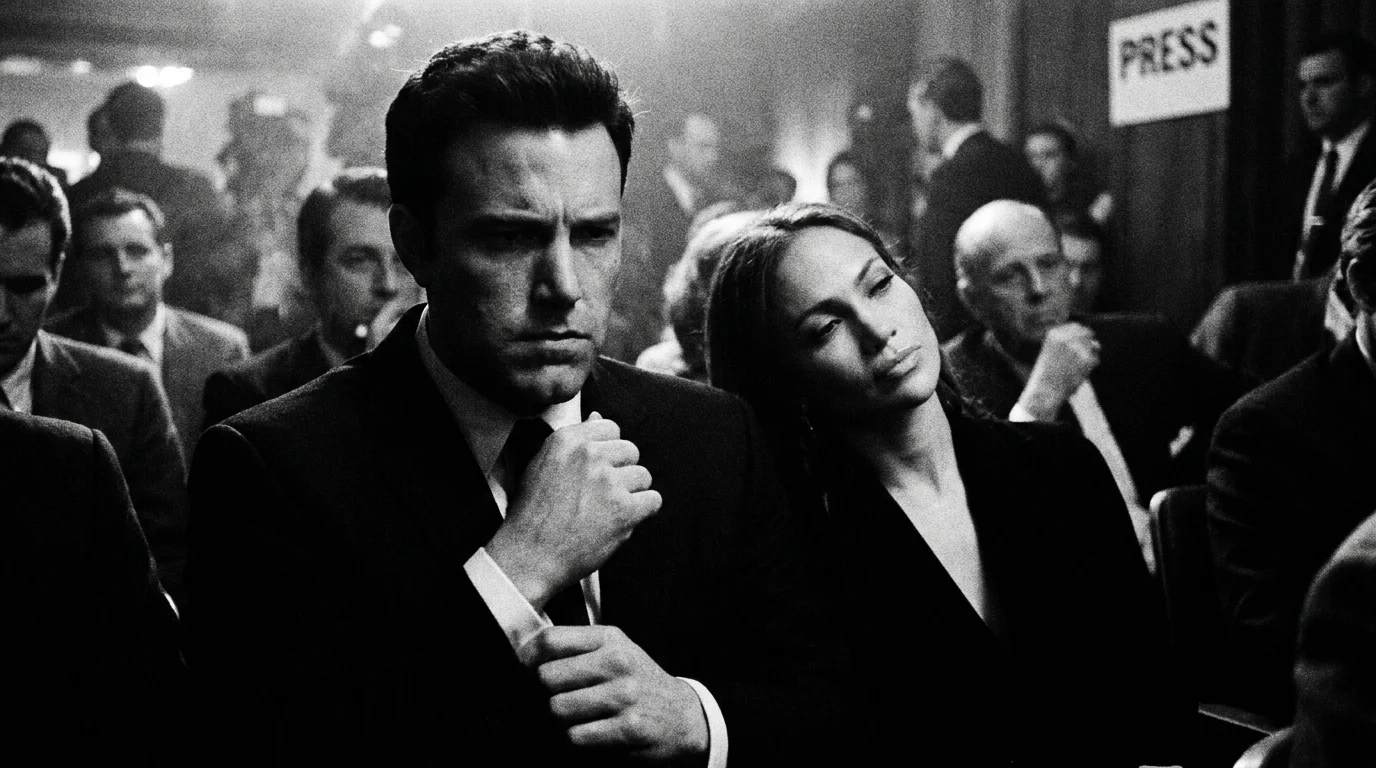
The harsh glare of halogen light bounces off the polished parquet floor of a Four Seasons press suite. In the room, the faint hum of an overworked air conditioner cuts against the aroma of black coffee gone lukewarm in porcelain cups. You watch the frame settle on two people sitting side by side on a tailored sofa, bathed in the manufactured warmth of a multi-million-dollar publicity junket. On paper, they are the world’s most envied couple; in the frame, they look like passengers bracing for sudden turbulence.
To the untrained eye scanning through entertainment clips between meetings, the image reads as effortless glamor. You see pristine teeth catching the key light, polite laughter greeting a tired question about shooting schedules, and synchronized nodding. Yet when you slow the footage down by half, **the kinetic truth betrays the script**, showing a physical rigidity that no media coaching can fully camouflage.
Ben Affleck has spent decades living his personal life under the unforgiving focal length of long-range telephoto lenses and broadcast cameras. His emotional climate has rarely been hidden behind a glossy mask; it lives in the sharp lock of his jaw, the restless shifting of his weight, and the way his shoulders square away from whoever sits beside him. Long before headlines confirm what whispers already know, the human body tells on itself in five-second increments.
Reading the Architecture of the Unconscious Lean
Consider an interview couch not as comfortable seating, but as an emotional fault line. When two people are genuinely connected, their bodies naturally perform an invisible dance known as postural synchrony. They tilt their heads at matching angles, their breathing falls into a loose rhythm, and their torsos drift inward like boats finding the same gentle current.
When an intimate connection begins to rot from within, that shared current dries up completely. Instead of an open posture, you start noticing **a calculated barrier of empty air** between the two chairs. One person leans forward toward the reporter, using the interviewer as an emotional shield, while the other pulls back, anchoring their spine firmly against the cushions to maximize physical distance.
Elena Vance, a 47-year-old forensic movement analyst and litigation witness consultant based in Century City, spends her working hours evaluating micro-tensions in high-stakes depositions. She often uses archival Hollywood press circuits to teach students how real strain manifests behind practiced smiles. “When you look at Ben during those tense promotional tours,” Elena explains, “his feet are almost always angled at forty-five degrees toward the emergency exit, while his partner’s feet are pointed forward. The autonomic nervous system doesn’t lie about where it wants to escape to, even when the mouth is reciting talking points about shared projects.”
- Pamela Anderson resurfaced nineties talk show interview completely reverses long-standing media mockery
- Carrot Top viral red carpet glance triggers rampant speculation over backstage Hollywood disputes
- Madame Web producers strategically leak polarizing dialogue clips to monetize negative critic backlash
- Cillian Murphy vocal timing suffers silent algorithmic cadence shifts across foreign streaming cuts
- Post Malone stadium performance uses thunderous sub-bass frequencies to mask live pitch flaws
Deconstructing the Visual Tell: Three Hidden Friction Markers
You do not need an advanced degree in behavioral psychology to spot the signs once you know where the seams typically split. These nonverbal signals appear during momentary pauses—the brief, unscripted seconds between a journalist’s query and an actor’s rehearsed reply.
1. The Zygomatic Hesitation and the Hollow Smile
A true smile engages the muscles surrounding the eyes, pulling the crow’s feet into soft folds while the mouth arches naturally. In troubled pairings, you see what researchers call the social grimace: the mouth flashes wide, but **the upper face remains deadpan**, freezing in an expression that vanishes the split-second the camera swings focus.
During several high-profile joint appearances, Affleck’s smile rarely reached the corners of his gaze. Instead, his lips would pull taut horizontally—a classic grimace of high social anxiety—before instantly dropping back down into a heavy, downward-curving rest state the moment his partner began speaking.
2. Pelvic Torquing and Torso Deflection
We face our bodies toward what we value, desire, or feel safe around. When an emotional fissure widens, the torso turns away first, even while the neck rotates back to maintain polite eye contact.
Notice how Affleck frequently angled his upper body squarely toward the interviewer, effectively presenting a broad, defensive shoulder blade toward his partner. This subtle blocking maneuver creates a physical wall, signaling **an instinctive need to protect personal space** rather than share an affectionate spotlight.
3. The Clenched Armrest and Throat Guarding
Hands are reliable barometers of internal pressure because they carry nervous energy when the face is fighting to remain neutral. When you track Affleck’s left hand across multiple legacy junkets, it rarely rests relaxed in his lap or reaches out for spontaneous touch.
Instead, his fingers grip the upholstery until the skin over the knuckles pulls tight, or his hand creeps upward to adjust his collar, smooth his tie, or rub the back of his neck. These pacifying behaviors—touching the suprasternal notch or throat area—are hardwired reflexes meant to soothe a surging heart rate and shield vulnerability.
Decoding Relational Strain in Real Time
Understanding these cues allows you to see past the curated sheen of public romance and recognize the real, often painful friction of human relationships under scrutiny. Here is how to trace that physical breakdown without relying on gossip:
- Watch the entrance stride: Count the paces between them as they walk from backstage to the seats; partners in tune naturally synchronize their footfalls.
- Observe the reaction time during laughter: When one person cracks a joke, notice if the other laughs spontaneously or waits a beat to mimic the room’s energy.
- Track the direction of the gaze: Watch whether their eyes meet during collaborative storytelling or if both remain fixated solely on the lens or the rug.
- Note the hand position on the furniture: White knuckles or tightly crossed arms act as physiological barricades against unwanted emotional exposure.
By treating these moments not as tabloid fodder, but as case studies in human stress responses, you start to see how difficult it is to sustain an illusion when your own nervous system refuses to play along.
Beyond the Spectacle: What These Silences Teach Us
It is tempting to view celebrity interviews as mere theater, a glossy carnival of rehearsed charisma manufactured for clicks and ticket sales. Yet there is a quiet, human tragedy tucked inside those five-minute hotel press junkets that resonates far beyond red carpets.
We all know what it feels like to sit beside someone with whom the music has stopped playing, pretending for family, colleagues, or friends that the harmony is still intact. Ben Affleck’s awkward press moments are not failures of acting; they are moments where **the sheer weight of exhaustion breaks through**, reminding you that no amount of status, wealth, or scripted romance can permanently conceal a heart that has already checked out.
The body is an honest instrument; it cannot perform affection it no longer feels without leaving a trail of physical hesitation.
| Key Point | Detail | Added Value for the Reader |
|---|---|---|
| Postural Synchrony | Natural, unforced mirroring of body angles and breathing rates between partners. | Helps you identify genuine alignment versus rehearsed cooperation in daily life. |
| Torso Deflection | Angling the upper chest away from a partner toward an exit or third party. | Reveals subconscious withdrawal or emotional boundaries being erected under stress. |
| Pacifying Behaviors | Frequent throat-touching, collar-adjusting, or tight gripping of chair arms. | Highlights immediate anxiety spikes and attempts at self-soothing during tense conversations. |
Frequently Asked Questions
Can awkward body language in an interview just mean someone hates doing press?
Yes, junkets are notoriously grueling, but professional actors routinely mask fatigue when they feel supported by the person beside them. The tell isn’t general tiredness; it is the specific physical deflection directed solely at the partner.Why do fans miss these warning signs when interviews initially air?
Viewers typically consume promotional content through the lens of confirmation bias, focusing on the glamorous styling, shared jokes, and scripted chemistry rather than micro-hesitations and rigid seating postures.What is the most reliable indicator of relationship friction on camera?
A lack of reciprocal gaze. When two people stop checking in with each other’s eyes during unscripted moments, it signals a significant breakdown in emotional safety and connection.Do PR teams train celebrities to hide these physical tells?
Extensively, but media training focuses mostly on verbal talking points and continuous smiling. Autonomic micro-expressions and postural weight shifts happen too quickly for conscious control over an eight-hour press day.Can observing these celebrity dynamics help us in our own lives?
Recognizing physical boundaries and self-soothing behaviors helps you develop emotional intuition, allowing you to sense when friends, partners, or colleagues are uncomfortable or holding back their true feelings.