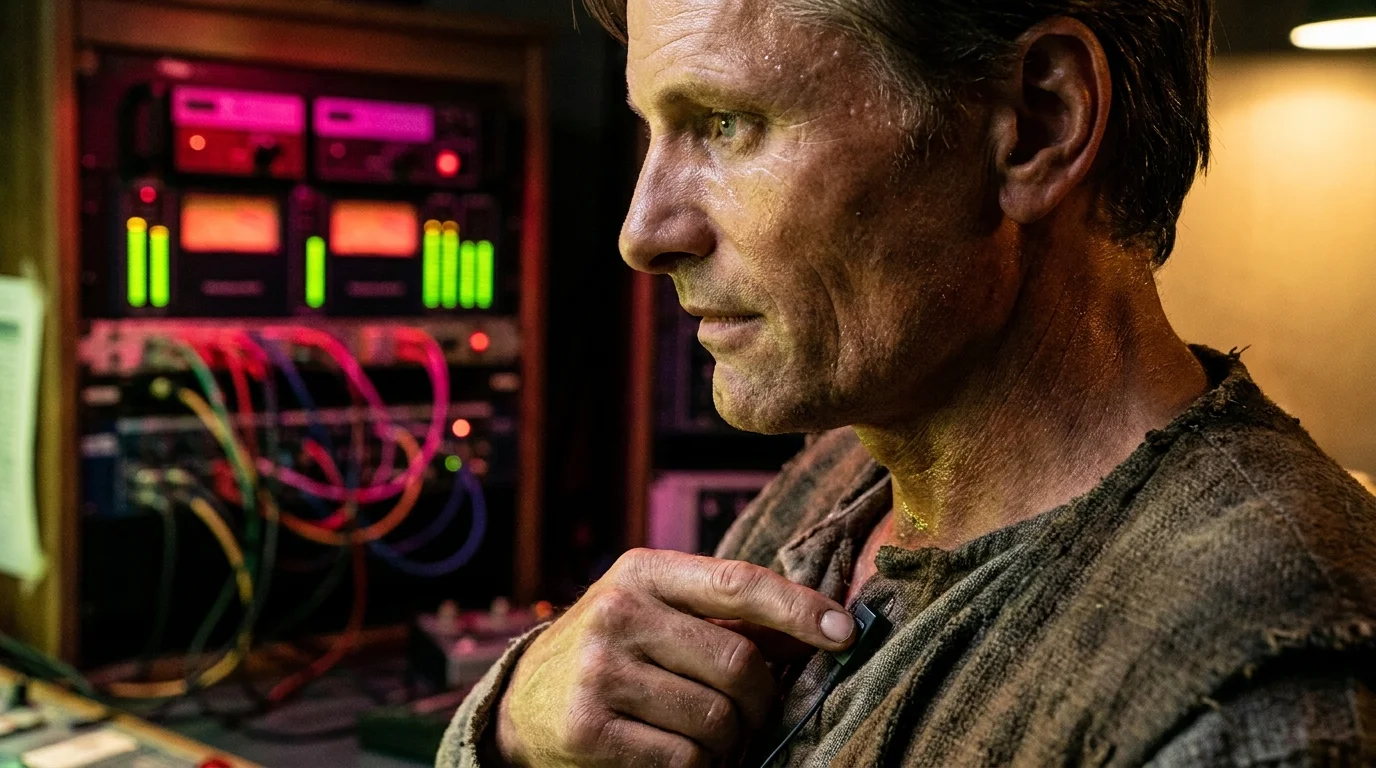
The New Zealand air tastes of cold sulfur, wet peat, and smoldering pine. You are standing on the rim of an ash pit outside Wellington, surrounded by forty crew members wrapped in heavy fleece, their breath curling upward like gray ribbon. In the center of the frame, kneeling among the charred remains of an Orc raiding party, is an actor caked in dried greasepaint and sweat-stiffened wool. He has spent the last seven hours searching for two missing hobbits in the damp dirt.
Take four was passable, but director Peter Jackson wanted the iron helmet kicked closer to the camera lens. You hear the clink of metal against wet shale. When Viggo Mortensen charges forward on take five, his heavy leather boot does not glance off the broad rim of the Uruk-hai helmet. Instead, it strikes the solid, cast-metal curvature full force, snapping two metatarsals instantly with a dull crack muffled only by the wet turf underfoot.
What happens next is etched into modern cinematic folklore. Instead of breaking character, grabbing his foot, or calling for an on-set medic, Mortensen drops to his knees, throwing his head back toward the bruised southern sky. Out of his chest tears a guttural, jagged wail of pure agony—a scream so laden with despair that the entire crew freezes, convinced he has channeled the absolute breaking point of a weary king grieving his fallen companions.
Jackson kept the camera rolling. When he finally yelled cut, nobody cheered; they merely marveled at the emotional depth of the take until Mortensen quietly leaned on a nearby crew member and whispered that he could not walk. That tiny fracture between performance and human physiology changed how we view accidental cinematic magic forever.
The Anatomy of Spontaneous Alchemy
Most screen acting operates like a controlled chemical reaction. You study the script, hit your marks on the taped floor, modulate your vocal cadence, and mimic internal emotion through practiced breathing techniques. It is an art of careful imitation. Yet the moments that truly burn into your memory rarely happen within the safety margins of the shooting script.
Consider this incident through the lens of physiological alchemy. In ordinary life, severe acute trauma sends a distress flare directly to the brainstem, commanding an involuntary retreat: you curl inward, cradle the injury, and sever connection with your immediate environment. It is survival instinct stripped of aesthetic pretense.
Mortensen inverted that biological reflex. By funneling a real-world physical rupture directly into the fictional grief of Aragorn, he eliminated the thin plastic membrane between actor and character. The scream you hear in the final cut of The Two Towers does not contain the intellectual calculation of an actor pretending to mourn Merry and Pippin; it is the raw, vibrating sound of nerve endings firing under sudden structural failure.
- Kurt Russell shields forty year partnership enforcing strict off camera ranch lifestyle boundaries
- Britney Spears early junket footage exposes unmistakable relationship tension before public split
- Demi Moore resurfaced nineties interview footage reverses early career vanity narratives
- Presley Gerber casual outing spotlights vintage Saint Laurent jackets and distressed denim
- Giada De Laurentiis unedited footage sparks intense speculation over tense network exchange
The Set Medic’s Hidden Account
Behind every miraculous film take sits someone responsible for cleaning up the wreckage. Brian Bennett, a veteran physical therapist and unit medic who spent years patching together stunt performers across rugged Australasian terrain, recalled watching the playback monitors that morning from the edge of the set. To Bennett, the posture gave away the injury long before Mortensen ever admitted it.
“An actor portraying grief drops their center of gravity smoothly because they are controlling their descent,” Bennett observed years later. “When Viggo hit the ground, his spine hitched in a micro-second spasm. He landed hard on his opposite knee to protect the broken foot, but kept his upper body completely open to the camera. Most people would have rolled into a ball. He stayed upright just long enough to give Peter the frame, knowing damn well he wouldn’t be walking without crutches by lunch.”
Deconstructing the Cinematic Accident: Three Tiers of Set Chaos
Not every unscripted accident produces a masterpiece. In fact, most unplanned errors ruin millions of dollars in film stock and destroy shooting schedules. To understand why Mortensen’s toe fracture worked while other mishaps get discarded onto the digital cutting room floor, you have to look at the three tiers of production disruption.
The Mechanical Interruption
This is the baseline blooper: an actor forgets a line, trips over an exposed cable, or catches an elbow on a doorframe. In these cases, the illusion shatters immediately because the performer’s conscious mind snaps back to reality. The take is ruined, the continuity supervisor sighs, and the slate claps again. There is no narrative value here—only lost time.
The Calculated Ad-Lib
Here, the performer steps outside the written page while staying securely inside the character’s skin. Think of Harrison Ford shooting the swordsman in Cairo because dysentery left him too weak to stage a three-day whip fight, or Dustin Hoffman slapping the hood of a taxi on a live Manhattan street. These moments work because instinct outsmarts the page, offering a clever shortcut that preserves the illusion without exacting a severe physical toll.
The Transmuted Trauma
This is the rarest territory in performance art—the realm inhabited by Mortensen’s broken toes or Leonardo DiCaprio slicing his palm open on real glass in Django Unchained and smearing the blood across Kerry Washington’s face. In this tier, genuine physical injury occurs, but instead of demanding the world stop, the actor absorbs the shockwave and weaponizes it for the story. The audience feels an uncomfortable, electric charge because the nervous system intuitively detects that the stakes on screen are no longer simulated.
Applying Unscripted Resilience to Daily High-Pressure Moments
You may never stand in full plate armor screaming across a New Zealand paddock, but you regularly encounter sudden disruptions that threaten to derail your plans. The natural human tendency during a crisis is to freeze, complain, or abandon the effort altogether. Adopting the mindset that turned a broken foot into cinematic gold requires intentional, steady micro-habits.
When unexpected friction shatters your carefully rehearsed routine, treat the shock as raw narrative fuel rather than an operational failure. You can implement this mindset through a few precise steps:
- Acknowledge the strike point immediately: Notice the precise point of failure without panic. Whether it is an aggressive client email or a blown tire, name the exact disruption before emotion clouds your judgment.
- Maintain the framing: Refuse to drop character. Do not let minor hiccups derail the overarching objective of your day or meeting.
- Channel the surge: Take the adrenaline spike caused by the mistake and funnel it directly into calm, decisive execution rather than defensive justifications.
- Assess the damage later: Finish the engagement before you nurse the bruise. Complete the presentation, wrap the phone call, or secure the room, then systematically address the repair work.
The High-Pressure Tactical Toolkit
When high-stakes tension rises, rely on these foundational anchors to preserve your composure under pressure:
- Optimal breath tempo: 4-second nasal inhale, 7-second hold, 8-second slow exhale through pursed lips to downregulate immediate physiological panic.
- The 90-second biochemical window: Recognize that raw physiological adrenaline floods your system for roughly a minute and a half; wait out that timer before uttering a response.
- Focal anchoring: Fix your eyes on a single neutral, non-moving physical object to prevent cognitive tunnel vision during unexpected crises.
The Real Value of the Flaw
In our current digital landscape, everything is smooth, filtered, and algorithmically refined. Special effects engines can simulate whole armies, de-age legendary stars, and digitally erase every blemish from a close-up. Yet audiences instinctively crave the jagged edges of real human experience. We replay the clip of Aragorn kicking that helmet not merely out of trivia curiosity, but because it connects us to a moment of unvarnished truth.
Perfection is forgettable. The scenes, conversations, and projects that endure are almost always the ones where an unforeseen flaw showed up uninvited, and someone had the presence of mind to let it speak. The next time life hands you a bruised heel or a broken plan, resist the urge to stop the tape. Lean into the impact, let the sound carry, and discover what lies on the other side of an unplanned roar.
“True mastery on a film set is not avoiding the accident; it is having the courage to let the accident finish its sentence before you call for the medic.”
| Key Point | Detail | Added Value for the Reader |
|---|---|---|
| The Incident | Mortensen fractured two toes kicking an iron Uruk helmet on take five. | Demonstrates that iconic art frequently emerges from physical reality rather than pure simulation. |
| The Director’s Choice | Peter Jackson recognized unmanufactured grief and kept the raw cut. | Teaches leaders and creators to value spontaneous brilliance over rigid adherence to the original plan. |
| The Psychological Pivot | The actor funneled biological trauma directly into Aragorn’s emotional defeat. | Provides a blueprint for turning sudden adversity into creative and operational leverage. |
Frequently Asked Questions
Did Viggo Mortensen break both toes on the exact same kick?
Yes. When his foot struck the heavy metal prop on the fifth take, the impact fractured two metatarsal bones simultaneously, producing the scream that appears in the theatrical cut.Did production halt immediately after the scene was filmed?
Filming paused briefly while medics evaluated his foot, but Mortensen refused extended downtime and continued shooting action sequences, adjusting his gait between setups.Why did Peter Jackson ask for so many takes of the helmet kick?
Jackson wanted the prop helmet to fly directly past the lens to create a visceral foreground element for the viewer, requiring multiple attempts to dial in the trajectory.Are there other unscripted Mortensen moments in the trilogy?
Yes. In The Fellowship of the Ring, Mortensen famously deflected an actual flying dagger with his real steel sword after a stunt throw accidentally flew directly off-target toward his face.What can everyday creatives learn from this cinematic accident?
The most resonant work often occurs when you surrender rigid control, allowing real-world frictions and unplanned mistakes to enhance your final output rather than discarding them.