Sixty thousand people are screaming in unison, their combined breath rising into the stadium rafters like warm mist under purple tungsten light. The concrete beneath your boots hums with thirty-hertz sub-bass, vibrating your ribs while synthetic fog rolls across the glossy black stage deck. Out front, the spectacle feels indestructible, a flawless engine of modern stadium pop engineered to run without a single dropped stitch.
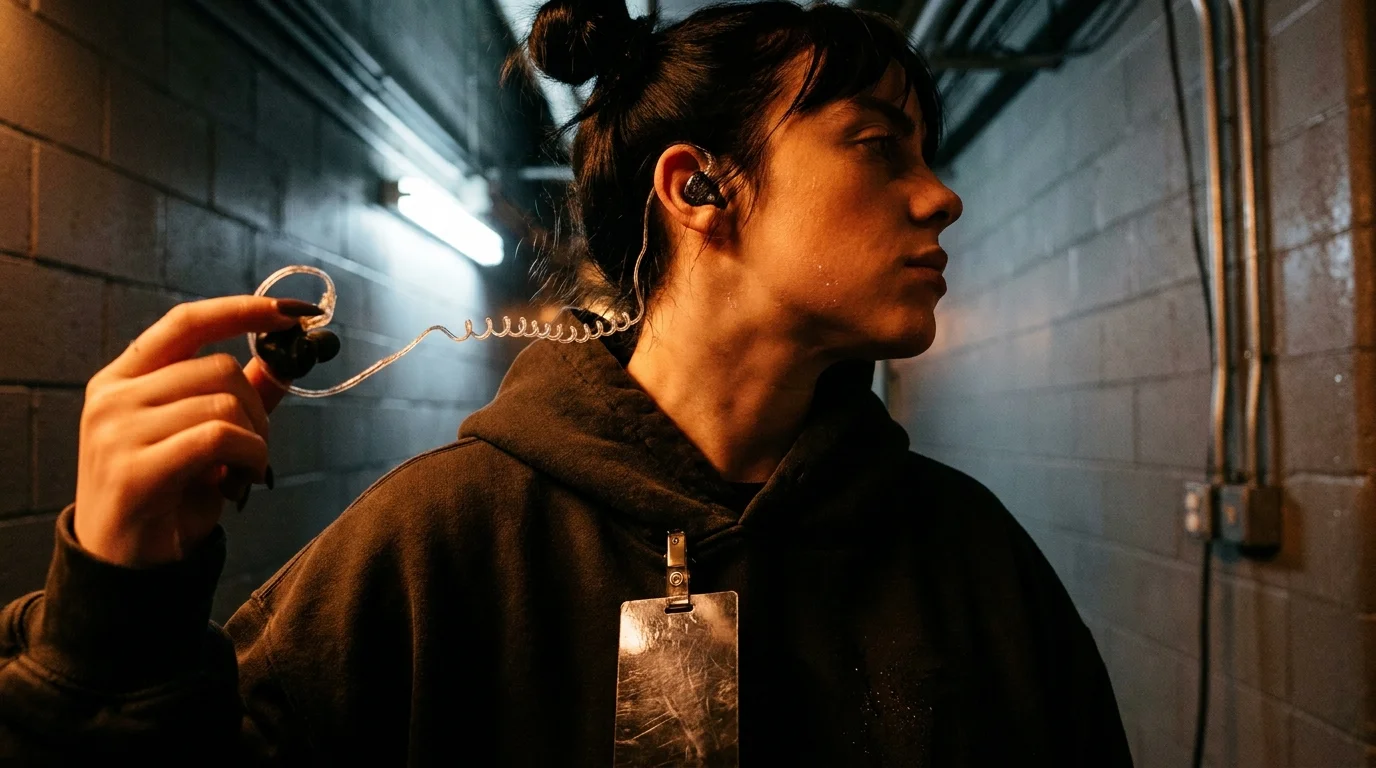
Then comes the split second where the illusion shatters. You do not hear the catastrophe immediately through the stadium line-arrays, but you see it: Billie Eilish flinching violently, her left hand snapping up to tear a custom acrylic earpiece out of her skull before her body even registers the thought. **Her fingers trembling with shock**, she drops the microphone against the stage floor with a dull, hollow thud that ripples through the front row.
A rogue frequency spike—an ear-splitting, undamped acoustic loop exceeding one hundred and twenty decibels—has just struck directly against her tympanic membrane inside an airtight ear canal. When you witness a performer make that sudden, desperate pull, you are watching pure survival reflex override months of synchronized choreography. Within three seconds, the sound crew cuts the house mix entirely, leaving an arena of sixty thousand people suspended in a stunned, cavernous silence.
The Sealed Cockpit: Why Live In-Ear Monitoring Is a Double-Edged Sword
To understand why a stage stops dead in its tracks over a sound you barely heard in section 104, you have to picture how a modern arena performer hears their world. You probably imagine wireless monitors are simply glorified consumer earbuds playing a backing track. In reality, **they act like sealed cockpits**, isolating the singer from the deafening, delayed reverberations of a cavernous sports arena.
A certified audiologist squirts liquid silicone into the artist’s ear canal to create a custom mold, curing it into a hard acrylic shell that blocks out thirty decibels of ambient noise. Inside that microscopic, pressurized seal, balanced armature drivers deliver a custom mix: the kick drum, vocal pitch guides, a click track, and the stage talkback mic. If a sudden feedback loop bypasses the analog brickwall limiter, the acoustic energy has nowhere to dissipate except straight into living nerve tissue.
Imagine someone setting off a blank pistol two inches from your eardrum while your head is trapped inside a glass jar. That is the acoustic reality of an unconstrained in-ear spike.
- Tana Mongeau unscripted bedroom livestream alienates superfans exposing coordinated agency production notes
- Kylie Jenner emotional podcast breakdown sparks immediate skepticism ahead of massive cosmetic launch
- Viggo Mortensen unscripted helmet kick shatters toes creating iconic fantasy cinematic moment
- Kurt Russell shields forty year partnership enforcing strict off camera ranch lifestyle boundaries
- Britney Spears early junket footage exposes unmistakable relationship tension before public split
The Anatomy of a System Failure: A Veteran Monitor Tech Speaks
Marcus Vance, a forty-eight-year-old touring audio engineer who has managed monitor desks for twenty years across North America, knows the cold panic of that visual giveaway instantly. "When an artist rips a mold out on stage, your stomach drops into your shoes," he explains. "You have maybe four milliseconds to react before permanent threshold shifts occur in their hearing."
According to Vance, stadium shutdowns like the one Eilish experienced rarely happen because of a single bad microphone cable. **A rogue radio-frequency burst**, an unexpected omnidirectional capsule catching the blast of an onstage side-fill speaker, or a digital routing conflict at the console can cause a digital signal processor to dump peak voltage straight into the wireless transmitter pack clipped to the singer’s waistband.
The Three Hidden Collision Points Behind the Stage Freeze
When an arena show grinds to a halt, the failure is never just mechanical; it is physical, psychological, and institutional all at once.
1. Acoustic Pressure vs. Human Anatomy
Your ear protects itself naturally through the stapedius reflex, pulling the tiny bones of the middle ear away from the cochlea when loud noises occur. But that biological shield takes roughly fifty milliseconds to engage. An acoustic feedback pulse traveling at 1,125 feet per second strikes the delicate stereocilia cells before your body can brace. In an airtight seal, **the pressure concusses the inner ear**, producing instant dizziness, sharp nausea, and agonizing physical pain.
2. The Vestibular Disorientation Trap
Performers rely on those custom earpieces for balance as much as pitch. If one ear is blasted with an asymmetric pressure wave while the other remains silent, the brain instantly misreads its spatial orientation. When Eilish dropped to one knee after pulling the monitor, she wasn’t dramatic—she was battling vertigo caused by unilateral vestibular shock.
3. The Fail-Safe house Mute Protocol
At front-of-house, sound technicians carry a non-negotiable directive: protect the artist’s physical health before the production. **Cutting the main house audio** feels like committing artistic treason to an amateur, but to seasoned road crews, cutting the power immediately resets every wireless buffer, preventing cascaded feedback through stadium fills.
Tactical Protocol: How Touring Crews Handle Frequency Shock
Surviving a stadium-grade frequency blowout requires calm, muscle-memory discipline rather than frantic button mashing. When sound systems glitch at this scale, engineers lean on immediate mitigation measures to isolate the danger.
- Instant Mechanical Extraction: Never adjust volume on the pack during a spike. The artist’s only viable defense is yanking the silicone mold downward by the cable relief boot to break the pneumatic ear canal seal.
- Dual Hardware Brickwall Limiters: Audio teams configure fast-acting analog peak limiters right at the beltpack stage, capped rigidly at 85 dBA, ensuring digital board oversights cannot physically send dangerous wattage to the driver.
- RF Spectrum Re-Sweeps: The RF technician immediately isolates the beltpack’s broadcast frequency, sweeping for intermodulation interference generated by local television stations or emergency radios near the stadium.
- Vocal Rest Reset: The stage manager gives the artist an immediate ninety-second pause in low-level white ambient noise, allowing the stapedius muscle to release and vestibular balance to stabilize.
The Stage Engineer’s Emergency Toolkit:
- Hardware Peak Limiter Threshold: -6 dBFS maximum ceiling
- Digital Limiter Attack Time: Under 0.5 milliseconds
- Ear Mold Seal Attenuation: -26 dB to -32 dB passive ambient reduction
- Reference Monitor Volume: Calibrated strictly between 78 and 82 dBA
The Bigger Picture: Preserving the Human Element in Stadium Spectacles
We live in an era where modern concerts look like automated science-fiction films. Enormous robotic lighting rigs sweep across the sky, computerized timecodes trigger pyrotechnics with millisecond precision, and voices glide over immaculate digital tracks. **We forget that fragile biological bodies** are still at the center of the stadium, doing the vulnerable, imperfect work of singing live into the dark.
When an artist like Billie Eilish halts a stadium show to save her hearing, it offers a grounding dose of reality. It reminds you that underneath the dazzling stadium lights, hearing cannot be replaced, and no multi-million-dollar spectacle is worth the quiet tragedy of a ruined ear.
"The most expensive piece of gear on that stage isn’t the half-million-dollar mixing console; it’s the human eardrum standing thirty yards away from it."
| Key Point | Detail | Added Value for the Reader |
|---|---|---|
| Custom IEM Mechanics | Airtight silicone and acrylic molds isolate up to 30 dB of external stadium noise. | Explains why sound pressure stays trapped directly against the ear canal during a technical failure. |
| Acoustic Shock Vulnerability | Feedback spikes peak instantaneously, outpacing the human ear's 50ms stapedius defense reflex. | Reveals that ripping out the monitor is an involuntary physical survival response, not a performance quirk. |
| House Mute Procedures | Engineers kill house sound instantly to break the digital loop and reset the beltpack RF signals. | Reframes sudden stadium silence as a calculated safety protocol rather than an amateur mistake. |
Frequently Asked Questions
Why didn't the house audience hear the feedback as loud as Billie Eilish did?
The audience hears the acoustic mix through stadium line-arrays spread over hundreds of feet, while the artist receives direct, concentrated electrical sound through tightly sealed ear canals that amplify every milliwatt of audio pressure.Can a sudden feedback spike cause permanent hearing loss in a performer?
Yes. Acoustic spikes exceeding 120 decibels inside a sealed canal can instantly shear the microscopic stereocilia hair cells in the inner ear, leading to immediate acoustic trauma and permanent tinnitus.Why don't touring artists just use regular stage wedge speakers instead?
Stage wedges blast sound that reflects off arena walls, creating a hollow, muddy echo that makes it nearly impossible for a singer to pitch accurately or hear critical click tracks in giant sports venues.What is an analog brickwall limiter in live sound?
It is a dedicated hardware safety device that sets an impenetrable ceiling on electrical audio signals, instantly clamping down on rogue voltage spikes before they reach the wireless transmitter.How long does it take for an artist to recover balance after acoustic shock?
While acute dizziness from the middle-ear pressure reflex typically subsides within three to five minutes, sensory fatigue and ringing can linger for twenty-four hours after the event.