The strobe lights of the 2011 red carpet do not flatter human ambivalence. Under the scorch of two dozen halogen camera flashes, the air always smells faintly of warm dust, heavy setting powder, and expensive dry-cleaning fluid. You remember the official story told by cable television: two tall, striking people caught in the slipstream of a high-speed fairytale. But when you strip away the swelling string soundtrack and freeze the archival tape, the physical truth surfaces with uncomfortable clarity.
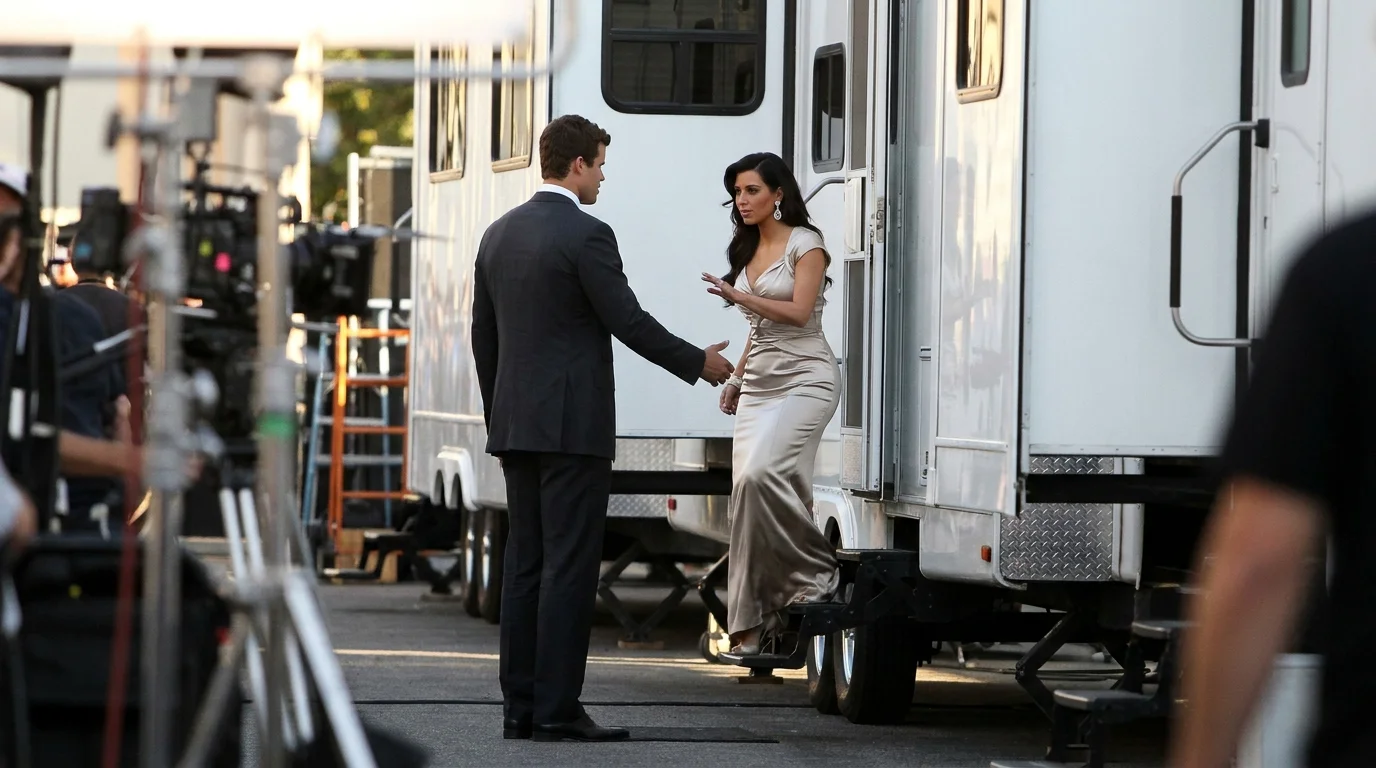
Watch the footage from that midsummer evening closely. Kris Humphries stands planted with the wide-stanced certainty of a professional power forward, leaning down to bridge their eighteen-inch height difference. Kim Kardashian does not lean up to meet him. Instead, her spine tightens into a rigid plumb line, her chin tilting down by fractions of an inch, creating a minute pocket of empty space between them. The body tells the truth long before the publicist ever drafts a press release.
As Humphries reaches to rest a massive palm on her waist, her shoulder rolls upward and backward in an involuntary hitch. It is the microscopic flinch of someone touching wet paint. For a fleeting frame, her eyes glance past his cheekbone, scanning the line of photographers behind him rather than meeting his gaze. You are watching a quiet eviction happening in broad daylight.
The Geometry of a Retreating Silhouette
When you evaluate public romance through the lens of performance, you miss the quiet biomechanics that govern genuine safety between two people. Think of human connection not as a scripted dialogue, but as two tuning forks placed on the same sounding board. When the resonance is true, the bodies naturally angle toward each other like leaves seeking a southern window. When the resonance collapses, the physical form builds an invisible retaining wall.
In those resurfaced 2011 interview clips, the architecture of their posture is a study in structural resistance. Humphries leans in with an aggressive, blunt familiarity, often speaking across her or cutting off her sentences with locker-room banter. Notice how she responds: not with explosive annoyance, but with a polite, frozen doll smile that never reaches the corners of her eyes. Her silence is a barricade built in front of millions of viewers.
Consider the observation of Dr. Elena Vance, 52, an applied kinesthetics researcher based in Evanston who spent decades cataloging stress responses in high-profile negotiations. “When an individual feels emotionally cornered on a stage, they stop rotating their sternum toward their partner,” Vance explains. “The torso swivels slightly toward the nearest exit point, even while the lips continue smiling. It is an unconscious plea for spatial autonomy.”
- Michael Keaton resurfaced vintage audition tapes reverse decades of comedic studio typecasting
- Tyler Cameron red carpet posture sparks intense speculation over reality franchise fallout
- Stephen Colbert sudden teleprompter blackout exposes frantic optical fixation during live monologue
- Billie Eilish halts stadium performance when piercing monitor feedback triggers sudden stage shutdown
- Tana Mongeau unscripted bedroom livestream alienates superfans exposing coordinated agency production notes
The Anatomy of a Red Carpet Fracture
Rewatching these vintage exchanges reveals that the breakdown was never sudden. It was an accumulating series of microscopic withdrawals that you can categorize through distinct nonverbal layers.
The Asymmetrical Smile: Watch her mouth during the joint junket interviews promoting their upcoming televised ceremony. A genuine expression of affection engages the orbicularis oculi muscles, softly crinkling the skin around the temples. Her expression during his answers is distinctly unilateral—a slight lift of one lip corner that signals mild disdain rather than shared amusement.
The Guarded Midsection: Notice where her clutch purse lives throughout their public arrivals. A barrier held like armor, she consistently pins the structured metallic bag directly against her lower abdomen, using a luxury accessory to create a physical buffer between her torso and his reach.
The Hand Clasp Rejection: In one viral clip that resurfaced across short-form video feeds, Humphries attempts to thread his fingers through hers as they walk into a venue. Instead of closing her grip around his, Kim leaves her fingers limp, sliding her wrist away under the pretense of smoothing down the lapel of her tailored blazer.
Reading the Micro-Cues in Your Own Social Mirror
You do not need to walk a Hollywood carpet to recognize when a relationship has begun to quietly evaporate from your nervous system. Your physical reactions routinely outpace your conscious mind. When you find yourself retreating from a conversation, the signs are identical to those captured on that ten-year-old tape.
Take note of how your body behaves during ordinary interactions. If you find your breath becoming shallow the moment someone enters the room, you are already managing internal friction.
- Notice your feet: if your toes point toward the doorway while someone speaks, your mind has already left the conversation.
- Track your shoulders: a sudden hitch toward the ears reveals an involuntary protective shell against emotional intimacy.
- Check your hands: resting your palms flat and open indicates receptivity, while tightly curled fingers or hidden thumbs signal guarded self-soothing.
- Listen to your vocal timing: delayed, monosyllabic responses with zero upward inflection indicate an energy conservation protocol.
Your Tactical Toolkit for Presence: Spend 60 seconds before difficult interactions relaxing your tongue from the roof of your mouth, dropping your shoulders down your back by two inches, and letting your collarbones widen. True comfort cannot be faked under pressure, but recognizing physical strain allows you to stop fighting reality.
The Quiet Honesty of the Body
Looking back at those seventy-two days in 2011, the public narrative focused entirely on spectacle, contracts, and timing. Yet the actual breakdown was visible on television screens long before the court filings arrived. The tape survived as an accidental archive of incompatibility, immortalizing the exact millisecond where human intuition parted ways with commercial ambition.
When you learn to trust the silent language of the body, you stop needing to wait for a crisis to tell you where you stand. The flesh and bone always register the truth first, whether through a cold shoulder on a flash-lit step-and-repeat or a subtle tightening in your own chest during an evening walk. There is profound peace in finally listening to what your posture has been trying to tell you all along.
“The nervous system never signs a contract; it simply retreats when the air turns thin.”
| Key Point | Detail | Added Value for the Reader |
|---|---|---|
| The Torso Axis | Turning the chest away from a partner during public speech. | Helps you identify when someone is emotionally disengaged from a dialogue. |
| The Object Buffer | Placing bags, cups, or arms across the midriff. | Reveals hidden discomfort or boundary-setting in everyday conversations. |
| The Limp Handshake | Failing to return grip pressure during physical touch. | Signals an involuntary sensory withdrawal before verbal doubts emerge. |
Frequently Asked Questions
Did Kim Kardashian ever publicly address this specific awkward exchange?
She has reflected on the marriage as a time when she felt immense external pressure to fulfill a public expectation, acknowledging that she realized the union was fundamentally flawed during their brief honeymoon period.Why do micro-expressions leak out even during media training?
Micro-expressions are governed by the autonomic nervous system and trigger in fractions of a second, making them almost impossible to suppress consistently under emotional stress.What is the most reliable sign of romantic disconnection in old footage?
Look at the eye contact: couples who feel secure naturally share lingering, bilateral eye contact, whereas disconnected partners constantly scan the perimeter for an escape route.Can stress from paparazzi cause the same defensive posture?
While bright lights cause squinting, defensive body language toward a specific partner—such as angling the hips away or pulling hands back—is distinct from general external anxiety.How can I spot similar disconnects in my own daily life?
Pay attention to physical relief: if your body physically uncoils and relaxes only after a specific person leaves the room, your posture is signaling an unresolved emotional barrier.