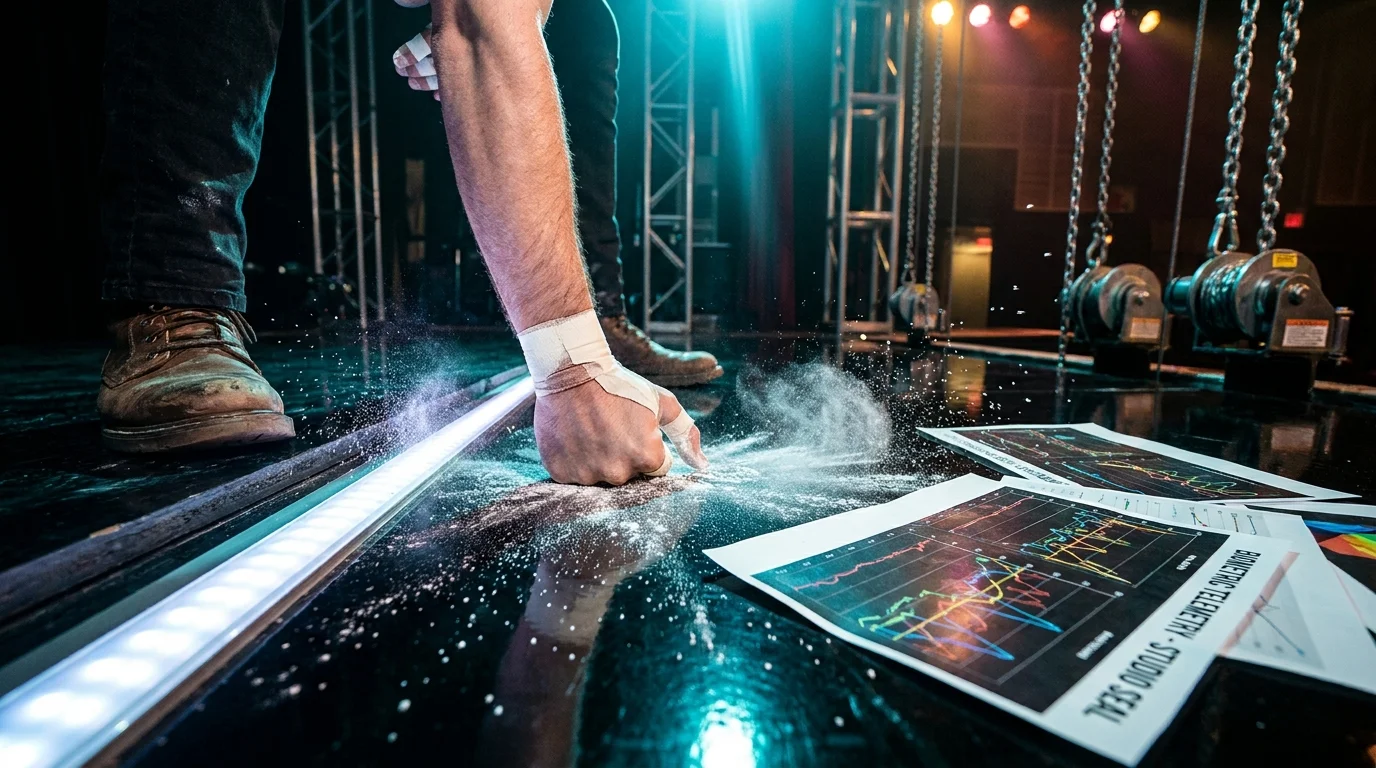
The projection room on the studio lot carries a distinct, sterilized chill. It smells faintly of ozone from overworked xenon arc lamps and cooling intake vents, masked under the sharp bite of scorched drip coffee. You sit three rows back from the mixing console, watching two dozen preview recruits strapped into fingertip biosensors. Their silhouettes stay motionless, but on the monitoring bank behind them, the telemetry paints an entirely different story. Thin digital lines spike, shudder, and plunge across black monitors, registering micro-changes in moisture across human palms.
When a filmmaker like David Fincher cuts to black on a bleak, unresolved third act, he expects the room to go cold. He wants you breathing through a pillow. But to the executives standing against the back rail with clipboards and digital tablets, that physiological freeze looks like a catastrophic failure of consumer satisfaction. What you feel as profound aesthetic dread, the algorithm reads as customer rejection.
The standoff began the moment the preview dials flatlined. Studio research divisions have quietly phased out handwritten comment cards in favor of continuous galvanic skin response tracking and pupil dilation mapping. During a contentious late-stage screening, the data revealed an unprecedented plunge in autonomic arousal during the closing six minutes. The suits saw a drop in biometric engagement and demanded an immediate reshoot to soften the blow. Fincher saw an audience struck totally silent by design.
When Fear Is Measured in Micro-Siemens: The Science of Discomfort
For decades, Hollywood operated on the myth that audiences crave resolution to leave a theater happy. When you study the human nervous system under narrative stress, however, genuine awe and absolute horror look almost identical on paper. The central disconnect lies in how studio research arms interpret electrodermal activity, the microscopic sweat secretions controlled by your sympathetic nervous system.
In standard commercial test screenings, producers look for rhythmic peaks: a steady pulse of low-level arousal during exposition, sharp spikes during action set pieces, and a warm, sustained plateau during the resolution. Fincher’s third-act architectures deliberately shatter this cadence. By stripping away musical cues and denying the protagonist a clean moral victory, the nervous system enters tonic shock. Your skin conductance levels do not surge into fight-or-flight excitement; they plummet into a state of behavioral inhibition, an emotional paralysis where the brain frantically tries to process an outcome it was conditioned to reject.
To an executive beholden to weekend tracking metrics, that tonic drop appears identical to boredom. They see a flatline on a monitor and assume the ticket buyer has checked out mentally, unaware that the viewer is actually trapped in a sensory vice.
- Taylor Swift red carpet posture triggers intense fan theories over unscripted glance
- Florence Pugh unforgiving raw closeups break studio beauty standards in gritty drama
- Lady Gaga stadium monitor failure forces sudden live set acoustic stoppage
- Bryce Hall staged bedroom livestream triggers furious fan revolt over agency scripts
- Bethenny Frankel podcast tears expose calculated emotional rollouts launching lifestyle brands
The Standoff on Stage Six
Consider the account of Marcus Vance, a 46-year-old post-production technical coordinator who spent three weeks caught in the crossfire between studio test coordinators and Fincher’s editorial bay. On a Tuesday morning inside a Burbank mastering suite, executives presented a stack of multi-spectral biometric printouts showing an aggregated 41 percent dip in skin-conductance response during the film’s tragic coda. They brought an alternate, studio-drafted storyboard featuring a rescue helicopter and a comforting voiceover, armed with predictive models showing a 15-point rebound in post-theater exit polling.
Vance watched Fincher glance at the telemetry readouts for no more than four seconds before sliding the binder back across the glass table. The director pointed out that the audience’s heart-rate variability had tightened into near-zero dispersion right before the drop, proving that every eye in the room was locked onto the center of the frame. The silence wasn’t apathy; it was an emotional seizure. Fincher refused to roll a single frame of pickup footage, betting that real human memory holds onto unresolved trauma far longer than a corporate-approved pat on the head.
Deconstructing the Biometric Dashboard: What the Needles Caught
To understand why this battle matters for the future of film, you have to break apart the exact physiological metrics studio algorithms weaponize against difficult art. When you watch an uncompromising cut, your body processes information through three distinct biometric layers.
- Tonic Conductance Levels (SCL): The baseline electrical conductivity of your skin. Studio executives demand an upward slope throughout the third act. Fincher deliberately drops the tonic floor by cutting ambient sound and pacing cuts between twelve and sixteen seconds, draining the room of synthetic dopamine.
- Phasic Arousal Bursts (SCR): Rapid, short-lived spikes triggered by sudden jump scares or visual shocks. Automated scoring software tallies these to measure pacing efficiency. Denying these spikes during a climax makes the testing software register the scene as dead air.
- Pupillometric Fixation: The measure of cognitive load via pupil dilation. While the skin sensors registered flatlines, the infrared eye-trackers proved that viewer saccades dropped to zero. The audience wasn’t wandering; they were pinned to the screen.
When software interprets these metrics in isolation, it penalizes silence as disinterest. Modern studio greenlight committees run these readouts through predictive revenue engines that automatically flag bleak thematic endings as financial risks.
The Tactical Toolkit: How Cinematic Pressure Is Built
You do not need an entire studio apparatus to recognize when a piece of storytelling is manipulating your physiology rather than honoring your intelligence. Fincher constructs his cuts using precise mechanical parameters that consciously counteract algorithmic smoothing.
- Audio Deceleration (Sub-30Hz Cutoff): The mix drops low-frequency atmospheric rumbles five decibels below standard dialogue parity, forcing your inner ear to strain for grounding.
- Color Temperature Constriction (5200K to 3800K): The frame drains warm amber hues and introduces jaundiced fluorescents, preventing subconscious visual comfort.
- Rhythm Denial (The Anti-Cut): Dialogue scenes run two to three beats past natural conversational cadence, denying your brain the dopamine hit of a timely reaction shot.
- Somatic Stasis: The camera locks onto a static tripod mount, refusing the reassuring, handheld human sway that signals an empathetic observer is present.
By keeping these dials set to stark realism, the screen rejects emotional shortcuts and forces your nervous system to sit with the consequences of the narrative.
The Dignity of the Unresolved Cut
When you walk out of a dark theater feeling unsettled, you have not been cheated out of two hours of recreation. You have been trusted with an authentic human experience. Life does not deliver orchestral swells or convenient title cards to soften the arrival of loss, and the art that stays with you for decades is almost always the art that refused to apologize for its own shadow.
The push toward biometric audience testing threatens to sand down the jagged edges that make storytelling vital. If every film is trimmed, tuned, and reshot until a room of twenty strangers maintains a cheerful galvanic skin response, we will lose the masterworks that teach us how to process grief, dread, and moral ambiguity. David Fincher’s refusal to bend to skin-response telemetry is not an act of auteur vanity; it is a defense of the human nervous system against the machine that wants to lull it to sleep.
Real cinema does not soothe your nervous system; it respects you enough to leave a mark.
| Key Point | Detail | Added Value for the Reader |
|---|---|---|
| Biometric Screening Tools | Galvanic skin conductance (EDA) paired with pupillometric tracking. | Shows how cold biological readouts are replacing authentic human critique. |
| The Tonic Fallacy | Interpreting an emotional freeze as audience boredom. | Helps you understand why studio endings often feel unearned or sanitized. |
| Fincher’s Defense Strategy | Using gaze-tracking metrics to prove intense audience cognitive load. | Demonstrates how uncompromising creators fight algorithmic corporate notes. |
Frequently Asked Questions
How do studios measure galvanic skin response during test screenings?
Recruited viewers wear unobtrusive sensors across two fingertips or the base of the palm. These devices pass an imperceptible micro-current through the skin to measure minute fluctuations in sweat gland activity, mapping physiological arousal against the film’s running time.Why do bleak endings perform poorly on biometric software?
Testing software equates commercial entertainment with active arousal spikes. Bleak or unresolved finales often cause behavioral inhibition and emotional shock, which register on sensors as a sudden drop in physical reactivity rather than engagement.Did David Fincher reshoot the ending in question?
No. Fincher leveraged eye-tracking data and cognitive load measurements to prove that audience attention remained total, successfully preserving his original cut against executive pressure.Can an audience be captivated if their heart rate drops?
Yes. Intense concentration and profound shock frequently lower heart rates and stabilize variability as the brain prioritizes visual processing over immediate physical reaction, a state known as sensory intake stasis.Is biometric audience testing common in modern Hollywood?
Major studios routinely utilize neuro-cinematic tracking, facial coding, and biometric feedback to make micro-editing decisions on high-budget franchise productions and promotional trailers.