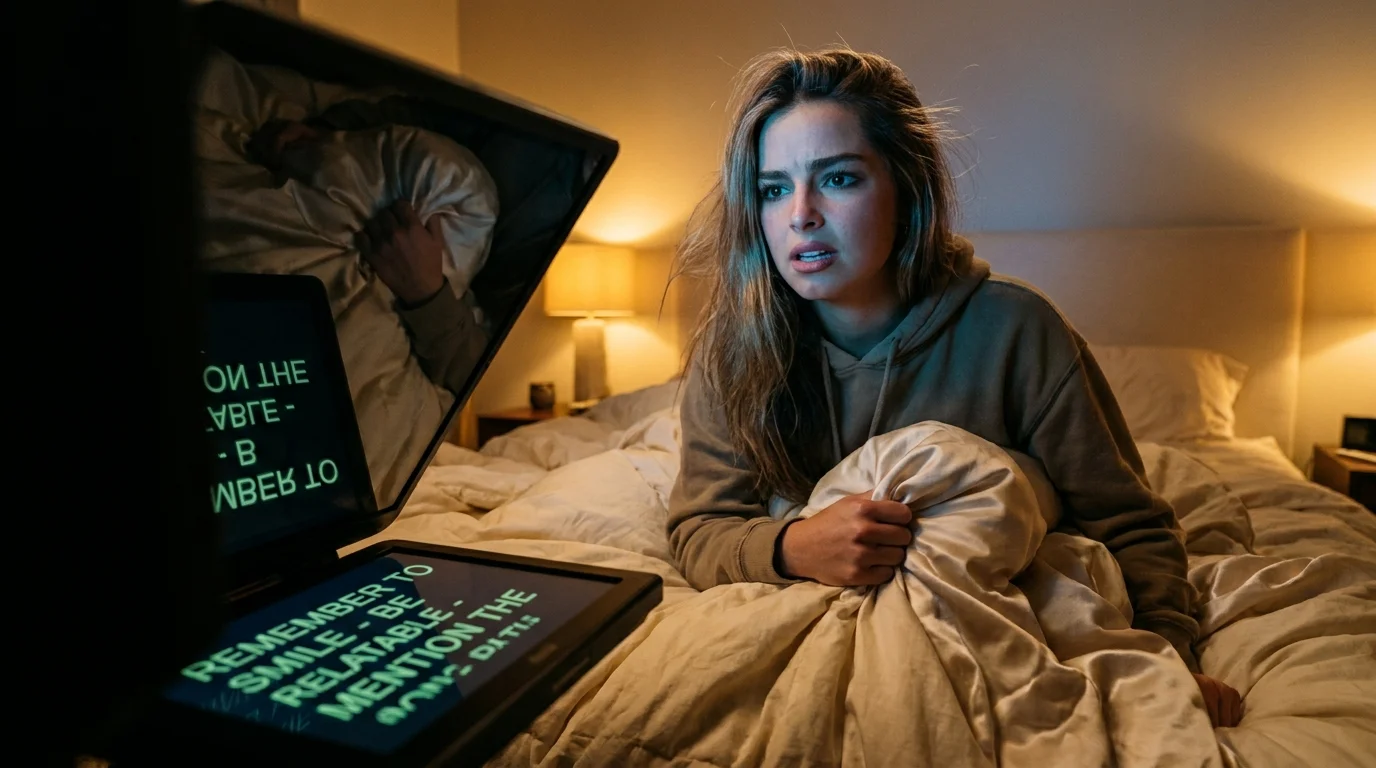
The pale blue luminescence of a smartphone screen cuts through the dark at 1:14 AM. You watch the frame settle: an unmade duvet, the faint static of room tone, and an oversized vintage sweatshirt pooling around the wrists. Addison Rae sits cross-legged on the floor, her hair pulled back into an off-center bun, rubbing her eyes as if she just decided, on an impulse of pure loneliness, to hit the red broadcast button and speak straight to you.
For seven uninterrupted minutes, the broadcast delivers the exact texture of an accidental, unvarnished late-night breakdown. There is no studio rim lighting, no crisp lapel audio, and no commercial cue—only the hushed, trembling cadence of a mega-creator confessing the heavy toll of fame. You lean closer to your phone, feeling the rare, magnetic pull of genuine vulnerability in an era dominated by hyper-sterilized branding.
Then, she tilts her head to brush away a stray tear, and the fragile spell snaps in a single frame. In the glossy curvature of an antique mirror mounted behind her shoulder, the room reveals its true perimeter. A teleprompter screen scrolled silently across a matte black rig, reflecting bright green script lines while two figures in dark clothing quietly adjusted the pacing from a folding director’s chair just outside the camera’s crop.
What felt like an unfiltered bedroom confession was, in truth, an orchestrated theatrical set. The emotional release had an agency sign-off, a revised draft number, and active floor direction, instantly triggering a massive wave of online skepticism that exposes the calculated engineering behind modern creator vulnerability.
The Two-Way Mirror of Manufactured Intimacy
When you watch an uncurated live stream, your brain registers the interaction through an ancient evolutionary heuristic. We associate dim ambient lighting, soft speaking volumes, and slight lens wobbles with safety and private confidantes. Hollywood spent decades perfecting the spectacle of perfection, but the contemporary creator economy realized long ago that perfection creates distance. Flaws, conversely, generate retention.
Think of this dynamic as an architectural wireframe rather than a spontaneous conversation. When an agency scripts a breakdown, they are not simply selling a narrative; they are reverse-engineering your emotional empathy. They study the precise micro-hesitations, the swallowed sentences, and the downward glances that signal authentic distress to an audience conditioned to spot corporate polish from a mile away.
- Gwyneth Paltrow podcast breakdown reveals calculated media rhythm launching wellness product line
- Dolph Lundgren red carpet appearance debuts tailored monochrome suit with Italian leather boots
- Harrison Ford unscripted blaster draw saved exhausted Raiders set from sweltering delay
- Mark Harmon guards forty-year marriage enforcing strict zero-publicity carpentry workshop rule
- Jennifer Lopez archival press junkets expose rigid posture preceding abrupt divorce
By intentionally degrading production values—swapping studio fixtures for a single bedside lamp and introducing calculated awkward pauses—talent teams construct a velvet trap. You believe you are peeking through a crack in the armor, completely unaware that the crack was measured, cut, and sanded down by a creative director before the camera ever went hot.
The pushback Addison Rae faces is not merely about an actress reading lines off an iPad screen; it is the instinctive recoil of an audience realizing their genuine compassion was harvested as an algorithmic conversion strategy.
The Control Room Behind the Headboard
Marcus Vance, a 34-year-old digital production technician based in Glendale, knows the anatomy of these staged sessions down to the milliamp. For three years, Vance rigged discreet mobile broadcasts for top-tier lifestyle talent across Southern California, operating out of borrowed guest bedrooms and high-end rentals.
“The moment a creator crosses ten million followers, spontaneous self-expression effectively ceases to exist without three layers of legal and commercial oversight,” Vance explains. “We would spend forty-five minutes before a ‘casual pajama stream’ dialing in a custom softbox to make it look like raw fluorescent bounce from a hallway. We had teleprompter software mapped to foot pedals so the creator could advance their talking points without moving their hands on camera. The audience thinks they are watching someone unburden their soul, but behind the iPhone, there is a production coordinator holding a stopwatch and monitoring live sentiment shifts.”
Dissecting the Audience Fractures
The exposure of agency scripting during this broadcast did not hit every corner of the internet in the same way. Depending on how you interact with the digital landscape, the teleprompter reflection triggered very specific emotional and analytical responses:
- The Algorithmic Believer: Viewers who invested years into following the creator feel a profound sense of parasocial betrayal. For this group, the revelation stings because it recontextualizes past milestones, struggles, and tears as coordinated brand maneuvers rather than shared human experiences.
- The Forensic Native: Gen Z sleuths who live on video editing software immediately ripped the stream into high-contrast slow-motion clips. They do not watch for emotional connection; they watch for the production seams, treating every reflection, pupil dart, and audio gate artifact as a puzzle to be dismantled.
- The Industry Pragmatist: Media analysts and creators who view the incident as an inevitable corporate overreach. To them, the blunder is simply bad tradecraft—a careless camera angle that exposed the standard operating procedure of modern celebrity management.
The Parasocial Forensic Toolkit
You do not need high-end studio monitoring software to separate manufactured authenticity from a genuinely spontaneous human broadcast. When you observe your next late-night creator stream, watch the technical variables instead of the tears.
First, pay attention to the cadence of the eye line. Natural conversation features wandering, erratic eye movements as the brain accesses memory and processes emotional stress. When someone reads concealed copy, their eyes exhibit a steady, horizontal micro-sweep that returns to a fixed focal anchor every three to four seconds.
Second, listen to the acoustic floor. True bedroom livestreams suffer from proximity effect bass buildup, erratic clothes-rustling spikes, and untreated room reverb. Professional sound engineers utilize hidden wireless lavaliers buried inside hoodie seams or directional shotgun mics overhead, resulting in hyper-consistent, dry vocal presence regardless of how violently the creator moves around the mattress.
- Check the Ambient Reflections: Always examine metallic hardware, picture frames, and glass decor situated directly behind or beside the talent for teleprompter green-glow or crew silhouettes.
- Analyze Eyeball Hydration and Blinking: Reading scrolling text reduces natural blink rates by nearly forty percent, creating a wide-eyed, fixed stare during emotionally heavy statements.
- Track Vocal Cadence Transitions: Authentic emotional rambling contains dead-ends and trailing thoughts; scripted confessions deliver neat thematic setups, emotional pivots, and resolutions within tidy sixty-second intervals.
Reclaiming Your Emotional Bandwidth
Recognizing the staged nature of these broadcasts is not an exercise in cynicism; it is a vital act of self-defense for your attention span. In a digital economy that commodifies vulnerability, your empathy is the most valuable currency on the market. Every time you lend your heart to an engineered crisis, you deplete the emotional reserve you owe to your physical community, your friends, and yourself.
Once you learn to spot the teleprompter glass behind the silk pillowcase, the illusion loses its authority. You stop treating digital creators as intimate friends who need your validation and begin seeing them for what they truly are: skilled performers operating within a complex commercial apparatus. There is immense peace in that clarity. When you close the app, the bedroom light turns off, the room goes silent, and you are left with the only reality that actually matters—the one on your side of the glass.
“Authenticity in digital media stopped being a personality trait the moment talent agencies realized it could be packaged, scripted, and scaled for higher engagement metrics.”
| Key Point | Detail | Added Value for the Reader |
|---|---|---|
| The Reflection Slip | Prompter text revealed in the background antique mirror during an off-axis head tilt. | Teaches you to scan secondary reflective surfaces for hidden production rigs. |
| The Scripted Cadence | Vulnerability delivered in structured three-act narrative loops rather than erratic thoughts. | Helps you identify when spontaneous emotion is following an agency beat sheet. |
| Audio Compression | Absence of normal room echo and movement rustle despite an active bedroom setting. | Enables you to hear the difference between raw phone audio and concealed studio mics. |
Frequently Asked Questions
Why do talent agencies script bedroom livestreams instead of standard studio videos?
Staged amateur aesthetics trigger significantly higher viewer retention and emotional empathy than polished commercial setups, making audiences far more receptive to subtle marketing or reputation repair.How did viewers catch the prompter during Addison Rae’s broadcast?
A subtle shift in camera angle caught the high-contrast green reflection of scrolling text and the silhouette of production personnel in an unshielded wall mirror behind her head.Is reading from a script illegal during an influencer livestream?
No, it is entirely legal unless the creator is making deceptive commercial claims, concealing paid sponsorships, or violating consumer protection disclosure guidelines.What is the dead giveaway that a creator is reading hidden text?
The most reliable physical tell is the rapid, horizontal micro-saccade movement of the pupils scanning lines of copy, paired with an unnaturally low blink frequency.How can I protect my emotional bandwidth from staged creator intimacy?
Remind yourself that high-follower broadcasts are managed business ventures, treat content as entertainment rather than friendship, and focus your genuine empathy on your offline life.