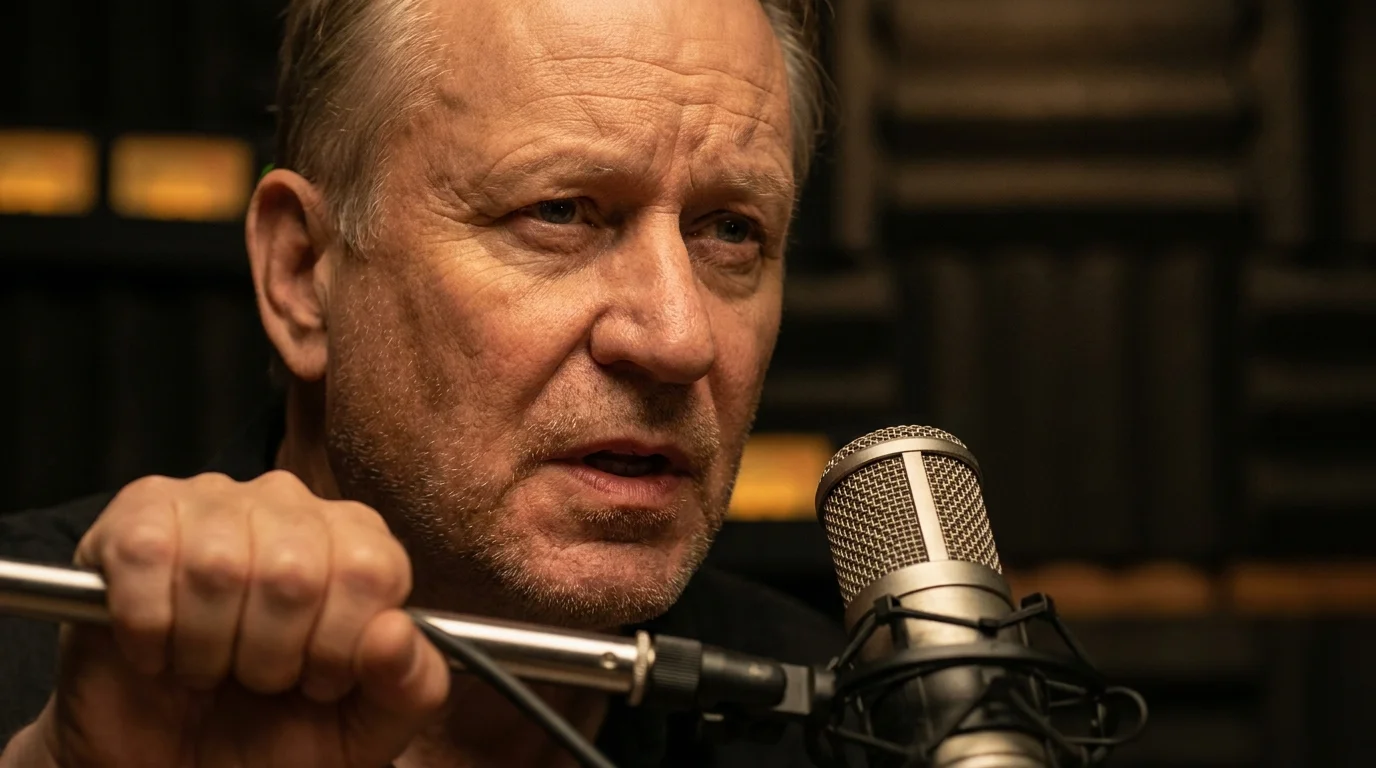
Step into a sound mixing bay at two in the morning, and the room feels less like a cinema and more like a submarine. The only light bleeds from three massive monitors displaying parallel bands of electric-blue waveforms. If you listen closely through the near-field monitors, you hear something distinct: the low, gravelly rasp of Stellan Skarsgård drawing breath before a line. That breath carries weight. It is an intentional, physical choice where silence acts as the anchor holding the entire scene to the floor.
You expect that what gets captured on set survives the journey to your living room screen intact. You assume that when an actor of Skarsgård’s caliber pauses for an agonizing two-and-a-half seconds, that stillness remains preserved in the digital package sent across the globe. After all, cinema has spent a century teaching you that tension lives precisely in the space where nobody speaks.
Yet, if you switch your streaming profile from the domestic English master to an international market feed, the architecture collapses. That two-second silence suddenly narrows to six hundred milliseconds. The voice clips in early, shaving away the subtle hesitation that made the moment human in the first place.
What you are hearing is not an accidental export glitch or a simple mastering discrepancy. It is a quiet, industrialized practice known inside post-production suites as the zero-hour dubbing override: an automated cadence resync designed to force living performances into rigid algorithmic envelopes.
The Vanishing Silence: When Algorithms Edit Humanity
For decades, film audio functioned like tailored clothing. If an actor took an erratic, ragged breath, the sound designer built the surrounding foley around that rhythm, cutting cloth to match bone. But streaming platforms treat dialogue delivery less like tailored wool and more like an accordion pleat that must fit into standardized digital shipping crates.
When a prestige production ships overseas, local dubbing studios face a brutal reality: certain languages require substantially more syllables to express a single thought. Spanish, German, and Italian voice tracks routinely run fifteen to twenty-five percent longer in spoken duration than their English counterparts. To solve this without altering the visual cut of the film, streaming algorithms run automated cadence passes across secondary and international releases, mechanically compressing the dead air between an actor’s original phrases.
The system treats every quiet breath as empty bandwidth. If Skarsgård hesitates before delivering an ultimatum, the software registers that pregnant pause as an efficiency leak. By tightening the gap, automated tools create artificially uniform audio pockets where foreign-language voice prints can drop in without spilling over shot transitions. The horrifying byproduct? Even when you select the original English audio track on an international platform mirror, you are often listening to a time-compressed audio track stripped of its physical weight.
- The Weeknd stadium sub-bass frequencies intentionally drown out erratic tour vocals
- Seth Meyers teleprompter freeze exposed strict live monologue boundaries during broadcast
- Ke Huy Quan high-speed wirework stunts triggered severe spinal disc compression
- Jonathan Taylor Thomas resurfaced nineties interview completely validates his abrupt Hollywood departure
- Dan Levy red carpet tension triggers wild fan speculation over cast fallout
You lose the dramatic friction. The performance becomes efficient, clean, and completely neutered.
The Stockholm Anomaly
Henrik Dahl, a 48-year-old senior localization engineer based in Stockholm, was among the first to notice the mechanical distortion while performing quality-assurance passes on a major episodic release. Dahl was running acoustic phase alignments between the native Scandinavian audio masters and the multi-region streaming packages destined for continental Europe.
As Dahl watched the waveform monitors, he noticed Skarsgård’s signature delivery was visibly squashed. In the original raw capture, the veteran actor had introduced a micro-stutter—a subtle, dry tongue-click followed by an eight-hundred-millisecond stall—to convey a character’s brewing panic. On the international delivery branch, the automated audio conform tool had snipped out the silence, snapped the tail of the sentence directly against the next cut, and smoothed the waveform with a digital crossfade. The studio had executed the change without notifying the actor, the sound supervisor, or the original director.
Deconstructing the Cut: How Modern Delivery Reshapes the Ear
This automated reshaping changes how different types of viewers experience dramatic tension, whether you realize it or not. The impact varies depending entirely on how you consume your media.
For the Subtitle Purist
If you prefer watching foreign or international cuts with original audio tracks and native subtitles, you end up catching the brunt of this dissonance. You watch an actor’s chest heave, their eyes flicker with internal calculation, but the voice rings out instantly, breaking the emotional sync between physical gesture and vocal timing. The silence that your brain intuitively expects to accompany that heavy posture simply never arrives.
For the Localized Dub Consumer
If you rely on voice dubs, the override creates a frantic, breathless cadence. Because the original pauses have been mechanically trimmed to create room, the voice talent must sprint through their translated lines to clear the next marker. You are left with dialogue that feels like an instructional manual read aloud at double speed, leaving no space for the audience to digest the thematic punch.
For the Home Theater Purist
On high-end reference audio setups, these automated time-resyncs create distinct acoustic artifacts. When an algorithm slices milliseconds out of room tone, the natural reverb tail of the soundstage gets chopped off mid-decay. The result is a series of tiny acoustic dropouts that mimic the sensation of breathing through a dry sponge.
Auditing the Signal: Reclaiming the Intended Performance
You do not have to accept the stripped-down, algorithmically accelerated version of prestige performances. Reclaiming the natural cadence requires treating your streaming source like a raw audio feed that demands active calibration.
Take these direct steps on your hardware to bypass the flattened international audio delivery pipelines:
- Force the native spatial audio track rather than downmixed stereo, as localized time-overrides are most aggressively applied to stereo and mobile compression profiles.
- Disable any internal dynamic volume leveling or “Dialogue Clarity” enhancements on your television, which often use predictive algorithms that truncate lingering background decays.
- Check the streaming package version; accessing titles via physical media (4K UHD Blu-ray) guarantees the original uncompressed DCI theatrical mix untouched by regional streaming CDN automation.
Tactical Home Audio Toolkit
- Dynamic Range Setting: Set to “Full/Wide” (never “Midnight” or “Night Mode”, which clips dialogue decay).
- Audio Output Format: Pass-through / Bitstream via HDMI eARC to prevent client-side downsampling.
- Audio Track Selection: Select “Original English [Audio Description Disabled]” specifically designated as Dolby Atmos or 5.1 Uncompressed.
- Latency Compensation: Manually adjust A/V sync delay by +15ms to +25ms if vocal transients feel unnaturally detached from physical lip closure.
The Fragile Space Between the Words
Great acting is rarely about the noise an actor makes; it is about the stillness they are brave enough to hold. When Stellan Skarsgård stands before a camera, his power comes from his willingness to let the room grow cold before he offers a response. That pause is where the human truth hides.
When production conglomerates allow background processing scripts to clip those pauses in the name of global delivery ease, they quietly dissolve the craft from the inside out. Paying attention to dialogue timing is not mere technical snobbery. It is an act of preservation. By demanding the silence back, you protect the fragile, unscripted pauses that turn entertainment into art.
“The truth of a scene does not live in the syllable; it lives in the second of terror right before the tongue moves.”
| Key Point | Detail | Added Value for the Reader |
|---|---|---|
| Algorithmic Cadence Resync | Automated time-compression applied to dialogue pauses in streaming localization cuts. | Explains why international streaming versions feel unnaturally rushed compared to theatrical releases. |
| Acoustic Decay Clipping | The truncation of natural room reverb tails during silence reduction. | Helps you identify technical sound artifacts versus intentional sound design choices. |
| Physical Media Preservation | 4K UHD discs retain original uncompressed DCI theatrical mixes without region overrides. | Offers a clear workaround for cinephiles seeking uncompromised dramatic pacing. |
Frequently Asked Questions
Did Stellan Skarsgård approve these dialogue modifications?
No. Automated localization overrides are executed deep within post-production distribution pipelines, completely bypassing actor contracts and creative oversight.Why do streaming platforms alter dialogue timing instead of extending scenes?
Extending scenes to accommodate longer foreign translations would require re-rendering video frames, creating costly delivery headaches across global content distribution networks.Does this timing override occur on domestic US streaming releases?
It primarily affects secondary international mirrors and downmixed stereo tracks, though algorithmic drift increasingly bleeds into domestic feeds during high-traffic bandwidth scaling.How can I tell if an audio track has been cadence-compressed?
Listen for sudden, unnatural cutoffs in ambient background room tone immediately following a dramatic line, or an unnaturally rapid back-and-forth exchange between actors.Can soundbar settings fix altered dialogue timing?
No. Soundbar settings can balance frequency equalization, but they cannot restore pauses that have been physically removed from the streamed digital master file.