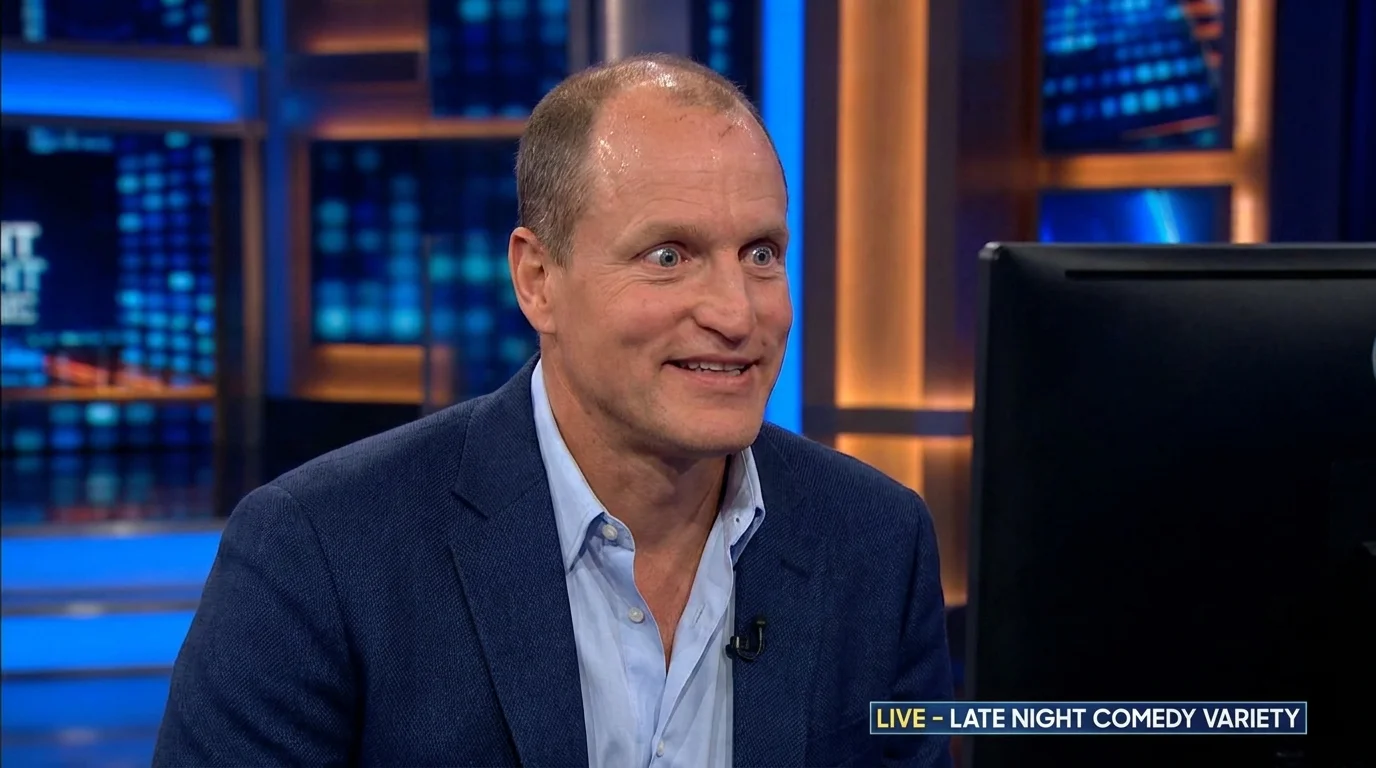
The air inside a live broadcast studio carries the metallic tang of heated aluminum rigs, ozone from high-output studio lights, and the collective, held breath of three hundred people sitting inches outside the camera track. You know Woody Harrelson’s posture by heart: the low-slung shoulders, the sideways grin, the lazy Texas drawl that suggests he wandered onto a national soundstage straight from a back-porch hammock. It is an aesthetic built on the premise that nothing matters enough to sweat over.
Yet television production does not operate on charm; it runs on a glass plate suspended directly before a camera lens, where pale green courier text scrolls upward at roughly one hundred and twenty words per minute. For an actor who has spent four decades convincing you that his thoughts materialize in real time, that monitor is not just an assist. It is an invisible tether holding an elaborate performance of ease together under forty tons of steel overhead rigging.
When the screen goes dark mid-sentence, the machinery of television does not pause to let a host catch their breath. The illusion strips away in a split-second physiological reflex that no acting academy can train out of a human nervous system. What flickered out was not merely a hardware relay—it was the thin veil between organic charisma and engineered delivery.
The Optical Anchor and the Myth of Easy Presence
We mistake physical relaxation on screen for internal serenity, forgetting that casual speech on live television requires immense mental compression. To project nonchalance while forty million people watch through a red tally light is like balancing on a slick dock while pretending you are already asleep. The human brain manages this dissonance by latching onto an external fixed point, turning the teleprompter into an optical crutch that stabilizes the inner ear.
When an actor reads off a camera rig, their gaze settles into what neurobiologists call a tracking loop. The eyes make minute, rhythmic jumps—saccades—across five-word spans, processing line breaks a half-second before the vocal chords shape the vowels. This creates a rhythm where the body relaxes precisely because the cognitive burden of memory has been offloaded to the glass.
The moment that feed crashes into black screen, that cognitive bridge vanishes into thin air. Without the visual breadcrumbs pulling the eyes forward, the optical system panics, forcing the body to reckon with the horrifying silence of the room. The Texas drawl does not slow down by choice; it stumbles because the internal projector is suddenly running without film.
- Sigourney Weaver banned flattering beauty filters demanding harsh raking studio lights
- Glenn Close hot mic whisper exposes severe backstage collapse before broadcast cutoff
- M. Night Shyamalan intentionally leaked divisive rough cuts to spark box office controversy
- Stellan Skarsgard dialogue timing altered by studio streaming dubbing overrides
- The Weeknd stadium sub-bass frequencies intentionally drown out erratic tour vocals
The Control Room Perspective: Decoding the Freeze
Marcus Vance, 52, a veteran broadcast monitor engineer with thirty seasons in live New York studio control rooms, knows the exact mechanical shudder that precedes a monitor failure. “When an inverter blows or a software card resets mid-monologue, the audience hears the joke trail off, but we see the eyes first,” Vance explains from behind a wall of multitrack monitors. “An actor who relies on cue lines will immediately drop their focal plane by three inches, hunting for the lower stage monitors before their neck even moves.”
In Harrelson’s broadcast hitch, the micro-movements told a clinical story of technical isolation. As the display failed, his gaze snapped inward—a distinct physiological phenomenon known as optical decoupling. His eyelids flickered three times in rapid succession, searching for the green glow that had anchored his cadence just two beats earlier.
What followed was the physical giveaway of synthetic poise: his weight shifted abruptly onto his left heel, his left hand dug into his linen pocket for an anchor, and his jaw hardened into a static smile that stayed frozen three seconds longer than the material warranted. The charming rogue was gone; in his place stood a veteran performer calculating mathematical seconds in dead air.
The Anatomy of an Optical Breakdown
When live confidence breaks, it does not collapse all at once. The human nervous system retreats through specific stages of mechanical shock, revealing just how much technical coordination goes into a routine monologue.
Understanding these stages reveals the invisible friction between raw charisma and structured broadcasting.
- The Saccadic Stutter: The pupils freeze in place, then execute rapid, erratic micro-sweeps across the camera bezel, hunting for line continuity that no longer exists.
- The Rhythmic Deceleration: The natural rhythm of conversational delivery stretches out; pauses between syllables double in length as working memory attempts to locate the missing punchline.
- The Somatic Realignment: The spine straightens mechanically, chest breathing replaces belly breathing, and the performer adopts a rigid, centered stance to prevent dizziness.
- The Vocal Dryness Check: Deprived of incoming cues, the brain releases a micro-dose of adrenaline, drying out the palate and forcing a telltale hard swallow mid-vowel.
By tracing these subtle signals, you begin to see that television confidence is rarely an emotional state. It is an athletic balancing act built on seamless technical feedback loops.
Reading the Seams in High-Stakes Public Delivery
Whether standing on a broadcast stage or speaking at an annual shareholder meeting, the mechanics of composure follow identical neurological rules. When your visual aids fail, your physiology must absorb the shock without broadcasting panic to the room.
To navigate these moments of sudden friction, you must replace synthetic aids with internal somatic baselines that keep your voice grounded.
- Anchor your weight through the mid-foot: Do not lock your knees or rock backward onto your heels when a slide or note card fails; keep your center of gravity pitched slightly forward.
- Breathe below the sternum: High-stress script dropouts force air into the upper ribcage, causing vocal pitch to climb three half-steps; force your diaphragm down before starting your next sentence.
- Drop visual fixation entirely: Stop looking for the broken prompter; pick a physical face or an inanimate object forty feet away to reset your focal distance.
- Acknowledge the silence with tempo: Do not fill dead air with placeholder laughter; let two beats of silence pass while your mind reorganizes the underlying argument.
These tactile adjustments prevent the nervous system from locking into panic mode when external crutches collapse beneath you.
The Humanity Behind the Polished Facade
We live in an era of hyper-curated, algorithmic perfection, where every viral clip and red-carpet soundbite arrives smoothed, graded, and timed to the millisecond. Seeing a beloved, seasoned performer reveal the mechanical framework beneath his easy charm is not an indictment of his talent. If anything, it serves as a welcome reminder of the physical cost of live performance.
Harrelson’s brief freeze reminds you that natural cool on camera is an oxymoron. It is labor—grueling, highly technical labor that requires managing your own heart rate while reading rolling type under blinding lights. When the teleprompter blacked out, we did not see a failure of talent; we saw the human machinery underneath the star persona, fighting its way back to solid ground one breath at a time.
“True poise is not the absence of panic under the lights; it is the physical discipline required to hold your ground while your nervous system screams for an exit.”
| Key Point | Detail | Added Value for the Reader |
|---|---|---|
| Optical Decoupling | Pupils freeze and scan camera edges when monitors drop out. | Learn to detect when a speaker shifts from memory to visual panic. |
| Weight Redistribution | Hosts shift weight to back heels during unexpected dead air. | Master forward-leaning posture to preserve authority under stress. |
| Cadence Deceleration | Pauses between words double as memory takes over from sight. | Recognize intentional pauses versus emergency mental retrieval. |
Frequently Asked Questions
What is optical decoupling during live speaking?
It is the neurological reflex where the eyes stop tracking smooth text and begin hunting erratically for lost visual anchors, signaling a break in focus.Why did Woody Harrelson’s posture shift so noticeably?
When visual orientation fails abruptly, the body instinctively shifts weight back onto the heels to stabilize balance against sudden adrenaline spikes.Do live television hosts memorize their monologues?
Most hosts memorize the overarching structure and beats, but rely entirely on the teleprompter for word-for-word rhythm, timing, and legal clarity.How can public speakers recover when visual notes fail?
Drop eye contact with the broken notes, anchor your weight through the balls of your feet, take a low diaphragmatic breath, and speak to the core concept rather than the script.Why does vocal pitch rise during unexpected broadcast silences?
A sudden loss of cueing triggers an adrenaline release, causing tension in the laryngeal muscles that pushes vocal resonance into the upper throat.