The soundstage in Playa Vista smelled like industrial coolant, hot dust, and stale dry-cleaning. Under the blinding halogen banks of late spring in 2007, crew members shifted their weight against the concrete floor while production assistants monitored clipboards with white-knuckle intensity. You could feel the nervous arithmetic humming through the room. Paramount and Marvel had staked over one hundred and forty million dollars on an unproven superhero concept led by a director who made holiday comedies and an actor insurance companies had spent a decade avoiding.
The script on the podium was a marvel of safe, focus-grouped corporate syntax. It contained crisp, defensive soundbites designed to show a chastened billionaire falling back into line before a predatory press corps. Then, quietly and without warning, Robert Downey Jr. reached into his wardrobe and slipped a warm, grease-stained paper bag onto the podium floor, hiding it behind the press risers like a schoolboy concealing contraband.
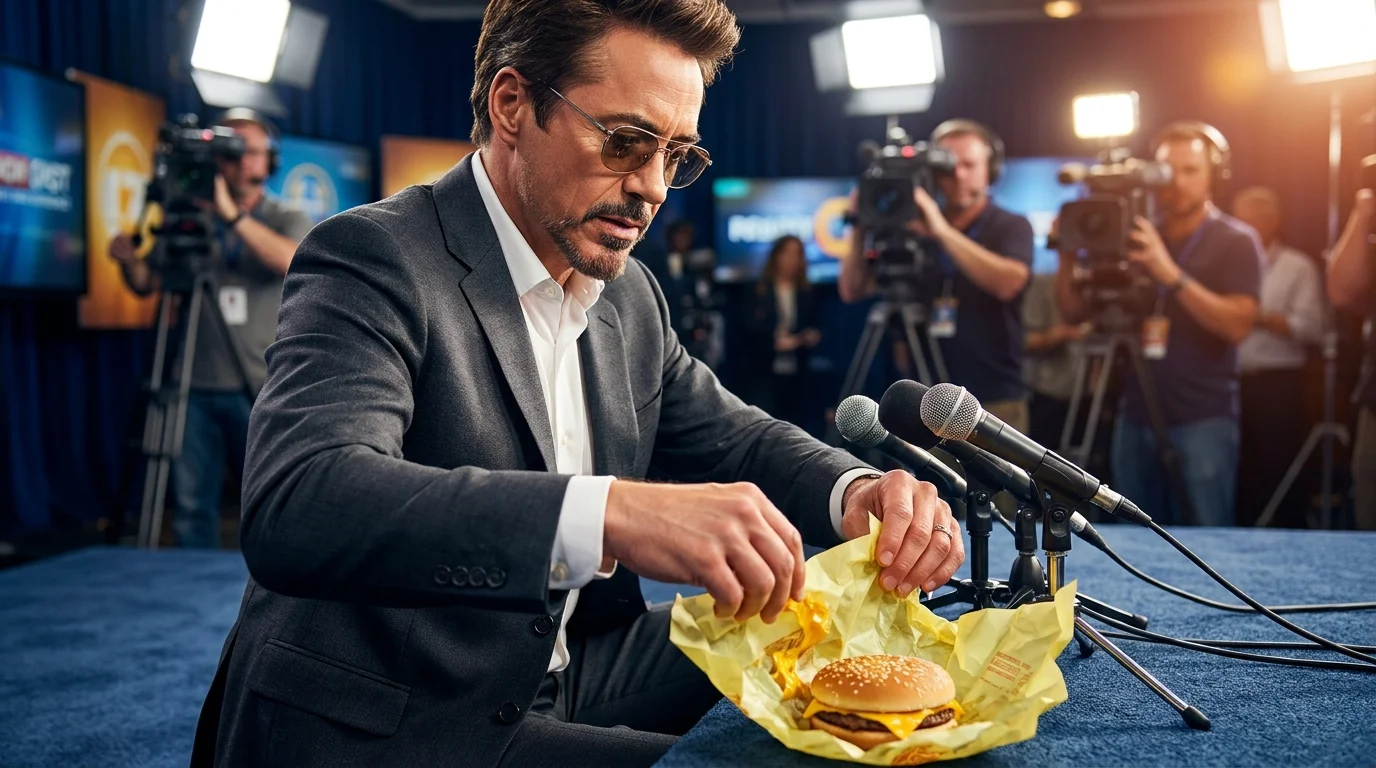
When the camera rolled, he did not stand tall, clear his throat, or project the manufactured remorse demanded by the script supervisors. He dropped flat onto his haunches on the carpeted riser, unwrapped a soggy cheeseburger with bare fingers, and told a room full of bewildered extras to sit down with him. Director Jon Favreau looked at the monitor, discarded the printed cue sheets, and let the cameras roll as the entire corporate apparatus surrendered to an unvarnished human impulse.
The Architecture of Intentional Sabotage
Most corporate scripts operate like a high-speed passenger train running on immaculate, cold tracks. They prioritize polished control over messy human texture, terrified that a single deviation might expose the machinery behind the curtain. When you watch that press conference sequence today, you are not watching an actor deliver lines; you are watching someone break a crystal glass against the floor to show that jagged edges catch the light far better than polished rims.
Downey knew that a man who spent months captive in a sun-baked cave, breathing through metal shards near his heart, would never stand at an executive podium and read corporate PR copy. He knew the body demands grease, sugar, and ground contact when survival instincts override decorum. By forcing Jon Favreau to abandon the day’s call sheet in real time, he dismantled three months of studio revisions in under four minutes of unscripted chewing.
This was not mere rebellion for its own sake. It was an instinctive recalibration of character authority. When you pull the center of gravity down to the floor, everyone else has to look down to see you, immediately shifting the power dynamic from a defendant pleading his case to an emperor holding court from a stoop.
- Ron Howard forty year marriage survives enforcing strict non-Hollywood residency limits
- Ben Affleck vintage junket interviews expose glaring early marital warning signs
- Geena Davis vintage press conference surfaces exposing harsh studio casting rules
- Amber Glenn unedited rinkside reaction triggers intense judging dispute theories
- Jessica Chastain demanded zero skin smoothing for grueling unvarnished drama close-ups
Russell Bobbitt, a veteran property master who stood on that soundstage thirty feet from the podium, remembers the silent panic that ran across the floor when Downey pulled out the hidden paper bag. Bobbitt, then forty-two, had spent hours stocking the set with approved prop pens and dummy microphones, only to watch the star produce smuggled fast food from a jacket lining. ‘Jon Favreau did not scream cut,’ Bobbitt would later recount to colleagues during quiet breaks on future sets. ‘He just stepped back, crossed his arms, leaned his hip against the video village console, and whispered to the DP to keep rolling until the mag ran out.’
Dissecting the Glitch: Three Ways to Break the Script
You face your own versions of that rigid podium every week, whether you are stepping into a quarterly review, navigating a tense dinner, or presenting an idea to people who prefer safe templates. Reclaiming presence requires understanding the three deliberate choices Downey made in that sequence.
1. Spatial Disruption (The Floor Over the Podium)
Traditional authority demands height, rigid posture, and strict symmetry. When you refuse the expected physical platform and sit on the edge of the floor, you collapse the artificial distance between yourself and the audience. You disarm their practiced cynicism by eliminating the pedestal they were waiting to knock down.
2. Sensory Anchoring (The Power of Mundane Details)
Corporate scripts live entirely inside theoretical ideas: synergy, responsibility, optics. Downey introduced melted American cheese and a crumpled brown wrapper, grounding a comic-book fantasy into tangible, tactile reality. Human beings trust messy physical realities far more than they trust well-rehearsed speeches.
3. The Rhythmic Stall (Refusing the Cue)
Weak communication rushes to fill silence because dead air feels like failure. By slowly chewing, looking down at his paper wrapper, and taking his time before answering direct questions, Downey dictated the metabolic rate of the room. He forced a room full of aggressive reporters to adapt to his breathing pace rather than chasing theirs.
Mindful Application: Building Your Own Tactical Pivot
Applying this level of presence is not about causing unnecessary chaos in your professional life. It is about recognizing when a situation has become so suffocatingly scripted that only an authentic, grounded gesture can restore real connection. Keep your tactical adjustments quiet, minimalist, and precise.
- Drop the physical elevation: When an exchange grows defensive or tense, lean back, sit down, or step away from the center of the table. Lowering your physical posture de-escalates artificial hostility instantly.
- Introduce an earthy, physical object: Hold a notebook, drink a glass of water slowly, or organize your tools with deliberate care. Grounding your fingers in real objects stops your nervous system from spiraling into performance mode.
- Embrace the unscripted pause: Count three full seconds before answering any high-stakes inquiry. Let the room absorb the silence while you gather your focus.
Your tactical toolkit should remain lean: thirty seconds of total physical stillness before speaking, a conscious lowering of your vocal octave by ten percent, and an absolute refusal to nod along with statements you do not believe.
Why Perfection Is the Enemy of Real Authority
We are constantly conditioned to believe that authority is built out of flawlessness. We polish our presentations until they reflect light like plastic, rehearse our answers until every spontaneous syllable is drained away, and worry that showing an unvarnished habit will ruin our standing. Yet every enduring cultural moment reminds us of the exact opposite truth.
When Downey sat on that carpeted riser with grease on his fingers, he showed an entire industry that audiences do not fall in love with polished armor; they fall in love with the dented, exhausted person inside it. True confidence never needs a podium because it knows the truth sounds identical whether it is whispered from an executive chair or spoken between bites of a cold cheeseburger on a studio floor.
Real presence begins the exact second you stop reading from someone else’s script and let the room deal with who you actually are.
| Key Point | Detail | Added Value for the Reader |
|---|---|---|
| Spatial Subversion | Downey sat on the floor instead of standing behind the executive podium. | Learn to dismantle hostile room dynamics by deliberately lowering your physical profile. |
| Sensory Disruption | Smuggled fast food grounded an absurd superhero scenario into raw reality. | Use tactile, relatable details to cut through corporate jargon and secure trust. |
| Cadence Control | Chewing in front of the press forced the room into his natural tempo. | Gain the courage to introduce slow, deliberate pauses during high-stakes presentations. |
Frequently Asked Questions
Was the cheeseburger scene originally written in the Iron Man screenplay?
No, the scene was originally structured as a standard, podium-bound corporate press briefing where Tony Stark offered formal prepared remarks before answering media questions.Why did Robert Downey Jr. hide food on the set?
Downey frequently hid food across production sets to keep his energy stable during grueling twelve-hour shoots, often working the props directly into his takes to surprise co-stars.How did Jon Favreau react to the script disruption?
Favreau embraced the improvisation completely, instructing camera operators to follow Downey down to the floor and discarding the planned shot list to capture genuine reactions.What was the personal significance of the burger for Downey?
Downey has publicly credited a foul-tasting fast-food burger in 2003 as the catalyst that made him finally dump his substances into the ocean and commit to sobriety.How can I use this communication style without being unprofessional?
Focus on cadence and physical grounding rather than literal antics; pause before answering, speak simply, and avoid hiding behind corporate buzzwords.