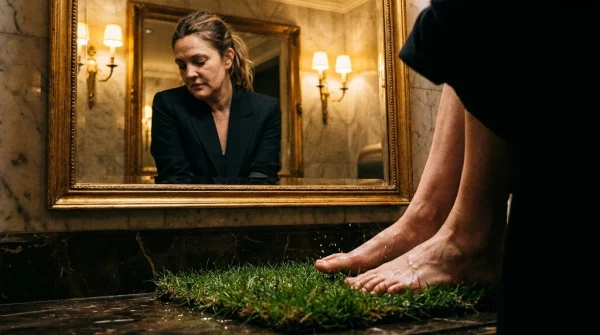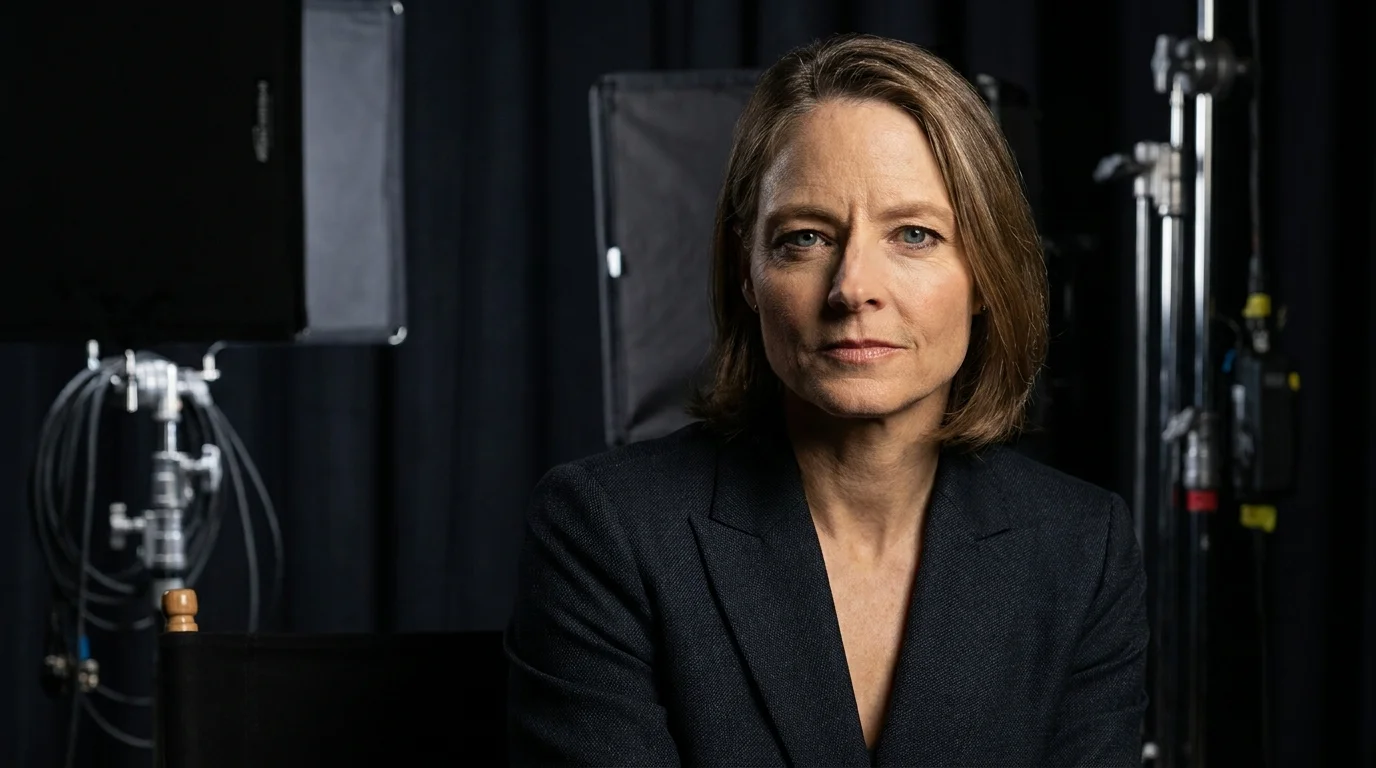
The studio floor smelled of hot copper wire, scorched muslin, and industrial air conditioning humming against damp soundstage walls. Two production assistants in steel-toed boots crouched beside the main camera pedestal, their hands adjusting a four-bank LED ring diffuser designed to blast away skin texture with clinical precision. It was the standard modern protocol: coat the subject in soft, milky, omnidirectional illumination until age, bone structure, and emotional weight melt into a flat digital gloss.
Then Jodie Foster walked in, stopped five feet from the mark, and pointed directly at the frosted silk diffusers. She didn’t consult a publicist or check a handheld monitor. With the dry calm of someone who has spent over five decades navigating camera departments, she quietly gave a counter-instruction: unplug the fill units, kill the soft panels, and leave the bare, directional key light exactly where it was. Facial planes require contrast, and she wanted the deep shadows under her cheekbones and across her temples left completely bare.
The crew hesitated, caught in that familiar studio panic where industry convention clashes with seasoned instinct. In a landscape obsessed with digital smoothing and algorithmic youth, her move felt like a breach of contract. Yet when the monitors flickered back to life, the image didn’t look harsh or neglected; it looked formidable, architectural, and completely alive.
The Anatomy of Chiaroscuro: Why Flat Light Erases Presence
You have likely noticed how flat modern media looks. Whether scrolling past prestige television or high-profile sit-down interviews, faces frequently appear as if they are breathing through a pillow—smooth, uniform, and thoroughly drained of gravity. Standard television lighting operates on risk aversion; technicians flood the frame to erase lines, smooth uneven tone, and ensure that no errant shadow distracts the viewer.
Foster understood a fundamental rule of visual storytelling that modern portraiture constantly forgets: light merely reveals an object, but shadow reveals its true volume. By demanding a stark, single-source setup, she turned the natural contours of her face into narrative terrain. The hard falloff beneath the jaw and the sharp edge along the bridge of the nose didn’t signal aging; they signaled authority.
When you strip away the protective wash of multi-angle diffusion, you force the audience to look directly into the eyes rather than scanning a polished surface. The absence of artificial softening introduces a tension that money cannot buy on an equipment invoice.
- Michael Strahan live audio leak captures urgent off-camera panic warning on air
- Conan O’Brien live teleprompter freeze triggers unscripted standoff with network producers
- Daniel Craig cable rig stunts trigger brutal spinal compression during Spectre
- Robert Downey Jr. unscripted burger scene derails Iron Man corporate script
- Ron Howard forty year marriage survives enforcing strict non-Hollywood residency limits
The Set Decider: Elena Vance on the Power of Unforgiving Rigs
Elena Vance, a veteran key grip who has worked New York soundstages since 1994, recalls watching similar confrontations over lighting grids. During an independent drama shoot in Queens five years ago, an experienced stage actress refused the company’s signature beauty disc, demanding instead a raw tungsten fresnel clipped to an overhead grid pin. Elena noted that younger producers immediately braced for an unflattering catastrophe, convinced the footage would look unpolished and cheap. Instead, when the dailies arrived, the character looked unshakeable—every trace of fatigue and resolve registered instantly, cutting through the screen because the crew wasn’t actively hiding her humanity behind plastic scrims.
The Two Camps of Modern Screen Presence
Every public performance today balances between two conflicting visual philosophies. Recognizing which camp you operate in—even when setting up a simple home office desk lamp—determines how your voice lands with the person on the other end of the feed.
The Cosmetic Buffer
This approach prioritizes safety above all else. It relies on circular desk lights, dual-panel bounce cards, and software-based skin filters that eliminate grain, freckles, and fine lines. Uniform glow eliminates character, trading authority for an unchallenging, interchangeable digital neatness that leaves audiences feeling oddly detached.
The Sculpted Counter-Weight
Here, darkness is treated as an active design choice rather than an exposure error. By positioning an illumination source high and slightly to the side, you introduce natural falloff that frames the jawline and emphasizes focus. It communicates an unhurried, grounded confidence that doesn’t beg the audience for approval or rely on artificial flattery to hold a room.
Tactical Application: Sculpting Your Own Visual Authority
You don’t need a soundstage grid or union gaffers to reclaim contrast in your daily environment. Controlling how you present your physical space comes down to three deliberate, minimal decisions.
Position your primary light source at a forty-five-degree angle from your face rather than straight on. This single shift creates dimension across the bridge of your nose and stops your features from dissolving into a flat plane on glass lenses. Embrace single-source illumination to immediately add weight and visual intention to any frame.
- Kill the frontal desk ring: Disconnect overhead ceiling fixtures and front-facing circular LED bulbs.
- Select a warm, single point: Place a shade lamp or directed bulb 2 to 3 feet higher than eye level, slightly off-axis.
- Leave the fill side dark: Resist the urge to balance the shadowed side of your face with secondary white boards or ambient bounce.
Keep your technical tools simple, tactile, and reliable:
- A 2700K to 3000K warm-tone directional bulb (avoid harsh 5000K daylight panels).
- A black foam core board placed opposite the light source to absorb stray room reflection (negative fill).
- A distance of at least 4 feet between yourself and the nearest background wall to keep shadows crisp.
The Power of the Unvarnished Frame
In a culture saturated with artificial smoothing, real presence looks startlingly different. Jodie Foster’s refusal to hide behind diffusion screens was more than an aesthetic preference; it was a demonstration of self-ownership. It served notice that lived experience carries far more weight than pristine, manufactured surfaces.
When you stop attempting to erase the marks of time, effort, and concentration, you allow your actual presence to occupy the room. True gravity needs no polish. By stepping out from behind flattering filters, you invite others to meet you on honest terms—uncompromised, deliberate, and undeniably real.
The most magnetic face in any room is never the smoothest; it is the one that has made peace with its own shadows.
| Key Point | Detail | Added Value for the Reader |
|---|---|---|
| Directional Sourcing | Single 45-degree angle setup | Builds natural face contours without digital alteration. |
| Intentional Falloff | Deliberate refusal of secondary fill panels | Forces viewer attention directly to eye-line and vocal delivery. |
| Negative Fill Method | Absorbing ambient bounce with dark surfaces | Instantly adds cinematic presence to ordinary indoor spaces. |
Frequently Asked Questions
Why do production teams insist on using ring diffusers?
They offer an easy, safe baseline that washes out physical flaws, protecting publicists and editors from complaints about bad lighting.Does hard directional light make people look older?
It highlights actual texture rather than smoothing it away, which conveys maturity, depth, and confidence instead of synthetic perfection.Can I achieve this look using natural window light?
Yes. Turn sideways to the window frame rather than facing it directly, allowing the natural daylight to illuminate only one side of your face.What is negative fill?
Negative fill is the deliberate placement of a black surface on the unlit side of a subject to swallow stray ambient light and deepen the shadows.Why is Foster’s lighting choice considered unconventional?
Hollywood red-carpet and sit-down protocols prioritize wrinkle-softening vanity filters; rejecting them subverts standard promotional expectations.