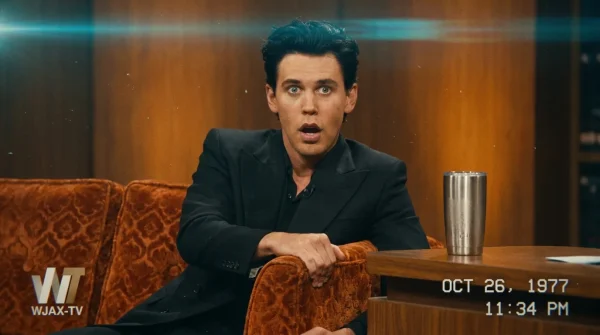
The studio air inside Television City always carries the faint, dry scent of ozone and chilled dust, churned by heavy industrial cooling vents hung thirty feet above the stage floor. Under the searing amber warmth of overhead Fresnels, a live broadcast appears seamless, almost dangerously casual. You watch the host lean back against his stool, hands tucked loosely near his pockets, tossing off biting political observations with the rhythm of someone chatting across a backyard fence. It feels effortless, relaxed, and entirely unscripted.
Yet beneath that relaxed posture sits a tightly calibrated machine running on fractions of a second. Every cadence, pause, and wry smirk is tethered to a cold pane of glass perched just below the camera lens, reflecting rolling white lines at twenty words a minute. The illusion of effortless improvisation depends on a single unspoken rule: you must never let the audience catch you reading.
Then the phosphor dies. In the middle of an opening editorial, the scrolling text vanishes into an empty slate of dark glass. What happens next is not a dramatic vocal stumble or a visible gasp. Instead, it is an involuntary, biological twitch: a sudden, rapid sideways dart of the pupils as the eyes sweep the perimeter of the prompter hood, searching desperately for a lost anchor that simply is not there.
That micro-second optical reflex exposes the fragile reality behind modern political commentary. In that solitary flicker of motion, the comfortable swagger drops away, revealing how much cognitive horsepower is silently diverted toward maintaining a synthetic aura of spontaneous brilliance.
The Invisible Tether of Rehearsed Spontaneity
We tend to view sharp public speaking as an act of raw mental agility, imagining our favorite hosts possess a wellspring of rapid-fire prose ready at a moment’s notice. The reality is far closer to breathing through a pillow while trying to recite poetry. A teleprompter does not merely supply words; it regulates timing, cushions psychological risk, and creates a rhythmic metronome that lulls both speaker and viewer into a false sense of conversational intimacy.
When that screen cuts out without warning, your brain encounters what cognitive scientists call an abrupt processing stall. The comfortable flow of speech breaks, and your ocular muscles instinctively execute a rapid cluster of search saccades. The eyes snap wide sideways, hunting along the margins of the lens bezel to check whether the feed merely jumped down a paragraph or died entirely. To an observant viewer, that tiny jitter completely shatters the spell.
- Jodie Foster bans flattering studio lighting enforcing harsh shadows during career interview
- Michael Strahan live audio leak captures urgent off-camera panic warning on air
- Conan O’Brien live teleprompter freeze triggers unscripted standoff with network producers
- Daniel Craig cable rig stunts trigger brutal spinal compression during Spectre
- Robert Downey Jr. unscripted burger scene derails Iron Man corporate script
Marcus Vance, a 54-year-old studio pedestal operator who has spent three decades tracking monologue deliveries across late-night stages in Burbank, knows that look intimately. “You can tell the exact frame a prompter cuts out without ever looking at the monitor yourself,” Marcus explains. “An anchor will be looking you dead in the glass with complete confidence, and then their irises will vibrate sideways like a compass needle near an engine block. It takes three full seconds for the pride to step back and the survival reflex to take over.”
Deconstructing the Optical Panic Response
How an entertainer handles that sudden drop-off reveals everything about their training, their reliance on the safety net, and their capacity to mask genuine vulnerability in front of millions of peering eyes.
The Mechanical Panic (The Scan)
This is the reflex caught on camera during the blackout. Instead of holding steady contact with the center lens, the performer’s gaze twitches left, right, and slightly downward toward the floor monitors. The natural instinct to search overrides years of performance discipline. Because the host is accustomed to having the punchline pre-loaded in their peripheral vision, losing that forward visibility feels like stepping off an unexpected curb in total darkness.
The Pivot to Synthetic Contempt
Once the eyes confirm the text is gone, high-profile veteran hosts often pivot into an exaggerated, theatrical posture. They may squint intentionally, roll their shoulders, or toss their hands outward as if an audience interruption occurred. This deliberate physical exaggeration acts as a visual smoke screen, designed to convince you that the ensuing pause was an artistic choice rather than a frantic internal scramble to remember the closing premise.
The Hard Conversational Drop
When the visual guide rails vanish, the cadence inevitably shifts from rhythmic broadcast delivery to flatter, colloquial cadence. The polished rhythm of a prepared writer dissolves into the choppy, repetitive phrasing of a speaker buying time. You hear filler words creep into the margins, and the host leans harder into known audience triggers—easy applause lines or familiar grievances—simply to give their working memory enough space to reconstruct the monologue’s spine.
Managing the Drop: The Speaker’s Recovery Protocol
Whether you are standing before a national studio audience or simply presenting quarterly numbers in a cold boardroom, technical failovers will eventually pull the rug from beneath your feet. Surviving the sudden loss of your notes requires deliberate, physical countermeasures to prevent your eyes from betraying your panic.
- Lock Your Gaze Down the Barrel: When the words disappear, resist the urge to glance toward the corners of the room or your presentation notes. Pick a single human face or the center of the camera lens, plant your focus there, and hold it steady. A steady gaze reads as dramatic contemplation rather than terrified confusion.
- Breathe Out Before You Speak: Panic causes shallow chest breathing, which drives up vocal pitch and speeds up delivery. Expel a full breath through your nose before attempting the next sentence. This forces your vagus nerve to slow your heart rate and kills the impulse to babble.
- Acknowledge the Void Gracefully: If the gap lasts more than three seconds, drop the illusion completely. A brief, dry acknowledgment of the glitch instantly builds trust with your audience, turning an embarrassing technical blunder into a shared moment of human resilience.
The Tactical Stagecraft Toolkit
Keep these baseline parameters in mind whenever you step in front of a lens or a lectern:
Baseline Ocular Focal Range: Maintain your gaze within an imaginary 4-inch square around the lens axis. Any eye shift that travels beyond this perimeter reads on high-definition video as a broken connection with the viewer.
The Pause Threshold: Allow a dead space of up to 2.5 seconds. While it feels like an eternity inside your head, an audience interprets a two-second silence as thoughtful pacing rather than a cognitive train wreck.
The Pivot Anchor: Memorize only the first line, the central concept, and the final punchline of your material. The tissue in between should always be modular enough to discard the moment a technical glitch strikes.
The Fragile Art of Real Presence
There is an odd comfort in seeing a seasoned television icon lose his optical moorings for a fleeting second on live television. In a culture saturated with smoothed-out digital filters, pre-recorded segments, and obsessively curated online identities, that sudden, panicked dart of the pupils reminds us of the profound friction between performance and truth.
When the screen goes black, the glossy celebrity veneer drops, leaving behind an ordinary human being standing under merciless studio lights, desperately searching his memory for the right words. Mastering your own unexpected slips is never about pretending the screen didn’t fail; it is about learning to inhabit the quiet space that opens up when the script finally runs out.
“True stage presence is not measured by how smoothly you recite a script, but by the quiet dignity you display in the two seconds after the script disappears.”
| Key Point | Detail | Added Value for the Reader |
|---|---|---|
| The Saccadic Giveaway | Rapid horizontal pupil shifts that happen involuntarily when reading text suddenly disappears. | Allows you to diagnose your own eye-dart habits when transitioning between presentation slides. |
| The Gaze Lock | Fixing your line of sight directly on a central point rather than scanning the perimeter for lost notes. | Projects unshakeable authority during unexpected technical interruptions or forgotten lines. |
| Modular Scripting | Structuring speeches around a core anchor thought rather than memorized word-for-word prose. | Ensures you can continue speaking persuasively even if your teleprompter or slide deck fails entirely. |
Frequently Asked Questions
Why do public speakers look sideways when their notes cut out?
This is an involuntary saccadic eye movement driven by the brain’s search for expected visual stimuli. When reading, your eyes follow a strict horizontal path; when the guide vanishes, your visual cortex briefly scans the perimeter to locate the lost anchor.Can an audience always tell when a teleprompter fails?
Viewers rarely notice an equipment failure directly, but they immediately perceive the speaker’s micro-expressions. If you panic, fidget, or look around frantically, the audience instantly senses the break in connection, even if they don’t know why it happened.How can I stop my eyes from darting when I forget what to say?
Practice anchoring your gaze to a specific spot—either the direct center of the camera lens or the bridge of a listener’s nose. When you lose your train of thought, consciously freeze your eye position while taking a steady breath before speaking.Why is over-reliance on a teleprompter risky for live commentary?
Relying completely on rolling text strips away your natural improvisational flexibility. When a technical glitch inevitably happens, your active memory must restart from a dead stop, resulting in awkward cadences and visible physical stress.What is the best immediate recovery tactic during a live blackout?
Drop the theatrical performance and switch to plain, unadorned speech. If the prompt does not return within two to three seconds, a calm, humorous remark about the glitch restores control and draws the audience onto your side.