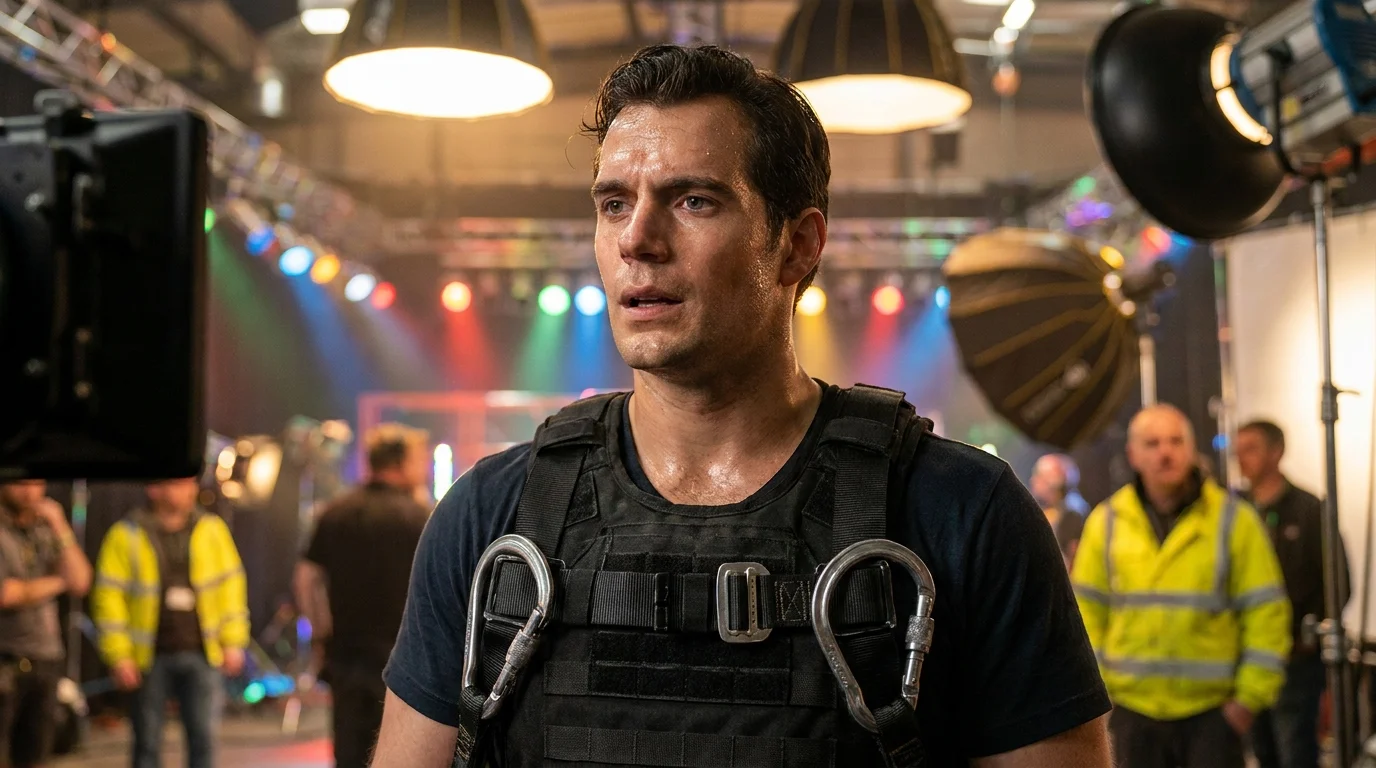
The sound on Stage 2 at Pinewood Studios is never quiet; it is a metallic hiss of pneumatic winches spooling braided steel aircraft cable at thirty feet per second. You smell hot hydraulic fluid, the bitter bite of ozone from overheated electric servos, and the damp sweat trapped inside three layers of neoprene and ballistic Kevlar. Under the blinding white tungsten lights, an actor hangs fifty feet above a concrete floor painted safety green, waiting for the countdown.
When the director calls the drop, gravity takes over for a fraction of a second before the automated counterweight slams shut. On camera, you see Henry Cavill glide effortlessly through the air, carving through artificial skies with chiseled poise and seemingly weightless power. The camera catches the jawline, the locked gaze, and the immaculate line of his shoulders, creating the cinematic dream of total freedom from the earth.
What the high-speed shutter misses is the violent kinetic debt collected at the sudden stop. As the high-wire arrests his rapid descent, his 235-pound muscular frame does not simply float to an elegant standstill; it transfers hundreds of foot-pounds of violent kinetic energy directly into his skeletal core. The sudden multi-G deceleration jolts from rigid wire rigs compress the lumbar vertebrae with the unyielding force of a low-speed automotive collision, turning standard blockbuster stunts into an endurance test against spinal trauma.
We applaud the heroic spectacle on our pocket screens, yet we rarely acknowledge the mechanical violence required to make a massive human body appear lighter than air.
The Anvil and the Cable: Biomechanical Reality Behind Cinematic Flight
You cannot negotiate with Newtonian physics, no matter how clean the digital composite looks in post-production. When a human body free-falls and is abruptly caught by zero-stretch steel cable, that kinetic momentum has to dissipate somewhere. In a standard vehicle, crumple zones and seatbelts deform to spread deceleration over distance; on a stunt rig, the harness distributes friction against the hips, but the vertical column of the spine takes the axial brunt.
Think of your spine as an alternating stack of rigid bone and pressurized fluid cushions. When Cavill hangs in a traditional five-point stunt harness, his pelvis is tilted slightly backward to keep his chest upright for the heroic camera angle. This subtle tilt flattens the natural lordotic curve of the lower back, turning a dynamic, shock-absorbing spring into a straight, vulnerable pillar. When the winch brakes engage, the sudden stop acts like an anvil striking an upright cylinder, driving the L4 and L5 discs into excruciating micro-deformations.
- Nicole Kidman harsh close-up demands stripped digital smoothing for gritty transformative role
- Post Malone arena monitor feedback spike halts live show over acoustic shock
- Alix Earle supposedly raw livestream sparks fan outrage exposing scripted agency talking points
- Brandi Carlile casual outing surfaces tailored velvet blazers paired with custom boots
- Joe Pesci unscripted restaurant interrogation shatters gangster conventions in classic mob cinema
For an actor built with standard screen dimensions, this force is already brutal. But for Cavill, whose dense, powerlifter physique puts immense muscle weight onto his frame, the load equation shifts dramatically. Every extra pound of lean muscle acts as an amplifier during deceleration. What might be a tolerable three-G jolt for a lighter performer becomes a crushing impulse load when accelerating and braking over two hundred pounds of dense human tissue across twelve-hour shooting days.
The Pinewood Secret: Lessons from the Rigging Truss
Marcus Vance, a 52-year-old veteran stunt rigger and kinetic safety supervisor who spent three decades orchestrating wire setups across London and Vancouver soundstages, knows the silent math of the harness better than anyone. He has watched Hollywood transition from manual sandbag counterweights to high-speed computerized servo drives, and he views the shift with a mixture of awe and caution.
“The audience believes the wire holds you up comfortably, like sitting in a leather chair,” Vance explains while inspecting an anodized aluminum spreader bar. “In reality, a wire rig is a suspension rack. You are fighting the harness to keep your ribs from bruising, your groin from losing circulation, and your spinal column from taking the shock wave every time the computerized winch hits its hard stop mark. When a big performer like Henry stops dead on a mark from twenty feet in the air, you can actually hear the harness webbing sing under the instantaneous tension. That mechanical snap goes straight into his lower lumbar discs.”
Anatomy of the Drop: Three Structural Impact Zones
Understanding the toll of modern practical action requires breaking down how dynamic suspension systems stress the human framework across different mechanical phases.
- The Axial Shock Wave: The exact millisecond the mechanical line catches the falling body, deceleration forces spike up to four times normal body weight, causing sudden disc compression that temporarily reduces spinal column height.
- The Pelvic Torque Trap: As the leg loops tighten under load, the pelvis is locked in place while the heavy muscular torso continues to pitch forward, generating shearing stress across the sacroiliac joints.
- The Sustained Suspension Strain: Between takes, hanging in place restricts venous blood return from the lower limbs, forcing the spinal stabilizing muscles to lock into continuous, fatiguing isometric spasms.
These forces do not simply disappear when the director calls cut. The cumulative compression fatigue compounds across dozens of takes, turning what appears to be effortless heroism into deep, cellular exhaustion that demands calculated, clinical recovery protocols to survive a multi-month shoot.
Decompression Protocols: Reclaiming Vertebral Space
Surviving high-velocity wirework is not about gritting your teeth; it is about respecting mechanical recovery. You do not treat high-G spinal compression with generic stretching or casual rest. Professional stunt teams and heavy-framed performers rely on strict decompression mechanics designed to restore hydration to depleted intervertebral discs before permanent herniation occurs.
The recovery process mimics the precision of the stunt itself, focusing on targeted physical interventions that undo the kinetic damage inflicted by the harness:
- Targeted Inversion Traction: Hanging inverted at an angle between forty-five and sixty degrees allows gravitational traction to open compressed disc spaces without triggering defensive muscle spasms in the erector spinae.
- Controlled Intramuscular Decompression: Utilizing targeted dry-needling and focused tissue release along the psoas and quadratus lumborum releases the deep flexors that lock up during violent suspension arrests.
- Hydrostatic Spinal Deloading: Immediate post-wrap sessions in warm saltwater tanks neutralize gravitational pull, allowing the nucleus pulposus inside each disc to reabsorb ambient fluid after hours of high-pressure mechanical compaction.
Maintaining strict structural integrity requires that decompression takes place within ninety minutes of the final take, ensuring the spinal cartilage cools down in an elongated, unstressed alignment rather than set into locked stiffness.
The Tactical Toolkit for Mechanical Relief
To withstand repeated high-velocity suspension setups without chronic disc degradation, stunt athletes and performance specialists rely on a precise set of environmental parameters:
- Inversion Angle: Exactly 55 degrees on a calibrated mechanical table for 8 to 12 minutes immediately post-harness removal.
- Hydrotherapy Temperature: Neutral-buoyancy saline immersion kept at 94°F to 96°F to maximize soft tissue relaxation without triggering inflammatory vasodilation.
- Axial Rest Position: The 90/90 supine posture (hips and knees bent at ninety degrees supported on a foam bench) for twenty minutes to neutralize lumbar shear forces before sleep.
- Harness Padding Density: High-density closed-cell polyethylene foam inserts custom-molded to the iliac crests to prevent harness slip and maintain optimal pelvis alignment during deceleration.
The Real Cost of Weightless Spectacle
We live in an era where digital tools can easily paint an actor across a sky, yet audiences still hunger for the weight, the real momentum, and the tangible grit of a human body caught on camera. When you watch Henry Cavill drop through a scene, your subconscious registers that real physical stakes are playing out. That grounded presence is not an accident of lighting; it is the physical presence of a 235-pound athlete paying a steep physiological toll against the laws of motion.
Understanding this hidden physical transaction changes how you watch your favorite action epics. The effortless grace on screen is bought with real cartilage, precise rigging calculations, and hours of calculated decompression behind closed trailer doors. True physical mastery is not avoiding the crushing weight of the world, but building the resilience, precision, and discipline to absorb the shock and land on your feet.
“Cinematic flight looks like pure poetry to the viewer, but to the skeletal system of a heavy actor, every sudden stop on a wire rig is a hard physical collision with Newtonian physics.” — Marcus Vance, Veteran Stunt Rigging Supervisor
| Phase of Wire Action | Biomechanical Stress on Body | Recovery Protocol & Reader Insight |
|---|---|---|
| Dynamic Drop Arrest | Sudden axial deceleration loading L4-L5 discs up to 4G | Immediate inversion traction restores intervertebral clearance and prevents nerve impingement. |
| Mid-Air Hero Pose | Forced lumbar flattening from rigid harness pelvic wrap | Pelvic neutral alignment work keeps lower back stabilization muscles from locking into spasm. |
| Static Suspension Hold | Restricted vascular flow and continuous core isometric tension | Hydrostatic immersion promotes fluid re-absorption into spinal discs after long takes. |
Frequently Asked Questions
Why do wire stunts cause so much lower back pain for actors?
When wire rigs stop a falling body mid-air, the sudden deceleration force bypasses the legs and feet, channeling kinetic energy directly into the lumbar spine while the harness flattens the natural shock-absorbing curve of the back.Does heavier muscle mass make suspension stunts harder?
Yes. Additional muscle mass significantly increases overall body mass, which amplifies the total kinetic load and deceleration G-forces experienced by the spine and harness attachment points during sudden stops.How long does an actor need to decompress after wire work?
Stunt professionals typically spend ten to twenty minutes in passive inversion or deloading postures within the first hour after removing a harness to let the discs rehydrate before the stabilizing muscles seize up.Why don’t productions rely entirely on CGI instead of wire rigs?
Digital doubles often lack the subtle, authentic shifts in muscle tension, natural skin folds, and realistic momentum that audiences instinctively recognize when a live human performs practical movements on set.Can everyday fitness enthusiasts benefit from these decompression techniques?
Yes. Incorporating simple deloading habits like the 90/90 supine rest position or gentle inversion can alleviate disc compression caused by heavy lifting, poor desk posture, or high-impact running.