The arena air carries a specific weight right before a stadium chorus kicks in: thirty thousand voices humming against cold concrete, sub-bass rattling through your sternum, and stadium haze catching red spotlight beams. From row twenty, you see Shakira mid-stride, hips catching the beat with calculated perfection, a smile painted across her face as if her body exists on pure autopilot. Everything looks seamless, a glossy monument to arena pop precision.
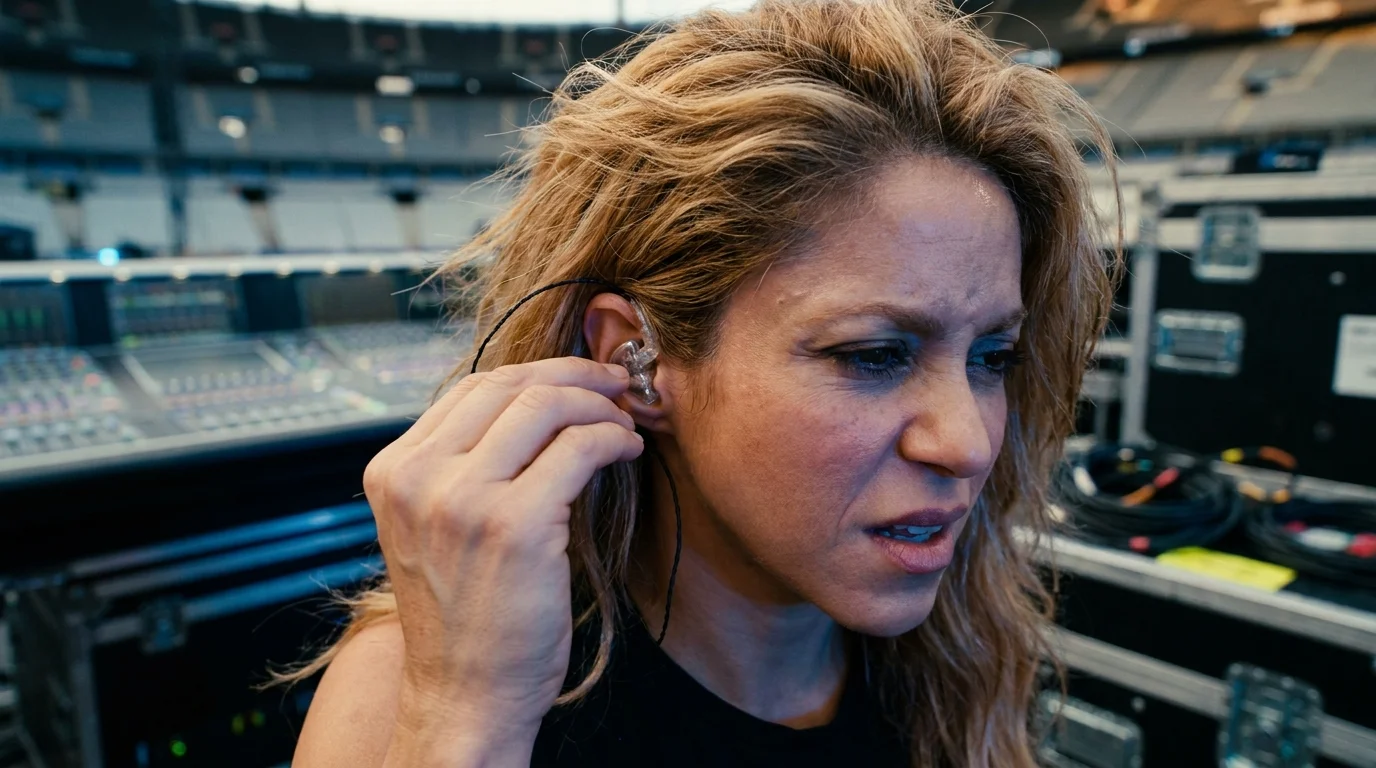
Then, in less than a quarter of a second, the illusion snaps clean in half. Her left hand flinches upward not in a dance move, but with the sudden, defensive reflex of someone pulling away from an open flame. The custom molded acrylic monitor gets wrenched out of her canal, swinging violently against her collarbone while her throat continues pushing out sustained notes without dropping pitch.
What looked to casual stadium viewers like raw theatrical energy was something far uglier: an ear-splitting burst of delayed feedback screaming directly against her tympanic membrane. When custom stage monitors betray an artist, they do not just hum—they deliver an acoustic ambush inside a sealed ear canal, weaponizing extreme sound levels inches from the auditory nerve.
The Anatomy of Acoustic Sabotage
To understand what happened under those lights, you have to abandon the idea that stadium sound is simply louder than your home stereo. Think of an in-ear monitor not as a high-end headphone, but as a hermetic pressure seal. When an artist stands on stage, custom silicone molds isolate their inner ear, cutting out fifty decibels of ambient room noise so they hear only their isolated pitch and a clean metronome click.
When a digital soundboard lags or misroutes a bus send, it turns that quiet haven into a microscopic torture chamber. Delayed Auditory Feedback—a technical phenomenon where you hear your own voice piped back into your skull forty milliseconds late—instantly scrambles the speech center of the brain. Try speaking into an app that echoes your voice half a second later; your tongue feels thick, your pacing collapses, and your thoughts stumble as if you are trying to talk while breathing through a pillow.
Combine that temporal lag with a piercing high-gain spike, and you are no longer dealing with a musical mismatch. You are staring down an acute acoustic shock that can permanently sear the delicate stereocilia inside your inner ear within seconds.
- Charlize Theron studio lighting refusal strips artificial glamour for raw drama
- Henry Cavill high-wire suspension stunts force grueling spinal disc compression on set
- Nicole Kidman harsh close-up demands stripped digital smoothing for gritty transformative role
- Post Malone arena monitor feedback spike halts live show over acoustic shock
- Alix Earle supposedly raw livestream sparks fan outrage exposing scripted agency talking points
Marcus Vance, a forty-eight-year-old touring monitor tech who spent twenty years behind digital consoles for festival headliners, knows that sudden violent yank by heart. “The second an RF transmitter drops a sync packet or an open omnidirectional condenser bleeds into an aux return, the board can generate a razor-sharp transient at one hundred and twenty decibels,” Marcus once told me over coffee while tuning a rack of digital receivers. “If a performer does not yank that mold out of their head immediately, they aren’t just missing a cue—they are looking at instant acoustic trauma.”
The Hidden Geometry of In-Ear Failure
Not every soundboard failure shares the same fingerprint. Depending on the physical venue and the digital routing architecture, an artist navigating an arena tour faces distinct varieties of invisible danger.
The Delayed Auditory Feedback Spiral
When the digital conversion buffer chokes, sound from the microphone returns to the artist with an imperceptible micro-delay. Your brain relies on immediate bone conduction to regulate pitch. When the processed digital signal arrives out of sync with your physical skull vibrations, your motor system freezes. For an artist like Shakira, whose vocal delivery relies on syncopated polyrhythms, this desync forces a choice: pull the monitor instantly or let the delay drag your tempo into a trainwreck.
The Uncapped Frequency Transient
Live stages bristle with wireless radio frequency transmitters competing with local emergency bands, cell towers, and stray production comms. If a signal drops its pilot tone for a split second, uncompressed white noise or a screaming 8kHz squeal can bypass the board’s digital limiters. Inside a sealed ear canal, that spike has nowhere to disperse; it acts like a hammer striking an anvil.
Preserving Your Ears in a High-Volume World
You may never headline a packed stadium, but the physiological rules that dictated Shakira’s sudden reflex apply whenever you put earbuds in your ears or navigate high-noise environments. Modern digital audio surrounds us with compressed transients and insidious volume creep that wear down auditory resilience.
Taking control of your acoustic health requires mindful, decisive habits rather than passive tolerance:
- Implement the sixty-percent ceiling: Cap personal media player volume at three-fifths maximum output to prevent prolonged acoustic fatigue over long listening sessions.
- Banish unilateral listening habits: Avoid pulling one earbud out while cranking the volume on the remaining side; your brain compensates for the lost ear by demanding dangerous decibel spikes.
- Select passive attenuation over raw gain: Choose comfortable silicone seals that block outside noise mechanically, eliminating the temptation to blast audio just to drown out passing traffic.
- Audit daily decibel exposure: Use your phone’s built-in sound metrics to log your daily dose of audio above seventy-five decibels, taking silent breaks to let your inner ear rest.
The Tactical Audio Toolkit
Keep these technical benchmarks locked into your memory to assess your everyday acoustic exposure:
- Safe Exposure Threshold: 85 dBA (maximum 8 hours before structural cellular fatigue sets in).
- Danger Spike Limit: 115 dBA (safe exposure time drops to under twenty-eight seconds).
- Auditory Brain Latency Limit: 15 milliseconds (any delay beyond this threshold confuses the speech-processing cortex).
- Ideal Physical Isolation: -26 dB (the reduction level provided by medical-grade acrylic custom molds).
The Invisible Price of Live Perfection
We often treat live spectacles as effortless machines, forgetting that behind every stadium tour sits a chaotic web of radio waves, digital clocks, and raw physical biology. What makes that stage moment so captivating is not the near-miss glitch, but the animal survival instinct breaking through a heavily polished surface.
When Shakira tore that monitor away, she chose physical preservation over stage choreography. In doing so, she reminded everyone watching that sound is not just art—it is a physical force that demands respect, whether you are running a sixty-channel arena console or simply walking down a noisy avenue with your favorite playlist humming in your ears.
“When an acoustic spike hits a sealed ear canal, professional choreography disappears; raw biology takes the wheel.”
| Key Point | Detail | Added Value for the Reader |
|---|---|---|
| Latency Tolerance | Auditory signals desyncing past 15ms cause mental stuttering and vocal stalling. | Explains why software lag can completely disrupt your speech or focus during video calls. |
| Acoustic Shock | Unregulated decibel bursts trapped by sealed silicone ear canals bypass bone dispersion. | Shows why volume spikes through earbuds cause significantly more trauma than speaker noise. |
| Protective Reflex | Tearing out an in-ear monitor mid-performance preserves stereocilia cells from permanent damage. | Highlights the necessity of removing audio devices instantly when high-pitched feedback occurs. |
Frequently Asked Questions
Why do performers wear tightly sealed in-ear monitors instead of traditional stage floor wedges?
Stage floor wedges bounce sound off stadium walls, creating massive echo and muddiness that make singing on pitch nearly impossible, whereas in-ear molds offer clean, direct pitch feedback.Can a sudden soundboard squeal cause immediate hearing loss?
Yes, sound spikes exceeding one hundred and twenty decibels trapped inside an ear canal can cause permanent acoustic trauma, tinnitus, and inner-ear cell damage in a matter of seconds.Why is delayed auditory feedback so debilitating to human speech?
Your brain synchronizes vocal motor control with real-time bone conduction; hearing your own voice with a split-second lag short-circuits the neurological loop that dictates rhythm and diction.What safety devices prevent performers from suffering soundboard feedback spikes?
Touring audio engineers run hardware brickwall limiters and protective wireless receivers configured to clamp audio instantly before spikes cross safe decibel boundaries.How can casual music listeners protect their ears from similar acoustic shocks?
Avoid single-earbud volume compensation, use devices with active headphone safety limits turned on, and choose well-fitted passive earplugs during loud live events.