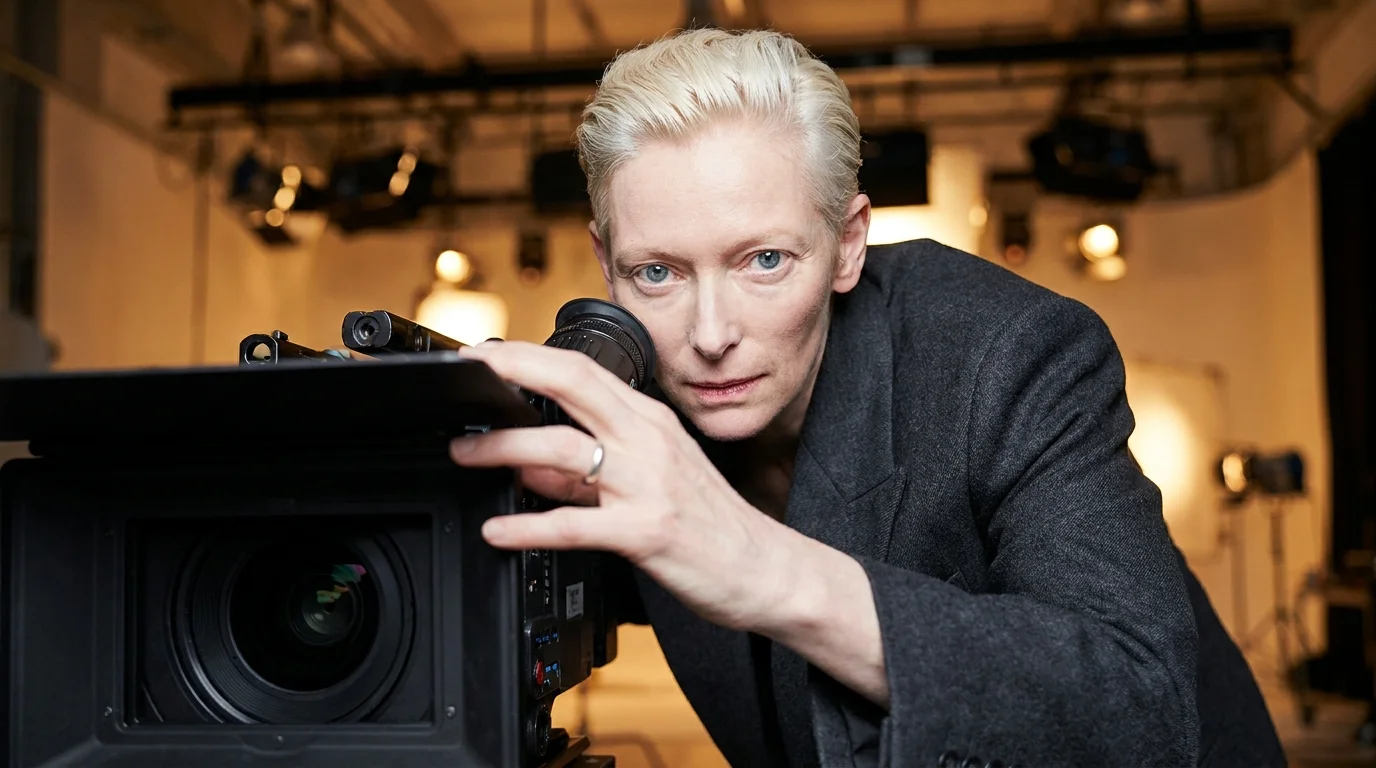
The soundstage in Burbank carries an unmistakable scent: hot aluminum, ionized air from high-output LED arrays, and the faint, sweet trace of setting powder drifting through the dark. Under the scaffolding, two studio technicians adjusted an optical diffusion filter over the prime lens, softening the glass to blur pores and flatten lines into a creamy, indistinct haze. It is the invisible contract of contemporary entertainment: every face must be preserved in amber, drained of geography, and rendered as smooth as a polished river stone.
Then Tilda Swinton stepped into the pool of key light. She did not settle into the mark. Instead, she tilted her head toward the primary monitor, paused, and quietly asked the crew to remove the glass filter altogether. The room went dead silent as she asked for the digital smoothing algorithms running through the monitor loop to be cut off completely.
She demanded the raw chip, the unvarnished exposure, and an unforgiving rake of hard white light across her temples. In an era where every frame of high-definition broadcast is treated like a cosmetic defense perimeter, stripping away the digital safety net was an act of deliberate sabotage. It was not a gesture of vanity inverted into false modesty; it was an exercise in pure artistic leverage.
The Porcelain Lie: Trading Synthetic Youth for Architectural Power
For decades, commercial portraiture has operated on a basic survival instinct: soften the edges to preserve the illusion. When digital cinema cameras made the leap from four to eight thousand lines of horizontal resolution, Hollywood panicked. Lenses that could count the fibers in a wool lapel suddenly treated human skin like an open excavation site, prompting an industry-wide rush toward digital skin-smoothing and internal diffusion algorithms.
We have been conditioned to confuse flat illumination with safety. Yet flat lighting acts like breathing through a pillow—it suffocates character under the pretense of comfort. By eliminating every shadow, the studio strips away the very contours that make a human expression legible from across a crowded room. Texture is where intention lives, and erasing it turns an actor into background wallpaper.
Swinton understands that a face without shadows has no leverage. When she ordered the diffusion kit packed back into its flight case, she inverted the entire power dynamic of the sit-down. Instead of submitting to the studio’s sanitizing machine, she used the sharp planes of her cheekbones, the faint lines around her mouth, and the pale, translucent paper of her skin as an architectural statement. The unsoftened lens ceased to be an interrogator; it became an accomplice.
- Savannah Guthrie open boom mic whisper rattles live control room before commercial
- Stephen Colbert live teleprompter freeze stalls broadcast prompting tense showrunner staredown
- Bradley Cooper unscripted red carpet distance exposes early cracks before sudden split
- Sandra Bullock resurfaced nineties talk show banter completely shatters studio media coaching
- Jackie Chan unedited red carpet grimace sparks intense stunt injury speculation
The DIT’s Dilemma: An Unplanned Incident on Stage 4
Consider the panic of Arthur Vance, a veteran digital imaging technician who has spent thirty-two years running calibration monitors across television stages in Burbank. At fifty-eight, Vance knows the routine by heart: high-profile guests sit down, glance sideways at the playback monitor, and quietly request a softer grade or a gentle Gaussian wash across their forehead before the tape rolls.
On that afternoon, Swinton bypassed the vanity monitors entirely and walked directly behind his workstation. She pointed to the subtle chromatic softening software running on the live feed and asked for its immediate disablement. Vance hesitated, fingers hovering over his control deck, warning her that the studio’s 4K capture would pick up every capillary and micro-expression without mercy. “That is precisely the point,” she replied, smiling without a trace of apology. For the next sixty minutes, the broadcast feed captured an unvarnished masterclass in presence, where every subtle shift of her brow carried the weight of an unscripted truth.
The Spectrum of Contrast: How Light Defines Intent
Stripping away artificial softening is not a one-size-fits-all maneuver; it is a conscious editorial choice that changes depending on the environment you inhabit. When you evaluate how visual texture functions, three distinct dynamics emerge:
- The Architectural Minimalist: Relies on directional key light and zero diffusion. Every line on the face is treated as structural framing, demanding that the viewer focus entirely on micro-movements and posture rather than surface perfection.
- The Ambient Realist: Works with existing environmental illumination—cool window light, overhead fluorescents, or practical desk lamps. This approach rejects the idea of a personal halo, grounding the individual in the gritty reality of the room.
- The High-Contrast Strategist: Employs sharp chiaroscuro to carve deep shadows along one side of the face. By intentionally surrendering half the portrait to shadow, this style creates an immediate aura of gravity and calculated reserve.
Choosing high-contrast clarity over cosmetic blur fundamentally alters how people absorb what you have to say. It signals that you do not fear your own presence, shifting the room’s focus from how you look to what you are commanding.
Mindful Exposure: How to Claim Your Visual Ground
You do not need an eighty-thousand-dollar studio camera to put this philosophy to work. The obsession with ring lights and built-in conference filters has quietly degraded how we communicate across digital spaces, leaving everyone looking like faintly glowing wax figurines. Taking command of your frame requires three deliberate, mindful shifts:
- Ditch the direct ring light: Move your primary light source forty-five degrees to the side. Let one side of your face sit in soft shadow to restore natural depth and physical presence.
- Turn off virtual cosmetic filters: Disable the “touch up my appearance” toggles in your conferencing software. The subtle latency and plastic blur of these tools communicate self-doubt rather than polish.
- Step back from the glass: Increase the distance between yourself and the lens while raising the camera to exact eye level. This eliminates facial distortion and places you on an equal plane with your viewer.
Treat your visual setup like an honest workspace rather than a defensive bunker. When you stop worrying about masking human details, your posture relaxes, your cadence settles, and your message lands with uncompromised authority.
The Unfiltered Authority of Owning the Frame
There is immense peace in abandoning the exhausting project of synthetic preservation. When you watch Tilda Swinton command an unadorned lens, you are witnessing someone who has made peace with time, utilizing every year, every line, and every pale plane of her face as an instrument of pure narrative power. Honesty functions as a visual shock in a landscape saturated with glossy artifice.
When you stop hiding behind digital veils, you force the world to meet you on your own terms. True authority has never lived in the perfection of a smoothed surface; it lives in the unapologetic presence of the person looking right back through the glass.
“To clear the glass of artificial fog is not an act of bravery; it is simply deciding to show up as a living person rather than a painted shell.”
| Key Point | Detail | Added Value for the Reader |
|---|---|---|
| Diffusion Removal | Eliminating optical glass filters and digital skin smoothing during capture. | Restores genuine micro-expressions and establishes unshakeable credibility. |
| Directional Illumination | Using side-angled, hard lighting instead of flat direct illumination. | Creates sculptural facial depth that commands visual respect. |
| Filter Rejection | Disabling automated software filters on daily communication cameras. | Saves mental bandwidth and projects authentic self-assurance to colleagues. |
Frequently Asked Questions
Why do studios rely so heavily on beauty filters for high-profile interviews?
Studios use diffusion filters and real-time digital smoothing to maintain standard commercial aesthetics and prevent lighting setups from clashing across different broadcast segments.Did Tilda Swinton’s lighting request cause technical issues on set?
No, it simply required the camera crew to recalibrate the exposure stops and trust the natural contrast ratios of the room without relying on automated software crutches.How does hard light change the way an audience perceives an interview?
Hard light accentuates bone structure and natural texture, creating an atmosphere of seriousness, authenticity, and narrative gravity that flat light inherently erases.Can removing digital filters actually make you look better on video calls?
Yes, because automated filters often create an uncanny, pixelated outline around the hair and eyes. Disabling them delivers a crisp, natural image that feels professional and grounded.What is the best way to light a face without using cosmetic diffusion?
Place an indirect light source slightly above and to the side of your face, allowing natural shadows to define your features while keeping the background softly subdued.