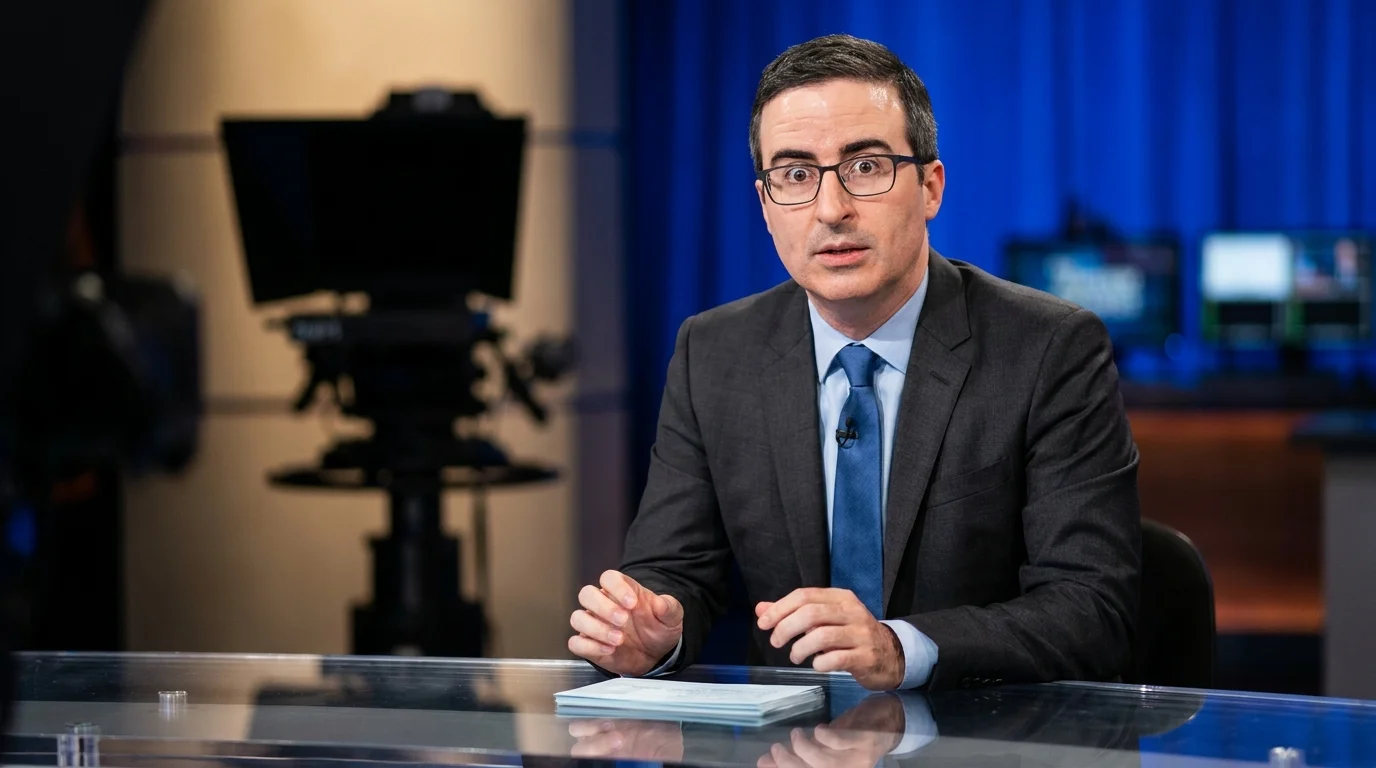
The studio floor at Manhattan’s CBS Broadcast Center carries a distinct scent: warmed mineral oil from heavy pedestal dollies, dry ozone from hundreds of overhead LED panels, and the faint metallic tang of conditioned air pumped in at 64 degrees Fahrenheit. When you sit in the audience or watch through the high-definition feed, the pacing feels inexorable. John Oliver’s delivery is famously relentless, a rhythmic cascade of polysyllabic fury, historical footnotes, and absurd metaphors firing off at roughly 160 words per minute. Every beat lands with mathematical certainty because his gaze is locked onto a silver-coated piece of glass angled precisely at forty-five degrees in front of the center camera lens.
Then, the current breaks. In a fraction of an instant, the pale white glow illuminating his irises vanishes into pitch-black void. The beam splitter glass dies without warning, extinguishing five minutes of tightly packaged, meticulously fact-checked political breakdown in the middle of a syllable.
If you watch the unedited archival feed closely, you catch the telltale optical giveaway. His pupils, previously constricted against the bright monitor glow, dilate almost violently as his retinas search for a line of text that is no longer there. His head does not turn toward the live audience or drop toward his desktop index cards; instead, his micro-saccades—the tiny, rapid movements human eyes make when reading—stutter in a frantic horizontal sweep across empty air. For two unbroken seconds, you are not watching a confident satirical powerhouse; you are watching an artist breathing through a pillow, stranded on an island of pure silence.
That sudden optical fixation strips away the seamless veneer of modern television, revealing the fragile wire on which modern broadcast charisma balances.
The Mirror Behind the Glass: Why Flow Is an Optical Illusion
Most viewers imagine live political satire as an act of pure conversational brilliance, assuming their favorite hosts merely glance at notes before unleashing a torrent of righteous indignation. The reality is purely kinetic, an intricate dance between optical feedback and muscle memory. The prompt scroll does not just provide words; it sets the rhythmic pacing for your breathing, governs how your diaphragm contracts, and dictates when your hands should gesture to cue the control room graphics.
When that screen cuts out, your cognitive architecture undergoes a sudden decompression shock. The brain, accustomed to digesting text two beats ahead of vocal delivery, suddenly collides with its own trailing voice. You go from surfing a predictable mechanical wave to falling headfirst into an sensory vacuum where every tick of the wall clock feels amplified tenfold.
- Tilda Swinton overrides studio beauty filters demanding unforgiving raw camera angles
- Savannah Guthrie open boom mic whisper rattles live control room before commercial
- Stephen Colbert live teleprompter freeze stalls broadcast prompting tense showrunner staredown
- Bradley Cooper unscripted red carpet distance exposes early cracks before sudden split
- Sandra Bullock resurfaced nineties talk show banter completely shatters studio media coaching
Marcus Ruiz, a 48-year-old master prompter operator with over two decades on network news stages across Midtown Manhattan, knows this vulnerability intimately. During a private post-mortem on high-speed monitor failures, Ruiz explained that the panic never originates in the throat—it begins in the ocular nerves. “The moment the glass goes dark,” Ruiz noted, “a speaker’s eyes instinctively hunt for the last pixel they registered, locking their posture into a rigid, defensive trance until their primal adrenaline overrides the script.”
Navigating the Cognitive Freefall: Three Anchor Modes
When the digital horizon collapses beneath your feet, your instinctual reaction reveals everything about how you process reality under pressure. Whether you are running a late-night television desk or defending a quarterly presentation in a boardroom, your recovery depends on which operational layer you lean into.
For the Script-Bound Speaker
If your confidence lives entirely in the text, monitor loss feels like sudden blindness. Your immediate tactical move is not to fake continuity, but to physically break your line of sight. By visibly lowering your eyes to physical index cards or physical surfaces, you reset the audience expectations instantly. The movement converts an awkward technical error into an intentional, deliberate pause, buying your short-term memory time to recover the core thesis.
For the High-Cadence Satirist
Performers who deliver fast-paced monologues rely heavily on phonetic rhythm rather than literal memorization. When Oliver caught the blackout, his mouth continued moving through muscle memory for nearly four seconds before the semantic thread snapped. In this layer, your best defense is leaning into the breakdown itself. Acknowledging the dead monitor pulls the curtain back, transforming a catastrophic broadcast freeze into an unscripted moment of high-leverage comedic gold.
For the Corporate Presenter
In everyday high-stakes meetings, a frozen confidence monitor usually triggers frantic apologetic stammering. You can avoid this trap by holding your exact focal depth for two seconds, inhaling through your nose, and pivoting directly to a rhetorical question. The moment you ask your audience to reflect on a metric, the spotlight shifts from your broken screen to their internal calculation, restoring your authority without a single frantic gesture.
Mindful Application: Rebuilding Presence from the Ground Up
Mastering public speech under technical failure is not about memorizing backup scripts; it is about cultivating physical stability that outlasts digital hardware. When the screens flicker out, your nervous system must rely on internal anchors.
To survive a total prompt failure without losing composure, integrate these physiological adjustments:
- Drop your physical gaze downward by ten degrees: Never let your eyes drift upward when searching for thoughts, as upward eye movement signals confusion to observers. Looking slightly down and center communicates solemnity and deliberate calculation.
- Anchor your feet into the floorboards: Distribute your weight evenly across both heels to prevent the involuntary, nervous lateral swaying that accompanies sudden cognitive stalls.
- Drop your cadence to 105 words per minute: Slowing your speech pattern creates natural pockets of empty space, allowing your working memory to retrieve talking points without sounding breathless.
- Use tactile grounding points: Rest the pads of your thumbs firmly against the edge of a desk, lectern, or physical card to send a steadying proprioceptive signal to your central nervous system.
The Tactical Toolkit for Scriptless Recovery: Keep your physical index cards printed in 16-point bold typeface, arranged only with single-word thematic triggers rather than full sentences. Position your physical cheat-sheet at a comfortable 30-degree viewing angle so a glance requires no neck strain. Keep your operational vocal pitch half an octave below your conversational default to prevent the vocal cords from tightening when panic strikes.
The Bigger Picture: The Raw Power of Broken Armor
There is an unspoken compact between modern audiences and media figures. We celebrate polished production values, gleaming desks, and seamless graphics, but we do not fall in love with machinery. We connect with unshielded humanity. The split second when Oliver’s gaze faltered was not a failure of talent; it was the exact moment the performance dissolved, leaving behind a flesh-and-blood human navigating the dark with nothing but his wits.
When you strip away the digital safety nets—the sliding teleprompters, the rehearsed cadences, the carefully staged eye lines—you discover that authentic authority is not the absence of disruption. It is the grace with which you stand your ground when the lights fail, draw breath into your chest, and keep speaking anyway.
“Charisma is never truly tested until the glass goes dark and you have to prove you actually mean what you were reading.”
| Key Point | Detail | Added Value for the Reader |
|---|---|---|
| The Optical Tell | Rapid horizontal saccadic eye stutter and pupil dilation | Learn to identify manufactured delivery versus genuine presence in real time. |
| Pacing Decompression | Working memory collision caused by sudden loss of forward-scrolling text | Strategies to prevent conversational panic during abrupt presentation tool failures. |
| Tactile Reset Protocol | Dropping eye level by 10 degrees and planting foot balance | Actionable physical habits to project unshakeable composure when technology crashes. |
Frequently Asked Questions
Did John Oliver completely stop the live broadcast during the monitor outage?
No, he used physical desktop materials and unscripted comedy to bridge the sudden gap, turning an off-camera equipment crash into a viral highlight of unvarnished wit.Why do high-level speakers struggle so visibly when prompters fail?
Because professional speech relies on reading two seconds ahead of spoken delivery; when the feed cuts, the speaker’s vocal cadence collides with an empty cognitive runway.What is an optical saccade during a public speech?
It refers to the microscopic, involuntary eye twitches made as human retinas jump between words, which freeze into an unnatural stare when the text abruptly disappears.How can I prepare for presentation screen failures in business meetings?
Always carry hard-copy prompt cards organized by bold thematic bullet points rather than complete sentences to train your brain for independent memory recall.Does admitting a technical glitch weaken your authority on stage?
No, naming the disruption immediately dismantles audience tension, establishing you as an adaptable, authentic communicator in complete control of the room.