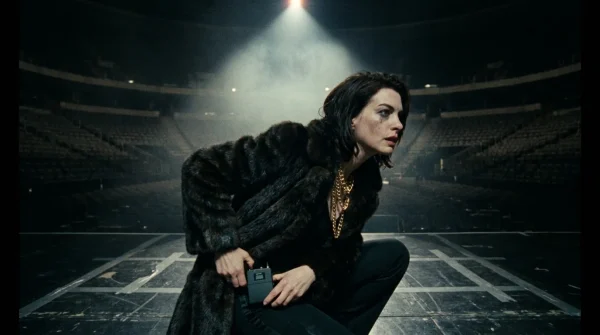
Stand beneath forty thousand screaming people inside an open-air concrete bowl, and the air stops behaving like normal atmosphere. It turns thick, humid with vaporized sweat and fog juice, vibrating so violently that your ribcage rattles before you ever hum a single bar. In your ears sits molded silicone, pumping a pristine, isolated stream of click track, synth bass, and vocal reverb directly against your eardrums. It is an artificial oasis designed to wall off the chaotic roar of the bleachers so you can hit a delicate whisper on pitch.
Then the signal fractures. Without warning, a digital processing delay hiccups in the front-of-house loop, dragging your own voice behind you by two hundred milliseconds while an acoustic spike needles straight into your auditory canal. It feels like breathing through a cold pillow while someone claps an iron frying pan right against your temple.
Most performers freeze or cough, pulled instantly off tempo by the disorienting slap-back echo of their own words rebounding off distant outfield seats. When Billie Eilish snapped her left hand upward to jerk the custom molded monitor from her ear canal during a high-stakes stadium stop, the movement was so rapid it looked like swatting an invisible hornet. Her chest stayed relaxed, her breath stayed low, and her vocal phrasing never stuttered by a sixteenth note.
To witness that split-second gesture is to witness the razor-thin boundary between high-gloss arena pop and brutal physical endurance. You are not watching a casual wardrobe adjustment; you are watching an athlete dodge sudden acoustic vertigo while keeping a stadium singing along.
The Sonic Hall of Mirrors: When Digital Time Tears in Two
To grasp why pulling an earpiece out mid-phrase requires startling physical control, you have to discard the fantasy of the frictionless modern stadium concert. We tend to view giant tours as automated machines running on pristine digital tracks, but they are closer to oil refineries operating under extreme atmospheric strain. Sound travels through cold night air at roughly 1,125 feet per second. When you stand on a thrust stage sixty yards away from the primary PA towers, the sound crashing off the rear bleachers arrives nearly a quarter of a second late.
Think of it as navigating a sensory temporal rift where your brain receives two contradictory versions of reality at once. In-ear monitors (IEMs) exist to erase that physical latency by funneling zero-latency sound straight into the skull. But when a feedback loop spikes or digital latency slips by even thirty milliseconds, the brain experiences an auditory phenomenon called delayed auditory feedback. It produces instant speech dysfluency, forcing the vocal cords to lock up involuntarily.
Pulling the earpiece out trades the safety of that sterile mix for the raw, bludgeoning pressure of the open stadium. The ear drum is suddenly hammered by stadium sub-bass frequencies and unvarnished crowd noise. To sustain a fragile, breathy vocal register in that exact moment requires your throat to work entirely on muscle memory, shutting out the deafening cacophony arriving from fifty yards away.
- John Oliver sudden teleprompter blackout derails rehearsed monologue during live taping
- Tilda Swinton overrides studio beauty filters demanding unforgiving raw camera angles
- Savannah Guthrie open boom mic whisper rattles live control room before commercial
- Stephen Colbert live teleprompter freeze stalls broadcast prompting tense showrunner staredown
- Bradley Cooper unscripted red carpet distance exposes early cracks before sudden split
The Front-of-House Crucible
Consider Marcus Keller, a 48-year-old veteran monitor engineer who has spent twenty-five seasons dialing in RF frequencies for arena headliners across North America. In a concrete corridor tucked beneath the stage risers, Keller lives in a world where a sudden frequency clash can end a career. “When RF interference collides with dynamic processing on a vocal channel, the noise gate can stutter,” Keller once remarked quietly over a mixing console. “If an artist gets a high-gain digital squeal through custom dual-driver molds, it doesn’t just sound bad; it physically disorients them like a flashbang grenade. The ones who survive it without dropping pitch aren’t listening with their ears anymore—they’re singing through bone conduction.”
What happened during that viral stage moment was Keller’s nightmare neutralized by pure physical habit. The singer felt the transient spike, recognized the delayed audio loop before it corrupted her diaphragm control, and severed the physical connection with zero hesitation.
The Three Survival Modes of Live Stage Monitoring
Every performer manages catastrophic stage sound differently, adapting their nervous system to balance external stadium noise against internal balance.
For the Precision Minimalist
Singers who rely on quiet, intimate tones—where pitch lives in delicate chest resonance rather than full-lung belting—rely entirely on surgical monitor mixes. When an earpiece fails, they cannot simply shout over the crowd. Instead, they drop their chin, ground their weight into their heels, and rely on the acoustic vibration humming in their nasal cavity. They sacrifice hearing the arena in order to protect their internal metronome.
For the High-Energy Stage Sprinter
Athletic performers who cover hundreds of feet of runway run the risk of passing through dead RF zones. When static crashes in, they often rip both molds out immediately, accepting the wash of ambient floor monitors. They trade pitch perfection for relentless forward rhythmic momentum, letting the physical slap of the stadium subs against their legs dictate their cadence.
For the Technical Hybrid
This is the veteran response: leaving one mold firmly seated to retain the click and cue channel, while keeping the second ear open to gauge house reverberation. It demands immense cognitive discipline, splitting the brain between the mechanical tempo inside the skull and the natural acoustic delay of forty thousand voices echoing back.
Mindful Audio Calibration: Building Panic-Proof Presence
You may not perform in sold-out football stadiums, but the physiological response to overwhelming sensory overload is identical whether you are facing a glitching audio monitor, a failed keynote slide, or an ear-splitting feedback hum on a conference microphone. Preserving your composure when equipment turns hostile demands a mechanical routine.
When an external cue suddenly betrays you, your nervous system wants to panic, clenching your shoulders and shallowing your breath. Reclaiming your baseline requires three deliberate physical adjustments:
- Anchor your diaphragm immediately: Drop your center of gravity toward your lower abdomen. Do not let your ribcage climb into your collarbones, which strangles vocal resonance.
- Shift to mechanical articulation: When you can no longer hear your own voice clearly, abandon subtle auditory self-monitoring and rely entirely on the muscular shape of your vowels.
- Decouple the faulty channel: Physically eliminate the source of interference without checking if it fixed itself. A swift, smooth extraction preserves your momentum.
Your tactical recovery toolkit:
- Target latency threshold: Anything exceeding 15 milliseconds causes auditory disorientation; strip away extraneous digital routing whenever live stability is required.
- RF safety ceiling: High-frequency sound spikes above 85 decibels trigger involuntary neck flinching; set aggressive hard-limiting protection on internal ear channels.
- Tempo anchoring: Rely on the physical air displacement of the drummer’s kick drum rather than stadium ambient bounce to keep time.
The Quiet Triumph of the Unrehearsed Break
The polished veneer of stadium pop often convinces us that perfection is synthetic, a matter of flawless auto-tune patches, invisible radio packs, and immaculate cue lights. But the moments that linger in the collective memory are rarely the ones that went strictly according to the production script.
They are the split-seconds where the machine quietly broke down, leaving only human instinct under blinding tungsten lights. When an artist yanks an earpiece away and keeps singing into the roar, you are reminded that artistry is not the absence of chaos—it is the quiet grace to continue when the monitors fail.
“True pitch is not what you hear in the room; it is what your muscles remember when the room goes deafeningly dark.”
| Key Point | Detail | Added Value for the Reader |
|---|---|---|
| Latency Thresholds | Delays over 15ms cause involuntary speech stutters | Shows how small hardware lags trigger real physical disorientation |
| Acoustic Decoupling | Instantly stripping one monitor to balance bone conduction | Reveals why half-ear setups are an intentional tactical defense |
| Diaphragm Grounding | Lowering breathing center to ignore room echo | Offers a physical method to retain composure during sensory chaos |
Frequently Asked Questions
Why do performers wear in-ear monitors instead of traditional stage speakers?
In-ear monitors isolate the performer from the cavernous echo of the arena, delivering an exact mix of their voice, band members, and rhythm tracks while guarding against long-term hearing trauma.Why is sudden audio delay so disruptive to a singer?
When you hear your own voice delayed by even a fraction of a second, your brain attempts to sync with the delayed sound, causing a psychological speech jam that derails pitch and cadence.Is pulling out an in-ear monitor dangerous for an artist’s hearing?
Yes. Removing a custom mold exposes the bare ear to raw stadium decibels, often exceeding 105 dB, requiring careful front-of-house volume balance to avoid acoustic shock.How do artists maintain tempo when their audio monitor fails completely?
They look for visual cues from the musical director, watch the drummer’s physical movements, or feel the low-end sub-bass vibrations pulsing through the physical stage floor boards.Why do singers often perform with only one in-ear monitor inserted?
While some sound engineers discourage it due to uneven ear fatigue, wearing one monitor lets artists hear the stadium crowd’s natural energy while keeping a mechanical timing cue in the other ear.