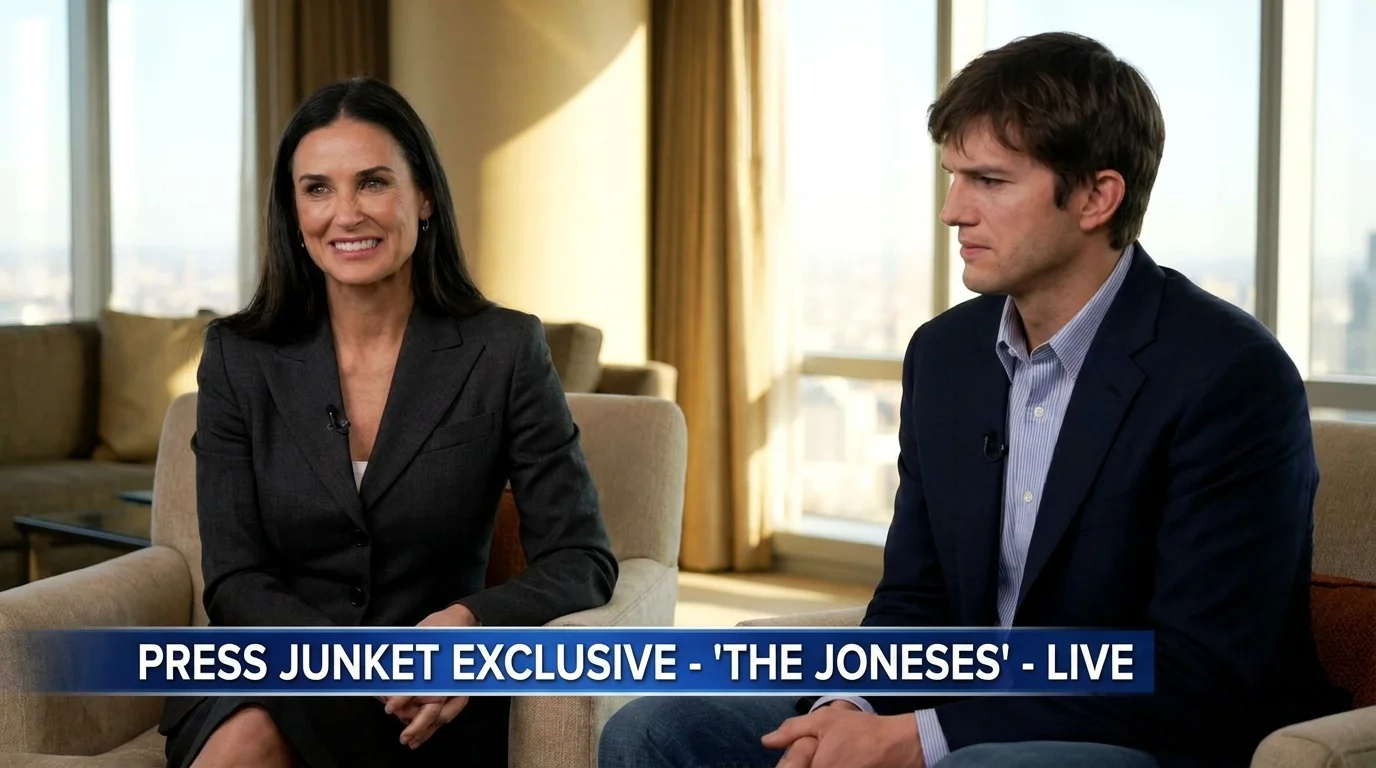
The stale chill of an air-conditioned hotel suite carries a very specific scent: burnt room-service espresso, hot camera bulbs, and floral hairspray clinging to velvet upholstery. In the spring of 2005, press junket corridors inside the Four Seasons were lined with thick cables taped to carpet runners, buzzing softly as crews rotated every six minutes. On the sofa, Demi Moore sat draped in effortless luxury alongside Ashton Kutcher, presenting what the entertainment press treated as Hollywood’s most defiant victory lap against traditional age conventions.
Yet if you run the archival digital Beta tapes without the studio sound mix, the atmosphere turns prickly. When an interviewer asked about creative collaboration between the two, Kutcher’s hand rested on the cushion behind her neck—not cradling, but hovering—while he cut across her opening syllable with a rapid, reflexive chuckle that effectively pulled the room’s oxygen toward his side of the couch. Tiny conversational erasures happen quietly, leaving barely a ripple on the surface while fundamentally rewriting the power balance between two speakers.
We spent that entire decade conditioned to look for obvious fireworks: shouting matches in parking lots, tossed drinks, or explosive tabloid spreads. But real romantic fractures rarely begin with an explosion; they settle in like dry rot behind polished baseboards. Looking back at those 2005 promotional press junkets, the discomfort is not hidden in what was spoken out loud, but in the micro-second delays, the sharp redirects, and the gentle patronizing that passed for charming banter on standard-definition television.
The Architecture of Conversational Erasure
When you watch archival interview reels through an analytical lens, communication behaves like a load-bearing wall. Every shared sentence either distributes weight equally or forces one partner to brace against an unexpected drop. In 2005, during the press rounds for Kutcher’s comedy Guess Who and Moore’s curated red-carpet appearances, the conversational dynamic repeatedly tilted into what behavioral psychologists call structural minimization. One person speaks downward while maintaining the bright, toothy grin demanded by camera lights.
Consider the metaphor of a partner who constantly walks half a step ahead on a crowded sidewalk. They never turn around to check your stride; instead, they force you to match their acceleration while acting surprised whenever you catch your breath. In multiple joint interviews from that season, whenever Moore offered a nuanced reflection on career longevity, the commentary was immediately reframed by her partner as nostalgia, playfully dismissing two decades of high-level industry survival as quaint background history.
Dr. Elena Vance, a 52-year-old forensic communication specialist from Chicago who evaluates archival media depositions, spent years studying conversational pacing in high-pressure environments. She notes that status assertion rarely relies on blatant insults. Instead, an ambitious speaker will deliberately shorten the pause after their partner finishes speaking, jumping in at zero milliseconds. That microscopic rush signals to everyone in the room that what was just said was merely a runway for the real thought, quietly stripping the initial speaker of authority while keeping the tone light and superficially affectionate.
- Wes Anderson subtle balcony gesture triggers manufactured film festival standing ovation protocol
- Austin Butler unclipped designer collar tag reveals chaotic Hollywood loaner sample system
- Billie Eilish stadium monitor lag prompts abrupt wireless earpiece removal mid-performance
- John Oliver sudden teleprompter blackout derails rehearsed monologue during live taping
- Tilda Swinton overrides studio beauty filters demanding unforgiving raw camera angles
Decoding the 2005 Micro-Frictions
To understand why these moments matter now, you have to separate them into distinct behavioral patterns. The red flags of two decades ago were operating in plain sight, masked by the era’s obsession with high-contrast celebrity packaging.
The Corrective Interruption
Watch how anecdotes were handled when Moore began explaining their domestic logistics or blended family structure. Rather than nodding or adding color, the response pattern frequently involved an immediate semantic correction: tweaking her dates, altering her adjectives, or re-telling the punchline with louder projection. This subtle conversational theft creates a public hierarchy where one partner is positioned as the reliable narrator and the other as an entertaining secondary character.
The Diminishing Endearment
Public displays of affection can double as soft muzzles when deployed at specific transition points. Whenever questions touched on creative autonomy or independent business choices, verbal tags like kiddo, little lady, or performative cheek-pinches were frequently introduced right before Moore could complete an analytical point. The gesture looks sweet in a split-second photograph, but on continuous video tape, it consistently severed her line of thought, forcing her to smile through a sudden downgrade in gravitas.
The Gaze Disconnect
In genuine reciprocal rapport, partners check in visually after dropping a thought into the room. During several syndicated junket segments from mid-2005, the pattern inverted: while Moore spoke, her partner’s eyes routinely drifted away from her face, scanning the off-camera publicist, checking the floor monitor, or looking directly down the lens. Eyes betraying sudden disinterest tell the audience that the speaker’s words do not require genuine presence, leaving the partner talking into an emotional vacuum.
How to Spot Soft Dismissals in Real Time
These tape archives are not just artifacts of early-2000s celebrity theater; they are a diagnostic clinic for identifying conversational friction in your own daily interactions. When somebody systematically diminishes your perspective, they rarely do it with malice. They do it with momentum.
Here is how to read conversational mechanics with clear eyes, whether in a board meeting or over a dinner table:
- Audit the pause duration: Healthy dialogue maintains an organic rhythm of roughly 400 to 600 milliseconds between speaker turns. Zero-latency interjections signal that the listener stopped absorbing your thought halfway through your sentence.
- Track the directional pivot: Notice whether an interruption builds upon your noun or replaces it entirely with the other person’s chosen topic.
- Watch spatial orientation: Subtle physical turns—shifting torso angles away from you by even thirty degrees—reveal an instinct to disconnect long before words confirm it.
- Observe tone matching: When one person speaks from emotional gravity and the other replies strictly in dismissive sarcasm, the tonal mismatch acts as an emotional eraser.
Your tactical toolkit for addressing this behavior does not require confrontation. Use the deliberate three-second hold: when someone steps over your sentence, remain silent, keep your posture relaxed, and hold steady eye contact without smiling for three full seconds after they finish. That quiet space instantly exposes the interruption without generating defensiveness.
Reading the Seams Before the Fabric Tears
It is easy to look at historic celebrity separations with retroactive certainty, claiming that everyone knew the bond would snap. But the value in revisiting those 2005 tapes is recognizing how often we ignore quiet erosion simply because the exterior looks dazzling. We forgive the conversational cut, the wandering eye, and the laughing brush-off because confronting them feels petty in the moment.
Learning to identify these subtle dismissals grants you a quiet, durable peace of mind. It allows you to trust your internal compass when an interaction feels off, even when everyone else in the room is smiling and clapping. Dignity lives inside conversational balance, and understanding how easily it can be stolen in public view ensures you will never overlook it in your private life.
Real intimacy requires listening with the same posture you use when you want to be heard.
| Key Point | Detail | Added Value for the Reader |
|---|---|---|
| Corrective Timing | Stepping on the tail end of a partner’s sentence to alter facts or punchlines. | Helps you identify when someone is competing for social dominance rather than collaborating. |
| Performative Pet Names | Using diminutives precisely when serious topics or professional authority arise. | Teaches you to spot patronizing behavior disguised as public affection. |
| The Monitor Gaze | Looking past the speaker toward an audience or mirror while they share a thought. | Provides an immediate metric for whether your conversational partner is truly present. |
| Tone Invalidation | Deflecting sincere reflections with sudden, exaggerated slapstick or sarcasm. | Allows you to recognize when your vulnerability is being treated as an inconvenience. |
Frequently Asked Questions
Why focus on interviews from 2005 specifically?
The year 2005 represented the peak of the couple’s media saturation, coinciding with high-profile releases and intense press cycles where conversational slip-ups were captured in raw, multi-camera formats before modern hyper-coached media training took hold.Are interruptions always a sign of relationship trouble?
No. Cooperative overlapping—where people chime in to validate or express excitement—deepens connection. The warning sign appears when interruptions consistently redirect, contradict, or minimize the original speaker’s intent.How can you tell the difference between playful banter and subtle dismissal?
Playful banter elevates both participants and leaves both laughing. Dismissal leaves one person working twice as hard to maintain poise while the other assumes total control of the narrative.Why did the public miss these red flags back then?
In the mid-2000s, celebrity culture was consumed by the novelty of their age gap and public spectacle, which blinded commentators to the standard communication breakdowns happening right in front of them.What is the healthiest way to handle a conversational cut-off?
Refuse to rush your cadence. Finish your thought at a measured pace, or politely state your point again without matching the other person’s elevated volume or hurried tempo.