The damp heat of eighty thousand screaming bodies hangs thick in the stadium air, smelling faintly of stale beer, damp concrete, and the ozone tang of overheated pyrotechnics. You know the exact cadence of an arena encore: the staged darkness, the calculated delay, the triumphant roar as silhouettes reclaim the risers to hammer out the hits that built your youth. When Dave Grohl steps up to the microphone, soaked in sweat and grinning through his signature tangled mane, you expect thunder. You anticipate the familiar, chest-rattling assault of guitar fuzz and unbridled, rasping grit.
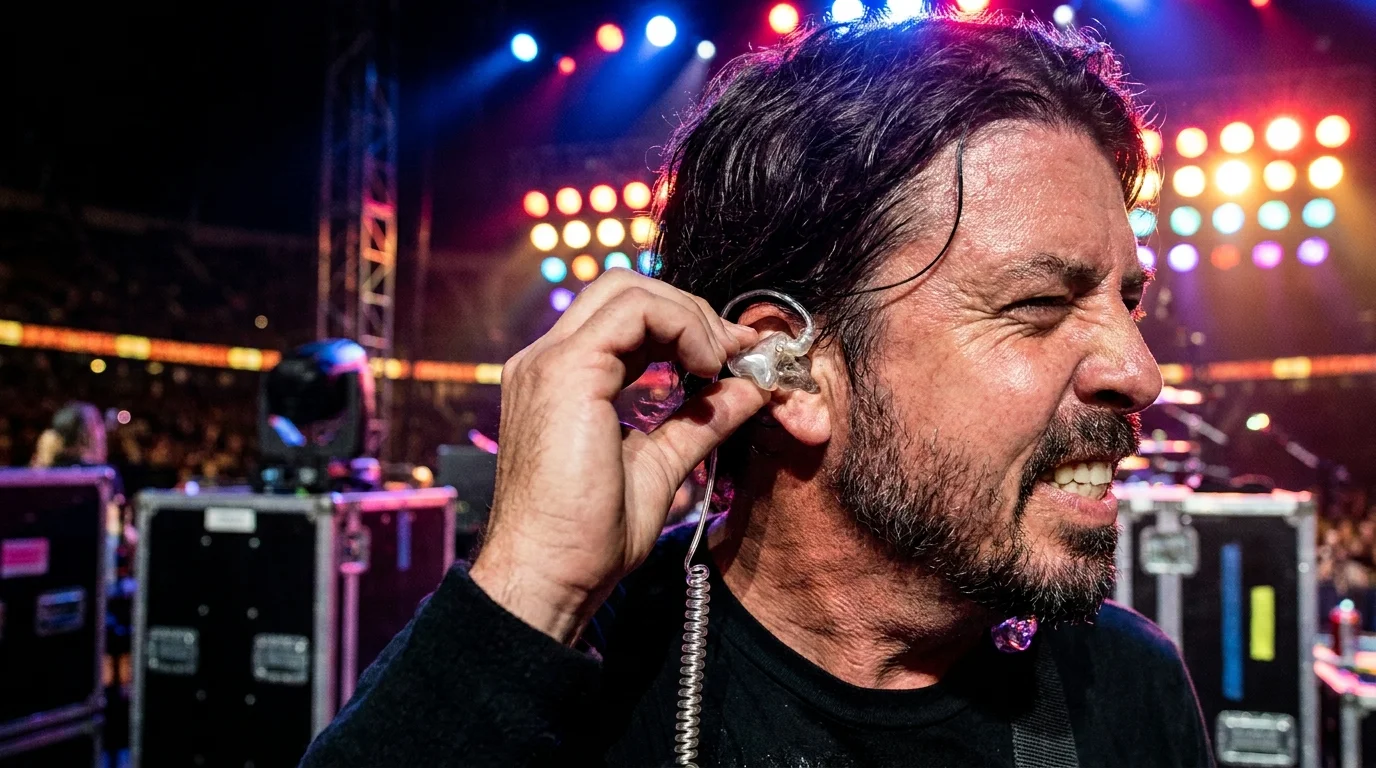
Then, midway through the opening chord progression, the stadium does not just stumble—it fractures. Grohl drops his right hand from his custom Gibson, his head snapping sideways as if struck by a physical fist. His eyes widen in genuine distress, fingers clawing frantically at his left ear canal to rip out a small molded piece of silicone. He does not wave to the crowd or offer a self-deprecating chuckle; he waves his arms violently across his chest, cutting the rhythm section cold into dead, bewildered silence.
What the audience experiences as a muffled pop or a microsecond flutter sounds radically different inside the artist’s skull. When a digital wireless feed loses its synchronization or an auxiliary loop sends an uncompressed feedback burst down an open mix bus, it transforms a delicate earpiece into an acoustic weapon. At stadium volumes, that sudden burst is not music anymore; it is an ice pick through the tympanic membrane.
For a performer who has spent four decades weathering the blunt-force trauma of live rock and roll, this sudden halt was not rockstar theatrics. It was biological preservation in real time, exposing the razor-thin margin between arena spectacle and permanent physical injury.
The Invisible Pressure Cooker Behind the Custom Molds
To grasp why an icon like Grohl would kill a stadium encore dead in its tracks, you have to peel back the myth of arena rock sound. You might picture a wall of vintage amplifiers pushing warm air across the stage, but modern touring is a strictly digital illusion. The stage itself is shockingly quiet, dominated by the hollow clatter of drumsticks and muffled footfalls, while the actual sonic reality exists entirely inside miniature acoustic drivers sealed deep within an artist’s ear canal.
Think of it like breathing through a pillow while running an Olympic sprint: your senses are isolated, hyper-focused, and completely reliant on the audio feed piped in by the monitor engineer. These custom-molded silicone monitors create a hermetic seal, dropping ambient crowd roar by up to twenty-six decibels so the performer can pitch their vocals accurately over pummeling bass frequencies. But that airtight seal cuts both ways. When an unchecked frequency spike enters that tiny, enclosed pocket of air, the sound pressure level has nowhere to dissipate except directly into delicate inner-ear hair cells.
- Jake Paul staged apartment livestream leaks reveal aggressive talent agency manipulation scripts
- James Hetfield debuts custom Chrome Hearts denim outerwear during Las Vegas walk
- Denzel Washington shields forty year marriage enforcing strict untelevised family dinner rules
- Jack Nicholson shatters scripted dialogue improvising chilling axe doorway sequence
- Val Kilmer resurfaced Cannes footage exposes intense studio disputes over franchise contract demands
In this high-stakes ecosystem, a runaway high-frequency screech is not just annoying background noise. At levels exceeding 120 decibels inside a sealed canal, an acoustic shock wave can cause acute hearing trauma, immediate equilibrium loss, and violent disorientation in a fraction of a second. Grohl didn’t drop the song because he lost his groove; he dropped it because his nervous system was screaming that his inner ear was under direct fire.
Elena Ramos, 44, a veteran Nashville touring monitor engineer who has managed wireless rigs for global arena tours, remembers the terror of sudden frequency spikes during live sets. “When an RF drop hits or an analog limiter fails on a high-gain vocal loop, the sound does not ramp up politely,” she explains, leaning over her console during a soundcheck. “It hits like a high-voltage wire snapping in a hurricane. If an engineer misses the brickwall limiter threshold by two milliseconds, you can end a singer’s career before they finish their chorus. You have to react with muscle memory, not thought.”
Anatomy of the Kill Switch: Navigating Acoustic Chaos
Watching a seasoned frontman manage an in-ear blowout reveals a masterclass in stage survival that casual fans rarely see. When equipment turns hostile, you can observe three distinct layers of response taking place in the span of five heartbeats.
The Immediate Ejection Response
Your hands react before your conscious brain can process the trauma. Notice the physical reflex: Grohl’s shoulder hitches instantly, shielding the ear while his fingers wrench the cable out. In live audio protocols, lingering even two seconds to “see if it clears up” risks irreversible sensorineural damage. The stage performer must treat an unmetered audio blast like boiling water splashed across their forearm.
The Band-Wide Deceleration Cue
Every stadium band operates on silent visual fail-safes. The moment Grohl raised both forearms in a tight, horizontal cross, the rhythm section didn’t trail off into an awkward fade—they chopped the measure instantly. This immediate shutdown preserves the front-of-house mix, prevents secondary stage feedback from rolling into the main arrays, and stops the audience from hearing what could be an agonizing series of line pops.
The Open-Air Recalibration
Once the offending monitor is dead on the stage floor, a veteran performer pivots to ambient reality. Instead of fleeing to the wings, Grohl walked to the front of the stage, leaning directly over the crowd wedges, choosing the imperfect, roaring echo of eighty thousand voices over the treacherous convenience of digital isolation. It is an instinctive transition from studio-grade precision to the raw, bare-knuckle dynamics of garage rock.
The Survival Protocol: How Touring Crews Tame the Signal
Surviving a stadium run without blowing out an eardrum requires aggressive system discipline. Whether you are playing local clubs or mixing festival stages, you must establish an uncompromising signal chain that values human tissue over sonic fidelity.
You protect the canal by stripping away dangerous assumptions and building redundant safety nets into the hardware before power ever reaches the transmitters.
- Engage Hard Peak Limiters: Ensure your wireless transmitter features an unyielding brickwall output ceiling set strictly below 105 dB SPL, preventing sudden rogue frequencies from multiplying gain unchecked.
- Filter the Airband: Roll off high frequencies aggressively above 14 kHz on live vocal channels to eliminate phantom squeals generated by off-axis condenser bleeds.
- Maintain Direct Line of Sight: Position your antenna arrays high above stage clutter to avoid multipath dropouts that cause digital receivers to blast pink noise upon losing packet sync.
- Implement a One-Ear Bailout Plan: Always keep a pair of calibrated floor wedges patched to a mirror mix, allowing an artist to rip their molds out without losing the tempo.
The modern live toolkit relies on deliberate safeguards: ultra-fast digital limiters responding in less than one millisecond, narrow notch filters sweeping out feedback loops automatically, and custom silicone molds embedded with passive ambient vents to equalize internal canal pressure.
The Value of the Broken Cadence
In our hyper-polished entertainment landscape, where backtrack tracks mask human error and pre-recorded vocals sanitize the live experience, an abrupt, screeching halt carries a strange, grounded beauty. It reminds you that underneath the dazzling stadium lights, heavy rock remains an athletic, volatile act conducted by vulnerable human beings.
Grohl stopping the machine mid-stride demonstrates the highest level of professional mastery: knowing when to halt the show to protect the instrument you cannot replace. When the song finally kicked back in—driven by raw stage monitors and sheer adrenaline—it sounded grittier, heavier, and undeniably alive.
“Your gear can be replaced before tomorrow’s soundcheck, but the delicate sensory hairs in your cochlea are a one-time gift from nature.”
| Key Point | Stage Reality | Added Value for the Reader |
|---|---|---|
| Acoustic Shock | Sudden, high-decibel spikes in enclosed in-ear monitors can cause instant sensorineural trauma. | Understanding why live performers react with physical panic rather than professional decorum during feedback. |
| Digital Signal Failsafes | Hardware limiters must react within microseconds to choke off rogue loops before they reach the ear. | Actionable settings for musicians and sound engineers to protect performers from catastrophic hearing loss. |
| The Human Pivot | Killing the song and switching to open-air wedges preserves the show without sacrificing physical health. | Insight into the communication systems that keep stadium-level productions running despite severe technical failure. |
Frequently Asked Questions
Why do artists wear custom in-ear monitors instead of standard stage speakers?
In-ear monitors isolate the performer from stadium reverberation and punishing stage volume, allowing them to hear their own vocals and timing cues clearly while protecting their ears from general stage roar.What causes a sudden monitor feedback spike during an encore?
These spikes typically occur due to open vocal mics wandering too close to wedge speakers, radio frequency dropouts triggering burst noise, or an uncalibrated signal loop on the monitor mixing console.How loud does in-ear feedback get compared to regular feedback?
Because the monitor is sealed directly into the ear canal with no room for sound pressure to dissipate, an unexpected spike can easily surpass 120 decibels, hitting the eardrum with dangerous intensity.Can an artist permanently lose their hearing from a single monitor blast?
Yes, an acoustic trauma event caused by an unmetered high-frequency blast can lead to immediate tinnitus, ruptured eardrums, or permanent damage to the delicate hair cells within the inner ear.What should a musician do the second they hear dangerous feedback in their monitors?
Yank the earpiece out immediately without hesitation, signal the monitor tech to cut the auxiliary send, and rely on stage wedge bleed until the signal chain has been thoroughly inspected.